History Curriculum/Book 17
Book seventeen of the curriculum
The History of Ancient Greece
The seventeenth book in the curriculum and the seventh of the Ancient Civilizations set. Sixteen chapters across four weeks — from the palaces of Minoan Crete and the gold of Mycenae, through the ships and letters of the Bronze Age world and the centuries after its palaces burned, the rise of the city-state, the colonies from Spain to the Black Sea and the first Olympic Games, to Marathon, Thermopylae and Salamis, the Athens of Pericles, Socrates and the philosophers, the long war between Athens and Sparta and the theatre that was played through it, and then Alexander, the kingdoms his generals carved out of his empire, the scientists of Alexandria and Syracuse, and the Roman conquest. TWO THINGS TO KNOW BEFORE YOU START. First, the first-person accounts in both printed editions are HISTORICAL FICTION — written to tell the story, informed by archaeology and the surviving record, and not the words of the people named. In this book many of the narrators are not even Greeks of the chapter's own age: pharaohs, Hittite kings, the excavators Arthur Evans and Heinrich Schliemann, and figures of myth such as King Minos. The Greeks, though, left more of their own words than any people before them: Homer and Hesiod, the histories of Herodotus, Thucydides and Xenophon, Plato's dialogues, the plays, the laws and decrees the Athenians carved in stone, and, later, Polybius, Plutarch, Arrian and Pausanias. The spade has added the rest — Knossos, Mycenae, the clay tablets of Pylos, Olympia and the Athenian Agora. This course tells you, chapter by chapter, which things the excavations show, which things an ancient author reports, and which things are myth that the Greeks told about their own past. Second, at the back of the Ultimate Guide, after the sixteen chapters, there are Cross-Curricular sections — Math, Science, English and Social Studies — and a set of History Assessments with an answer key, to use alongside this course. They are not a fifth week and there is nothing to hand in for them.
Read the book
Turn the pages of both editions right here. Ancient Greece is a members’ book: subscribers and Adventure Box Course families read every page.
🔒 A members’ book — Living History 295 pages, Standard Book 385 pages. Subscribe, or buy an Adventure Box, to read it.
4 Weeks, 16 Chapters, Choose 8+ to Read
Pick the chapters you want to read each week. The living books and the sources are one click away.
Pick two or more of these chapters to read. Finish two of the ones you choose to open Week 2.
K–5th Grade
6th–8th Grade
9th–12th Grade
Crete: What the Greeks Said, and What the Spade Found
- Homer, Odyssey 19.172–179: "There is a land called Crete" (tr. A. T. Murray) composed c. 700 BC; Murray's translation 1919Odysseus, in disguise, describes Crete to Penelope: ninety cities and many tongues, and "the great city Cnosus, where Minos reigned" — "he that held converse with great Zeus". This is the oldest Greek text to name Knossos and Minos. It is a poem, composed some seven hundred years after the Knossos palace burned, and it tells us what Homer's audience believed, not what a king did.
- Thucydides, History of the Peloponnesian War 1.4: Minos and the first navy (tr. Richard Crawley) written c. 431–400 BC; Crawley's translation 1874"The first person known to us by tradition as having established a navy is Minos." Thucydides says he made himself master of the sea, ruled the Cyclades and cleared it of pirates. Note his own words — "known to us by tradition": the most careful historian of Greece is telling you this is a tradition, a thousand years old by his time.
- Plutarch, Life of Theseus 15–19: the Minotaur, and the Cretans' own version (tr. Bernadotte Perrin) written c. AD 100; Perrin's translation 1914Plutarch tells the Athenian story of the tribute of youths and the Labyrinth, then gives a second account: "Philochorus, however, says that the Cretans do not admit this, but declare that the Labyrinth was a dungeon", and that the 'Minotaur' was a general named Taurus. Two ancient versions of one legend, side by side, written down well over a thousand years after the palaces.
- Arthur Evans, The Palace of Minos at Knossos, volume 1 (Internet Archive scan of the Cornell University copy) London: Macmillan, 1921The excavator's own report. Evans bought the site, dug it from March 1900, named the civilization "Minoan" after the king of legend, and named the scripts Linear A and Linear B. Read it for what he found — the plans, the frescoes, the storerooms of jars — and remember that the name of the civilization and many room names ("Throne Room", "Queen's Megaron") are his.
Mycenae, Pylos and the Earliest Greek Writing
- Heinrich Schliemann, Mycenae: A Narrative of Researches and Discoveries at Mycenae and Tiryns (Internet Archive scan of the Cornell University copy) New York: Scribner, Armstrong & Co., 1878Schliemann's account of opening the shaft graves of Grave Circle A in 1876, with the gold masks and the drawings of what came out of each grave. He believed he had found Agamemnon's family. The graves are now dated to the sixteenth century BC, centuries before any date the Greeks gave for the Trojan War — read his reasoning, and see where the evidence stops and his belief begins.
- Pausanias, Description of Greece 2.16.5–7: the ruins of Mycenae (tr. W. H. S. Jones) written c. AD 160–180; Jones's translation 1918A traveller of the second century AD walks round the citadel: "There still remain, however, parts of the city wall, including the gate, upon which stand lions", built, he was told, by the Cyclopes, and he was shown the graves of Atreus and Agamemnon. The Lion Gate he saw is the one still standing; the graves are what local guides told him.
- Thucydides 1.10: "Now Mycenae may have been a small place" (tr. Richard Crawley) written c. 431–400 BC; Crawley's translation 1874Thucydides warns that a city's ruins are a poor guide to its power — Sparta's would look small, Athens' twice as great as it was — and then weighs Homer's numbers for the fleet, saying a poet would exaggerate. An ancient historian testing a poem against the evidence he had.
- Michael Ventris and John Chadwick, Documents in Mycenaean Greek: Three Hundred Selected Tablets from Knossos, Pylos and Mycenae (Internet Archive lending library) Cambridge University Press, 1956THE TABLETS THEMSELVES, transcribed and translated by the two men who showed in 1952 that Linear B writes Greek. Ventris died in a road accident in 1956, the year it was published. Lists of rations, sheep, bronze, chariot wheels and offerings to Po-se-da-o (Poseidon). A LIBRARY BOOK: it can be borrowed free from the Internet Archive with an account.
Ships, Kings and Letters Around the Aegean
- Institute of Nautical Archaeology, the Uluburun Late Bronze Age shipwreck excavation ship sank in the late 14th century BC; excavated 1984–1994The excavators' own project page for the wreck off southern Turkey, found by a sponge diver in 1982. "The Uluburun ship was transporting a bulk cargo of copper and tin ingots, in the usual ratio of 10:1 to produce bronze", with glass, ivory, ebony and Mycenaean and Canaanite pottery on board — a single ship's load of the trade chapter 3 describes.
- Gary M. Beckman, Trevor R. Bryce and Eric H. Cline, The Ahhiyawa Texts (Internet Archive; Society of Biblical Literature open-access edition) Atlanta: SBL, 2011 (texts of the 15th–13th centuries BC)Every Hittite text that mentions "Ahhiyawa", in transliteration and English, including the Tawagalawa letter of a Hittite king to the king of Ahhiyawa, whom he calls his brother. Many readers take Ahhiyawa for the Mycenaean Greeks (Homer's "Achaeans"); read the letters and see what they say themselves. The texts are contemporary with the Mycenaean palaces.
- James Henry Breasted, Ancient Records of Egypt, volume 4 (Internet Archive scan, Brigham Young University copy) Chicago, 1906; inscriptions of Ramesses III, c. 1180 BCBreasted's translations of the twentieth-dynasty inscriptions, including the Medinet Habu record of Ramesses III's eighth year, when the northern peoples of the islands and the sea — those Egyptologists call the Sea Peoples — came against Egypt by land and sea. It is the pharaoh's own victory inscription, carved at the time, and it speaks as a victory inscription does.
- Herodotus, Histories 2.112–120: what the Egyptian priests told him about Helen (tr. A. D. Godley) written c. 430 BC; Godley's translation 1920"When I inquired of the priests, they told me that this was the story of Helen" — that she never reached Troy but was kept in Egypt by King Proteus. Herodotus sets this beside Homer's version and gives his reasons for thinking Homer knew it. A second ancient account of the Trojan War, written down some eight centuries after any date the Greeks gave for it.
Pick two or more of these chapters to read. Finish two of the ones you choose to open Week 3.
K–5th Grade
6th–8th Grade
9th–12th Grade
The Poets and the Historians on the Age After the Palaces
- Hesiod, Works and Days 109–201: the five races of men (tr. H. G. Evelyn-White) composed c. 700 BC; Evelyn-White's translation 1914A Boeotian farmer-poet's account of the past: a golden race, then silver and bronze, then "a god-like race of hero-men" who fought at Thebes and Troy, and then his own iron race. It is how one Greek of the eighth or seventh century BC pictured the ages before him. Read the rest of the poem for his own world of farms, debts and lords who take bribes.
- Homer, Iliad 18.478–608: the shield of Achilles (Butler's translation, as Perseus pairs it) composed c. 750–700 BC; Samuel Butler's translation 1898Hephaestus makes a shield showing "two cities, fair to see and busy with the hum of men": a wedding, a lawsuit argued before the elders in the place of assembly, a city under siege, ploughing, harvest and a dance. It is a poet's picture of the world of the early city-states as he and his audience knew it.
- Thucydides 1.12: the migrations after Troy (tr. Richard Crawley) written c. 431–400 BC; Crawley's translation 1874Thucydides' own account of the unsettled centuries: sixty years after the fall of Ilium the Boeotians were driven from Arne, and "twenty years later the Dorians and the Heraclids became masters of Peloponnese", and only later came the colonies of the Ionians and the islanders. It is what the Greeks of the fifth century believed about their early past; the excavations show the destructions, not who caused them.
Lawgivers and the City-State
- Aristotle (school of), Constitution of the Athenians 12: Solon in his own verses (tr. H. Rackham) written c. 330 BC, quoting poems of c. 594 BC; Rackham's translation 1952This chapter quotes Solon's own poems about his reforms — "this is how it happened is the unanimous account of everybody, and in particular Solon himself in his poetry recalls the matter": he freed the land of its mortgage stones, brought home Athenians who had been sold abroad, and wrote laws for rich and poor alike. Solon's own words, two and a half centuries older than the book that preserved them.
- Decree to republish Draco's law on homicide (IG I³ 104), Attic Inscriptions Online inscribed 409/8 BC; the law itself of c. 621 BCTHE ATHENIANS' OWN STONE. In 409/8 BC the city ordered Draco's law on homicide to be copied onto a marble stele and set up before the Royal Stoa; the stone survives, with the law's opening clauses on killing without intent. It is the oldest Athenian law whose words survive, recopied two centuries after Draco.
- Plutarch, Life of Lycurgus 1 (tr. Bernadotte Perrin) written c. AD 100Plutarch opens with a warning: about Lycurgus the lawgiver, "nothing can be said which is not disputed" — his birth, his travels, his death and even the date he lived. Everything Plutarch then tells you about Sparta's founder is tradition, gathered some eight hundred years or more after the time it describes; read it as that.
- Herodotus 1.65: two accounts of where Lycurgus's laws came from (tr. A. D. Godley) written c. 430 BC"Lycurgus, a man of reputation among the Spartans, went to the oracle at Delphi". Herodotus then gives both versions: some say the Pythia gave him the Spartan constitution, but "the Lacedaemonians themselves say" he brought it from Crete. Two ancient accounts, set out by the writer who heard them.
Colonies and the First Olympiad
- Herodotus 4.150–158: the founding of Cyrene, as told at Thera and at Cyrene (tr. A. D. Godley) written c. 430 BC, of events c. 630 BCThe Theraeans' story — the Delphic oracle, the reluctant colonists, Battus — and then, at 4.154, "the Cyrenaeans tell a wholly different story about Battus". Herodotus prints both. The best ancient account of how a Greek colony was founded, and an example of what to do when the sources disagree.
- Thucydides 6.3–5: the Greek colonies of Sicily (tr. Richard Crawley) written c. 415–400 BCThucydides lists the colonies one by one with their mother cities and founders: the "Chalcidians from Euboea with Thucles, their founder" at Naxos, Syracuse from Corinth under Archias the next year, and so on, with the intervals in years between them. These are the dates later historians build on; they rest on the tradition the cities kept about themselves.
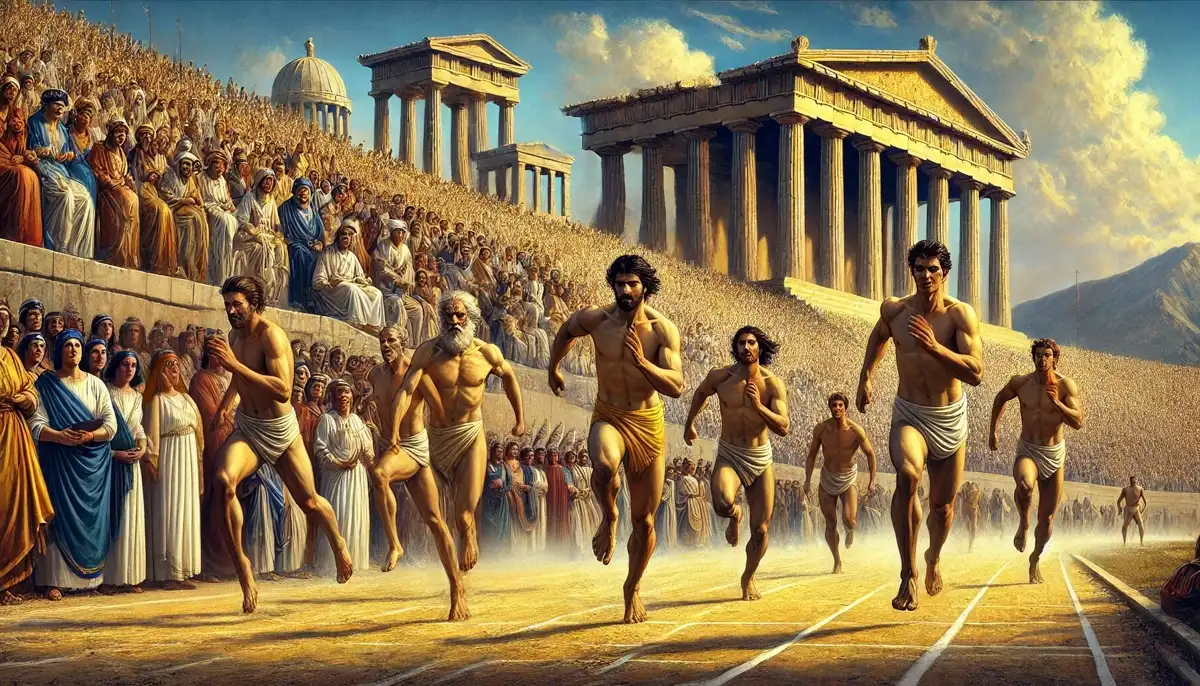
- Pausanias, Description of Greece 5.8.5–6: the first Olympiad and Coroebus (tr. W. H. S. Jones) written c. AD 160–180Pausanias saw Olympia when it was still in use. He reports the myths of the Games' founding and then the record: from the time the "unbroken tradition of the Olympiads began", the footrace came first, and Coroebus of Elis won it. The year we call 776 BC comes from the list of victors drawn up by Hippias of Elis around 400 BC.
- Pindar, Olympian 10: Heracles founds the Games (tr. Diane Svarlien) 476 BC, for a boy boxer of Western LocriA victory ode sung for a winner at Olympia. Pindar tells how Heracles marked out the sacred grove of Zeus and held the first contests. It is the myth of the Games' founding as a poet of the fifth century sang it at the festival itself — a different founding story from the Pelops legend Pausanias also reports.
Pick two or more of these chapters to read. Finish two of the ones you choose to open Week 4.
K–5th Grade
6th–8th Grade
9th–12th Grade
Marathon, Thermopylae and Salamis
- Herodotus 6.112: the Athenians charge at Marathon (tr. A. D. Godley) written c. 430 BC, of 490 BC"The space between the armies was no less than eight stadia", and the Athenians crossed it at a run; they were, he says, "the first Hellenes whom we know of to use running against the enemy". In 6.117 he gives the dead: 6,400 Persians, 192 Athenians. He was born about six years after the battle and wrote within living memory of it.
- Herodotus 7.228: the epitaphs at Thermopylae (tr. A. D. Godley) written c. 430 BC, of 480 BCThe inscriptions set up where the Greeks fell: "Here four thousand from the Peloponnese once fought three million", and the epitaph for the Spartans. Herodotus says the Amphictyons set them up. The numbers on a war memorial are a memorial's numbers; Herodotus's own count of Xerxes' army (7.185–186) is larger still.
- Aeschylus, Persians 353 ff.: the messenger's speech on Salamis (tr. H. W. Smyth) first performed in Athens, 472 BCA play by a man who had fought at Marathon, staged eight years after Salamis before an audience that had rowed in the battle. It is set at the Persian court, and a messenger tells the queen how the fleet was lost. Poetry, not a report — but the earliest surviving account of the battle by anyone.
- Herodotus 8.84: who began the battle of Salamis (tr. A. D. Godley) written c. 430 BC, of 480 BC"Ameinias of Pallene, an Athenian, charged and rammed a ship" — that is the Athenian account. Herodotus adds that the Aeginetans say their ship began it, and the story of a phantom woman who cried out to the Greeks. Another place where he tells you plainly whose story is whose.
Athens: Its Democracy, Its Empire and Its War
- Thucydides 2.35–46: the funeral speech of Pericles (tr. Richard Crawley) speech of winter 431/430 BC; written down by ThucydidesPericles' speech over the first year's dead, as Thucydides reports it — "Its administration favours the many instead of the few; this is why it is called a democracy." Thucydides says (1.22) that he kept to the general sense of what speakers said, not their exact words.
- The first Athenian tribute list, 454/3 BC (IG I³ 259), Attic Inscriptions Online inscribed 454/3 BCTHE EMPIRE'S OWN ACCOUNTS. When the Delian League's treasury was moved from Delos to Athens, one-sixtieth of each ally's tribute was given to Athena, and the amounts were carved on a great marble block on the Acropolis, city by city. Count the cities and see how far the alliance reached.
- Thucydides 1.23: the truest cause of the war (tr. Richard Crawley) written c. 431–400 BCThucydides separates the grievances each side spoke of from the cause he believed was truest, though least spoken of: "the growth of the power of Athens, and the alarm which this inspired in Lacedaemon". He was an Athenian general in the war and was exiled after losing Amphipolis in 424 BC.
- Xenophon, Hellenica 2.2.20–23: the surrender of Athens (tr. Carleton L. Brownson) written c. 380–355 BC, of 404 BCThe terms Sparta imposed — the Long Walls and the Piraeus walls pulled down, the ships surrendered — and then Lysander sailed in and the Peloponnesians "began to tear down the walls to the music of flute-girls, thinking that that day was the beginning of freedom for Greece". Xenophon, an Athenian, was then a young man; he continued Thucydides' unfinished history from where it breaks off.
Philosophers, Physicians, Builders and Playwrights
- Plato, Apology of Socrates (tr. Harold North Fowler) Socrates' trial 399 BC; Plato wrote within a few years of itPlato's version of the speech Socrates made at his trial — Plato says (34a, 38b) he was there. "How you, men of Athens, have been affected by my accusers, I do not know". Read at 21d what Socrates says he learned from the oracle: that he did not think he knew what he did not know. Xenophon wrote a second, shorter Apology; the two differ.
- The Hippocratic Oath (tr. Francis Adams) c. 400 BC (date uncertain); Adams's translation 1849"I swear by Apollo the physician, and Aesculapius" — the oath a pupil took on entering the craft, from the collection of writings that goes under Hippocrates' name. Read what the doctor promises his teacher, his patients and the gods. The phrase "First, do no harm" is not in it.
- Plutarch, Life of Pericles 12–13: the buildings on the Acropolis (tr. Bernadotte Perrin) written c. AD 100, of the 440s–430s BCHow the Parthenon and the other works were built, and who was in charge: "His general manager and general overseer was Pheidias, although the several works had great architects". Plutarch also reports the complaint, made at the time, that Pericles spent the allies' tribute on them. Written five centuries later, from earlier writers now lost.
- Sophocles, Antigone 441–470: the unwritten laws (tr. after R. C. Jebb, as Perseus prints it) first performed in Athens, c. 441 BCAntigone answers the king who forbade her to bury her brother: "it was not Zeus that published me that edict". A tragedy performed at the festival of Dionysus before the whole citizen body. Read the scene, then compare how Aristophanes' Clouds (423 BC) puts Socrates on the comic stage.
Pick two or more of these chapters to read.
K–5th Grade
6th–8th Grade
9th–12th Grade
Alexander in the Ancient Accounts
- Arrian, The Anabasis of Alexander (tr. E. J. Chinnock, Project Gutenberg) written c. AD 130–160; Chinnock's translation 1884The fullest surviving history of Alexander's campaigns. Arrian, a Greek in Roman service, wrote more than four centuries after Alexander's death and tells you in his preface that he followed Ptolemy and Aristobulus, two men who marched with Alexander, and that where they agree he takes their account as true.
- Plutarch, Life of Alexander 1 (tr. Bernadotte Perrin) written c. AD 100"For it is not Histories that I am writing, but Lives" — Plutarch says he will look for a man's character in small things, a phrase or a jest, as much as in battles. That is why his Alexander is full of stories (Bucephalus, the Gordian knot, the oracle at Siwa) that Arrian tells differently or not at all.
- Diodorus of Sicily, Library of History, book 17 (tr. C. Bradford Welles, LacusCurtius) written c. 60–30 BCThe oldest surviving continuous account of Alexander's reign, about three centuries after it, from a Greek historian who compiled earlier writers. Set any chapter beside the same events in Arrian: they drew on different sources, and where they differ, you have two ancient accounts.
The Kingdoms After Alexander
- Plutarch, Life of Demetrius 18: the successors take the title of king (tr. Bernadotte Perrin) written c. AD 100, of 306–305 BCAfter the sea battle off Salamis in Cyprus, "the multitude for the first time saluted Antigonus and Demetrius as kings", and Ptolemy, Lysimachus and Seleucus followed. The moment Alexander's empire became five kingdoms in name as well as in fact.
- Strabo, Geography 17.1.8: Alexandria and the Museum (tr. H. C. Hamilton and W. Falconer) written c. 7 BC–AD 23A Greek geographer who lived in Alexandria describes the city as he saw it: the palaces, the harbour and "the Museum is a part of the palaces", with its covered walk and the common hall where the scholars ate, and the tomb of Alexander. Written some three centuries after the city's founding, by an eyewitness of its later days.
- Polybius, Histories 29.27: "the day of Eleusis" (tr. Evelyn S. Shuckburgh) written c. 150–120 BC, of 168 BCThe Roman envoy Popilius meets King Antiochus IV outside Alexandria, hands him the Senate's decree, draws a circle round him in the sand and tells him to answer before he steps out. Polybius was then a leader of the Achaean League and was taken to Italy as a hostage the next year; he gives the reason the king gave way: news of the Roman victory over Macedon at Pydna.
Mathematicians and Inventors
- Euclid, The First Six Books of the Elements (ed. John Casey, Project Gutenberg) written c. 300 BC; Casey's edition, Dublin, 1880sThe definitions, postulates and propositions in the order Euclid set them out at Alexandria — the book that was taught as geometry for more than two thousand years. Read the five postulates and the first proposition (how to build an equilateral triangle) to see the method: every step proved from what came before.
- The Works of Archimedes, ed. T. L. Heath (Internet Archive scan, University of Michigan copy) written c. 250–212 BC; Heath's edition 1897Archimedes' own treatises in English, including On the Sphere and Cylinder, the Measurement of a Circle and the Sand-Reckoner, in which he mentions Aristarchus's hypothesis that the earth goes round the sun. His own words, as opposed to the stories later writers told about him.
- Vitruvius, On Architecture 9, preface 9–12: Archimedes and the king's crown (tr. Joseph Gwilt, LacusCurtius) written c. 30–15 BC, of the 3rd century BC; Gwilt's translation 1826The story of "Eureka": Hiero suspected his goldsmith, and Archimedes, getting into a bath, saw the water run over and ran home naked shouting that he had found it. Vitruvius describes the test as measuring the water each mass displaced. It is a story told about two centuries after Archimedes; it is not in his own works.
- Plutarch, Life of Marcellus 14–19: Archimedes at the siege of Syracuse (tr. Bernadotte Perrin) written c. AD 100, of 214–212 BCPlutarch describes the engines with which Archimedes held off the Roman fleet and army, and gives more than one account of how he was killed when the city fell in 212 BC. Note that Plutarch himself says the stories differ, and that Marcellus was grieved by his death.
Rome and the Greeks
- Polybius, Histories 18.46: the proclamation at the Isthmian Games (tr. Evelyn S. Shuckburgh) written c. 150–120 BC, of 196 BCBefore the crowd at the Isthmian Games the herald announced, in the name of the Senate and of Flamininus, that the Corinthians, Phocians, Locrians and the other Greeks Philip V had ruled were to be free, ungarrisoned, untaxed and governed by their own laws. Polybius, an Achaean statesman born about 200 BC, wrote it within living memory.
- Livy, History of Rome 33.32–33: the same proclamation, the Roman account (tr. Canon Roberts) written c. 25 BC–AD 17, of 196 BCLivy tells the same scene in Latin, following Polybius: the crowd asks for the proclamation to be read again and nearly crushes Flamininus in its joy. Read it beside Polybius to see how one ancient historian used another.
- Pausanias, Description of Greece 7.16: Mummius and the sack of Corinth (tr. W. H. S. Jones) written c. AD 160–180, of 146 BCThe end of the Achaean League's war with Rome: the consul Lucius Mummius takes Corinth, kills the men, sells the women and children, and pulls down the walls. Pausanias wrote three centuries later, when Corinth had been refounded as a Roman colony.
- Res Gestae Divi Augusti: the deeds of Augustus (LacusCurtius, Loeb text of F. W. Shipley) written by Augustus, finished AD 14Augustus's own record of his career, set up in bronze before his tomb and copied in Latin and Greek at Ancyra. In chapter 25 he says all Italy swore allegiance to him and demanded him as leader in the war in which he was victorious at Actium (31 BC); in chapter 27 he records that he added Egypt to the empire of the Roman people. The last Hellenistic kingdom ends here, in the conqueror's words.
What comes with the book
The Ultimate Guide
The textbook itself — the sixteen chapters these lessons are built from.
Living History
Heroes and Villains: Ancient Greece — Told By Those Who Were There. The Heroes & Villains series, in the first person.
The Adventure Box
Cards, lesson plans, activities, coloring pages and the craft kit for this era.