Our digital curriculum library
Learn History in All Seven Learning Styles
A full history program built around the books — read a chapter, meet the people in it, watch the lesson, hear the music, do the activity, then prove you have it.
How the curriculum works
Every chapter of every book becomes a lesson, and every lesson has eight tabs. The order is deliberate: you read first, then meet the people, then see and hear it, then do something with your hands, then find out whether it stuck.
- Overview — what the chapter covers, the themes to look for, and the words it introduces.
- Music — the era's music video, second because nothing sticks like a song: hear it once and it carries through everything after it.
- Subject Matter Expert — someone from the chapter tells it in the first person, from the Heroes & Villains series, with a written account of who they were. (The tab is labelled Expert, for room.)
- Reading — more of the documented story beyond the chapter: what the letters, chronicles and excavations record, and the details that stick.
- Lesson Video — every video for that chapter, in one place.
- Activity — the hands-on project from the book, with its objective, materials, instructions and learning outcome, and a journal the student writes afterwards.
- Extra — the same chapter free on the blog, for when the book is not to hand, and printable coloring pages to download.
- Exam — eight questions drawn at random from a bank of sixteen, marked instantly with an explanation either way, plus one written answer a parent grades.
All seven learning styles
Every student learns a little differently. Each chapter reaches the same history through reading, listening, discussion, hands-on activities and play, so every learner has a way in. Join each material to the learning style it serves.
- Living Textbook → Verbal / Linguistic
- Standard Textbook → Solitary / Intrapersonal
- Decks of Historical Conquest Cards → Social / Interpersonal
- Activities (for kinesthetic–tactile learners) → Physical / Kinesthetic
- Online Gaming → Logical / Mathematical
- Online History Course (goes along with all the materials) → Aural / Auditory
- Coloring Pages → Visual
- Visual
- Likes to take things in through pictures, maps, diagrams, colour and video.
- Aural / Auditory
- Likes to learn by listening: stories read aloud, talks, discussion, music and rhythm.
- Verbal / Linguistic
- Likes words, reading and writing: books, notes, word games and explaining in their own words.
- Physical / Kinesthetic
- Likes to learn by doing: handling things, building, moving about and hands-on projects.
- Logical / Mathematical
- Likes patterns, reasons and order: cause and effect, sorting facts, puzzles, numbers and strategy.
- Social / Interpersonal
- Likes learning with other people: talking it through, group work, games and teaching someone else.
- Solitary / Intrapersonal
- Likes working alone and thinking things over: self-paced study, journals and personal goals.
Join each material to the learning style it serves: choose one, then its partner — or drag between them. Point to a learning style, or tap it, to see what it means.
No lines yet — pick a material to start.
Learning styles describe how a student likes to learn — preferences, not fixed types. Most people use several, which is why every chapter offers all seven.
What a parent sees
Two pieces of written work per chapter come back to you — the rest a student marks themselves.
Marked in the browser
The multiple-choice exam is a self-check. It never leaves the student's device, and every answer is explained whether they got it right or not.
Sent to you
The written exam answer and the activity journal go to the Xogos parent account grade page, where you read and grade them yourself.
Nothing is lost
A half-finished exam and a half-written journal are kept, so a student can go back to the chapter and return to exactly where they were.
Start here
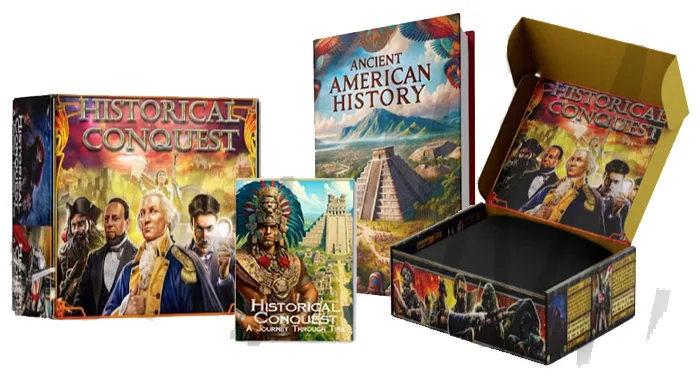
Book 1: Ancient America
The first book in the curriculum. Sixteen chapters across four weeks, from the peoples of the Arctic to the Caribbean islands Columbus sailed into.
The whole series
Ancient America is the first. The rest of the history library follows the same shape.
The Adventure Box
A month of one topic — cards, lesson plans, activities and craft kits, in the post.