History Curriculum/Book 12
Book twelve of the curriculum
The History of the Birth of a Nation
The twelfth book in the curriculum and the sixth of the Early American set, directly after the American Revolution. Twenty chapters across five weeks — from the Treaty of Paris and the day Washington handed his commission back to Congress, through the Confederation that could ask for money and not take it, Shays' Rebellion, four months in a shuttered room in Philadelphia, ratification fought out state by state, the first election, the first cabinet, the first courts and the first ten amendments, to Hamilton's finances, the Whiskey Rebellion, the Barbary coast, the first political parties, and the election of 1800. TWO THINGS TO KNOW BEFORE YOU START. First, the first-person accounts in both printed editions are HISTORICAL FICTION — written to tell the story, built on the surviving record, and not the words of the people named. That matters more in this book than in any other in the course, because these particular people left more writing behind than almost anybody else of their century, and all of it is published and free to search: you can check them. Second, at the back of the Ultimate Guide, after the twenty chapters, there are Cross-Curricular sections — Math, Science, English and a set of Testing pages — to use alongside this course. They are not a sixth week and there is nothing to hand in for them; they are there to be used while you work through the five weeks.
Read the book
Turn the pages of both editions right here. Birth of a Nation is a members’ book: subscribers and Adventure Box Course families read every page.
🔒 A members’ book — Living History 381 pages, Standard Book 439 pages. Subscribe, or buy an Adventure Box, to read it.
5 Weeks, 20 Chapters, Choose 10+ to Read
Pick the chapters you want to read each week. The living books and the sources are one click away.
Pick two or more of these chapters to read. Finish two of the ones you choose to open Week 2.
K–5th Grade
6th–8th Grade
9th–12th Grade
The Peace, and What It Did Not Settle
- The Treaty of Paris signed at Paris, 3 September 1783; ratified by Congress at Annapolis, 14 January 1784Ten articles, and short enough to read in fifteen minutes. Article 1 recognises the states by name as free and independent; Article 2 draws the boundaries; Article 4 says creditors on either side shall meet no lawful impediment to recovering debts. AND THEN ARTICLE 5, which is the one that mattered: Congress shall "earnestly recommend" to the state legislatures that confiscated Loyalist property be restored. The Guide says the treaty "required" restitution. Read Article 5 and you can see why almost nothing was restored — and why Britain, citing Articles 4 and 5, kept the northwest forts until 1796.
- The Newburgh Addresses, and Washington's answer to them Newburgh, New York, 10–15 March 1783Two anonymous papers circulated among officers who had not been paid, and the short speech Washington made on 15 MARCH 1783 answering them. Note the date: this is SIX MONTHS BEFORE the peace treaty, which is the whole point — the danger was that the army would be disbanded unpaid. The Guide's chapter 1 dates it to November 1783 and its chapter 2 dates it correctly.
- Washington's address on resigning his commission Annapolis, 23 December 1783He handed the commission back to the body that had given it to him, in public, and went home to farm. The text he read is in the Journals of the Continental Congress. It is arguably the most consequential thing anybody does in this entire book, and neither printed edition prints a word of it.
The Articles, and Why They Could Not Hold
- The Articles of Confederation drafted 1777, ratified 1 March 1781Read three articles and the rest of the week explains itself. ARTICLE II reserves to each state "its sovereignty, freedom, and independence, and every power … not by this Confederation expressly delegated". ARTICLE VIII funds the union by requisition on the states, which is to say by asking. ARTICLE XIII requires the assent of EVERY state legislature to any alteration — which is why the Constitution's Article VII chose nine instead.
- The Land Ordinance of 1785 and the Northwest Ordinance of 1787 the Congress of the ConfederationThe two things the Confederation did that outlasted it: a rectangular survey into townships and sections that still shapes the American landscape from an aeroplane window, and a territorial system with a stated path to statehood and a prohibition of slavery north-west of the Ohio. THE GUIDE DESCRIBES THE 1784 ORDINANCE AS THE SURVEY-AND-SALE ONE; that is 1785. The 1784 ordinance is Jefferson's, on territorial government.
- The requisition returns and impost proposals of Robert Morris Superintendent of Finance, 1781–1784Not arguments but figures: what Congress asked each state for, and what arrived. Morris's accounts are the clearest demonstration in the period that a government which can requisition and cannot tax does not have a revenue, it has a hope.
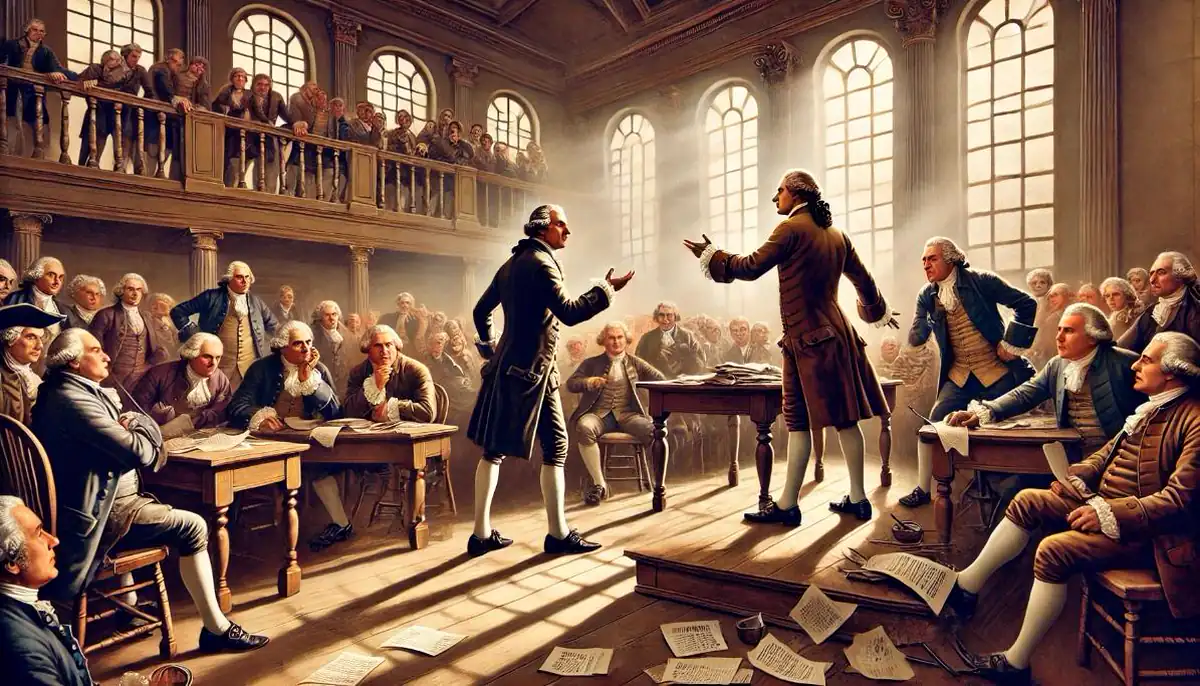
Shays' Rebellion, From Every Side
- Washington to Henry Knox, and Knox's reports to him winter 1786–87Knox was in Massachusetts and wrote to Washington in alarm; Washington's replies are the record of a retired general deciding that the Confederation could not stand. Read them for how frightened people at the top actually were, and then read the next entry for how exaggerated some of that fright was.
- The Massachusetts Disqualification Act, the indictments and the pardonsMassachusetts, 1787The state's own legal record of what it did to the Shaysites and then undid: oaths of allegiance, disqualifications from office and jury service, a handful of death sentences, two executions at Lenox in December 1787, and Shays pardoned in 1788. The legal papers are a better guide to the size of the rising than the letters are.
- Jefferson to William Stephens Smith Paris, 13 November 1787The "tree of liberty" letter, written from France about Shays' Rebellion and quoted more often than any other sentence of the 1780s. Read the WHOLE letter, which takes two minutes: in it Jefferson also says the rebels were wrong, that they acted "from the ignorance, not the depravity" of misinformation, and that such risings should be pardoned rather than punished. The famous sentence means something different with the rest of the letter around it.
Pick two or more of these chapters to read. Finish two of the ones you choose to open Week 3.
K–5th Grade
6th–8th Grade
9th–12th Grade
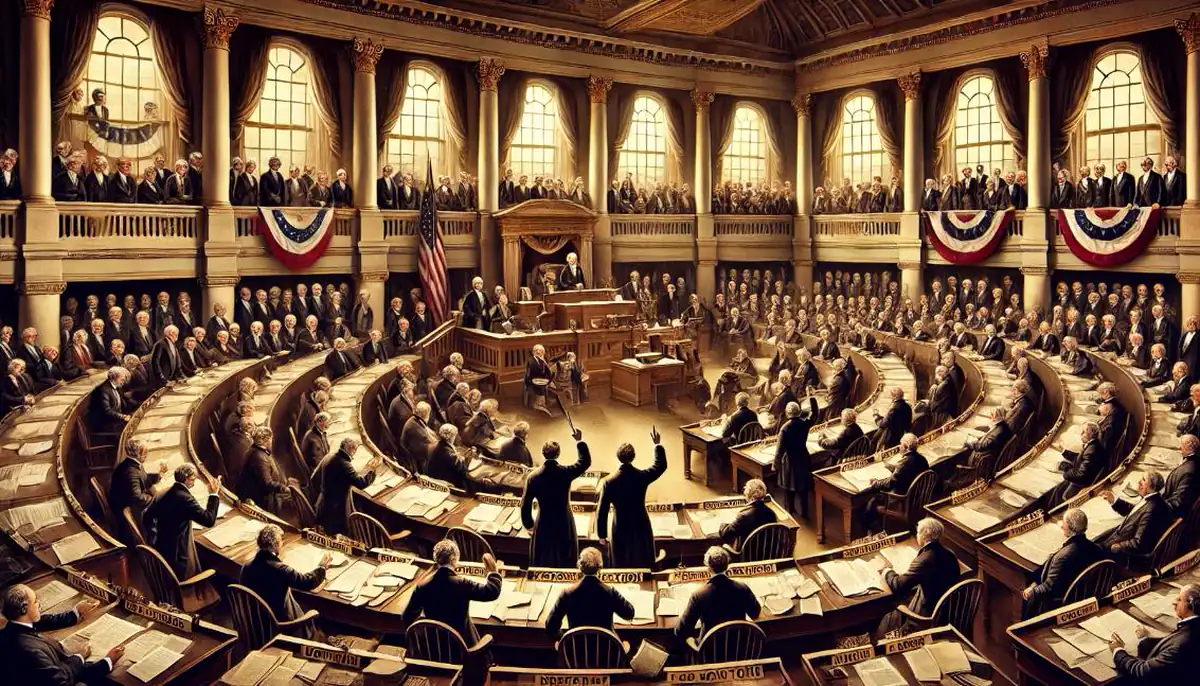
The Convention, and the One Man Who Took Notes
- James Madison's Notes of Debates in the Federal Convention of 1787 kept daily, May–September 1787; published 1840, after his deathTHE INDISPENSABLE SOURCE, AND A PROBLEM AT THE SAME TIME. The Convention sat in secret and kept only a bare official journal, so nearly everything anybody knows about what was said comes from one delegate's private shorthand, written up afterwards, revised by him over the following decades, and published fifty-three years later when every other delegate was dead. Use it constantly and remember all three of those facts. It is also the document that shows the Convention's real calendar, including the ADJOURNMENT FROM 26 JULY TO 6 AUGUST that the Guide fills with eight invented sitting days.
- The Constitution of the United States signed 17 September 1787; in force 4 March 1789Four handwritten pages. Article VII is one sentence long and settles how the whole thing was to come into being: "The Ratification of the Conventions of nine States, shall be sufficient for the Establishment of this Constitution between the States so ratifying the Same." NINE STATES — not, as the Guide's chapter 9 says, a two-thirds majority. Read Article I Section 9 and Article IV Section 2 for the two clauses about slavery that never use the word.
- The Virginia Plan and the New Jersey Plan presented 29 May and 15 June 1787The two rival answers, two pages each, and the argument between them is the argument of the whole summer: representation by population or by state. Randolph read the first; Paterson read the second. NOTE THE DATE ON THE SECOND — 15 June. The Guide says Paterson "formally introduced" it on 14 June and then formally introduced it again on 15 June.
The Argument in Public
- The Federalist New York newspapers, October 1787 – August 1788Eighty-five essays by Hamilton, Madison and Jay, written fast, for one state, to win one vote. No. 10 on faction and No. 51 on ambition counteracting ambition are the two everybody reads; No. 78 on the judiciary is the one that mattered most later.
- The Anti-Federalist essays — Brutus, Cato, Centinel and the Federal Farmer 1787–1788The other half of the argument, and the half that won something: the Bill of Rights exists because these men would not stop asking for it. Brutus I, of 18 October 1787, is the best single essay — its argument that no republic can be governed fairly across so great an extent is the one Madison answers in Federalist No. 10. AUTHORSHIP IS UNCERTAIN FOR ALL FOUR PEN-NAMES and should be given as "attributed to": Brutus is usually assigned to Robert Yates, Cato to George Clinton, Centinel to Samuel Bryan.
- Elliot's Debates on the Adoption of the Federal Constitution collected and published 1827–1830The state ratifying conventions, where the argument was actually decided — Massachusetts, Virginia, New York, Pennsylvania and the rest. PATRICK HENRY'S VIRGINIA SPEECHES ARE PRINTED HERE IN FULL, which is how this course can say that the line the Guide attributes to him is not among them. Like Madison's notes, it is a later compilation of shorthand taken at the time.
Ratification, State by State
- The ratification instruments and the recommended amendments December 1787 – May 1790Each state's own document. The interesting ones are Massachusetts, which ratified on 6 February 1788 with a list of recommended amendments attached, and Virginia and New York, which did the same — that practice is what turned a promise into the Bill of Rights. Delaware was first, on 7 December 1787; New Hampshire was ninth, on 21 June 1788; Rhode Island was last, on 29 May 1790.
- The Confederation Congress resolution putting the new government into motion 13 September 1788The old Congress's last substantial act: setting the dates for choosing electors, for the electors to vote, and for the new Congress to meet, and naming New York as the place. A government voting itself out of existence, in one page.
- The Documentary History of the Ratification of the Constitutiona modern scholarly edition, in progress since 1976Every surviving scrap of the ratification argument — convention journals, private letters, newspaper squibs, tavern toasts — state by state. It is where anybody checking a ratification-era quotation should go, and it is the reason the Guide's "Letters of Confederacy" can be said with confidence not to exist.
Pick two or more of these chapters to read. Finish two of the ones you choose to open Week 4.
K–5th Grade
6th–8th Grade
9th–12th Grade
The First Congress, and the Man Who Wrote Down What It Was Like
- The Journal of William Maclay kept 1789–1791; first published 1890THE ONLY INSIDE ACCOUNT OF THE FIRST SENATE, which sat with its doors closed until 1795. Maclay was a Pennsylvania senator who disliked ceremony, disliked Hamilton, and wrote it all down each night — including the weeks-long argument about what to call the President, in which Vice President Adams pressed for "His Highness the President of the United States of America and Protector of their Liberties" and the House insisted on the plain constitutional wording. NEITHER PRINTED EDITION CITES MACLAY, and the Guide instead credits the title "Mr. President" to a decision of Washington's own.
- The Annals of Congress, First Congress 1789–1791; compiled from newspaper reports 1834–1856The House debates, which were public from the start. Note what they are: a compilation assembled forty years later out of shorthand reports in newspapers, not an official transcript. They are indispensable and they are second-hand.
- The Tariff Act of 4 July 1789 and the Collection Act the first Congress's first revenue lawsThe first substantive statute of the United States, signed 4 July 1789 — and note the date against the Guide's claim that the tariff was "Hamilton's first tax policy": Hamilton was not appointed to the Treasury until 11 September 1789. This was Madison's work in the House.
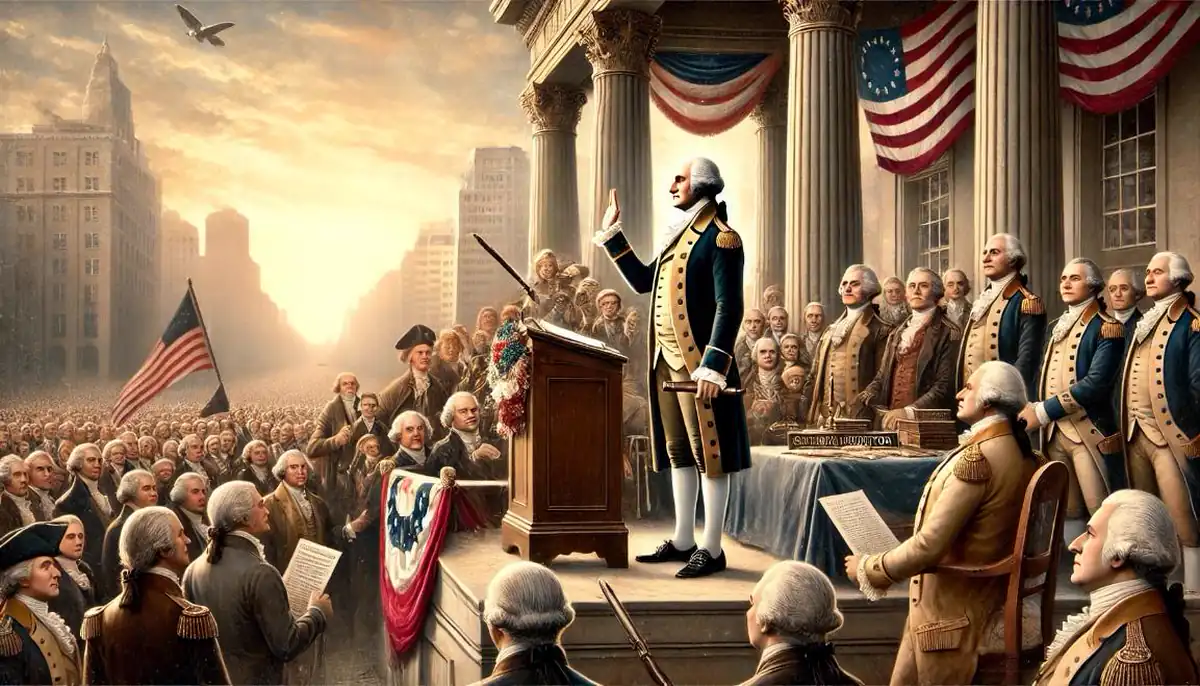
The First Presidency, in Documents
- The certified electoral returns and the count of 6 April 1789 counted at Federal Hall, New YorkSixty-nine electors, each casting two votes, and therefore 138 votes cast. Washington had 69 — every elector's first vote — and Adams 34. The rest were scattered among ten other men, which is why Adams's total looks so thin: the electors were deliberately splitting their second votes to make sure Washington came first. THE GUIDE'S LIST OF RECIPIENTS SUMS TO 135 AND OMITS JOHN MILTON'S TWO VOTES AND EDWARD TELFAIR'S ONE.
- Washington's First Inaugural Address Federal Hall, New York, 30 April 1789Short, nervous and explicitly provisional — he calls the new government "the experiment entrusted to the hands of the American people". Two details worth checking against the record rather than the retellings: NO CONTEMPORARY ACCOUNT HAS HIM SAY "SO HELP ME GOD", and the Bible detail comes from a recollection published much later. The Guide, to its credit, does not print the phrase.
- The acts creating the departments, and Washington's requests for written opinions July–September 1789 onwardState on 27 July, War on 7 August, Treasury on 2 September, the Attorney General in the Judiciary Act of 24 September. THE WORD "CABINET" IS NOT IN THE CONSTITUTION: what Article II gives is the power to "require the Opinion, in writing, of the principal Officer in each of the executive Departments". Washington's written requests, and the replies — Hamilton's and Jefferson's opposed opinions on the Bank in February 1791 above all — are the cabinet inventing itself on paper.
A Judiciary Built by Statute
- The Judiciary Act of 1789 signed 24 September 1789Article III is a few sentences; this statute is the judiciary. It made a Supreme Court of SIX — a Chief Justice and five associates — thirteen district courts and three circuits, and it required the Supreme Court justices to RIDE CIRCUIT, which they hated and which shaped the early Court more than any doctrine. Its Section 13, on writs of mandamus, is the clause Marshall would use against itself in Marbury fourteen years later.
- The commissions of the first six justices September 1789 onwardJohn Jay as Chief Justice, with John Rutledge, William Cushing, James Wilson, John Blair and Robert Hanson Harrison — who declined, and was replaced by James Iredell. NEITHER PRINTED EDITION LISTS THEM, although the Guide's chapter 11 has both Rutledge and Harrison as recipients of electoral votes without ever mentioning that Washington then put them on the Court.
- Chisholm v. Georgia 2 U.S. (2 Dall.) 419 (1793)The first great constitutional decision: a citizen of one state could sue another state in federal court. The reaction was immediate and hostile, and it produced the ELEVENTH AMENDMENT within five years — the fastest reversal of a Supreme Court decision in American history, and a much better "first case" for a student than the three the Guide chooses, one of which cannot be found and one of which is a confusion with a case of 1809.
Pick two or more of these chapters to read. Finish two of the ones you choose to open Week 5.
K–5th Grade
6th–8th Grade
9th–12th Grade
The Amendments, and the Two That Failed
- The twelve articles of amendment Congress proposed joint resolution of 25 September 1789TWELVE, not ten. Read them in order and the numbering puzzle solves itself: the first proposed article, on the size of the House, was never ratified, and the second, on congressional pay, was not ratified until 1992, when it became the TWENTY-SEVENTH Amendment. That is why the third proposed article is the First Amendment and the fourth is the Second. THE GUIDE BUILDS THREE SECTIONS ON THE OPPOSITE ASSUMPTION — "Why the Second Amendment Is Second", "Why the Third Amendment Was Placed Third", "Why the Fourth Amendment Was Placed Fourth" — and then supplies the refutation itself a few pages later.
- Madison's speech introducing the amendments House of Representatives, 8 June 1789He had opposed a bill of rights at the Convention, calling such guarantees "parchment barriers", and he introduced one here because Virginia's ratification had been bought with the promise. The speech is candid about that. It is also the answer to the Guide's claim that he advocated a bill of rights while the Constitution was being written.
- The state ratifications of the Bill of Rights 1789–1791Virginia completed the ten on 15 DECEMBER 1791. Worth noticing: Massachusetts, Connecticut and Georgia did not get round to ratifying until 1939, for the amendments' 150th anniversary.
Hamilton's Three Reports, and the Bargain
- The First Report on the Public Credit submitted to the House, 9 January 1790The document the Guide's chapter 15 never names, although it takes its figures from it. About $54 million in federal debt — roughly $40m domestic, $12m foreign, the rest accrued interest — plus about $25 million owed by the states, to be funded at par and assumed by the union. The phrase "the price of liberty", which the Guide quotes without a source, is in here.
- The Report on a National Bank, and the two opinions on its constitutionality report 13 December 1790; Jefferson's and Hamilton's opinions February 1791; act signed 25 February 1791The best-matched pair of documents in the whole course. Washington asked both men to put it in writing, and they did: Jefferson's strict reading of the necessary-and-proper clause against Hamilton's broad one, four days apart, on the same question, for the same reader. Everything later American constitutional argument does, those two papers do first.
- The Residence Act and the Funding Act of 1790 16 July and 4 August 1790The Compromise of 1790 in its legal form: assumption of the state debts, and a capital on the Potomac. The famous dinner at Jefferson's lodgings is known from JEFFERSON'S OWN ACCOUNT WRITTEN YEARS AFTERWARDS, which is worth saying whenever the story is told.
Resistance, and the First Navy
- The excise act of 3 March 1791 and the Militia Act of 1792 the tax, and the power used against those who would not pay itThe whiskey excise, and then the statute that let a president call out the militia on a federal judge's certification — which is the legal machinery of 1794. Read them together and the Whiskey Rebellion becomes a question about law rather than about temper.
- Washington's proclamations of 7 August and 25 September 1794, and the pardons of 1795 the government's own account of what it was doing and whyThe proclamations set out the case for the militia call-up in the government's own words. Washington reviewed the troops at Carlisle and Bedford in October and TURNED BACK; Hamilton and Henry Lee took the force west. The Guide says he "personally led the troops to western Pennsylvania" and then says he returned to the capital, two paragraphs apart.
- The Naval Act of 27 March 1794, and the Treaty of Tripoli the six frigates; the treaty signed at Tripoli 4 November 1796 and ratified 10 June 1797The act authorised United States, Constellation, Constitution, Chesapeake, Congress and President — and the Guide names all six correctly, which is worth saying. THE TREATY OF TRIPOLI THE GUIDE NEVER MENTIONS AT ALL, although it spends pages on the Tripoli relationship; its Article 11, in the English text laid before the Senate, is one of the most argued-over sentences of the period and a student should meet it as a document rather than as a talking point.
Pick two or more of these chapters to read.
K–5th Grade
6th–8th Grade
9th–12th Grade
Parties Nobody Meant to Found
- The Gazette of the United States and the National Gazette Philadelphia, 1789–1793The two party papers, founded by men the two party leaders had put there: John Fenno for the Federalists, and Philip Freneau — who was given a State Department clerkship by Jefferson — for the opposition. Read a week of each side by side. The first American party system is visible in newsprint before it is visible in any institution.
- Washington's Farewell Address published in the American Daily Advertiser, Philadelphia, 19 September 1796IT WAS NEVER DELIVERED AS A SPEECH. It is a newspaper piece, drafted by Madison in 1792, revised by Washington, and rewritten by Hamilton by letter in the summer of 1796. What it actually warns against is "the baneful effects of the spirit of party generally" and "permanent alliances" — not, as it is usually quoted, "entangling alliances", which is Jefferson's phrase from his 1801 inaugural. THE GUIDE PRINTS A SENTENCE, "Beware of party spirit", THAT IS NOT IN THE DOCUMENT.
- Jay's Treaty, and the House's demand for the instructions treaty signed 19 November 1794; Senate consent 24 June 1795; ratified 18 August 1795; House appropriation 30 April 1796The most unpopular treaty in American history until the twentieth century, and the moment the parties hardened. TWO THINGS TO CHECK AGAINST THE GUIDE: Article 12, the West Indies trade clause, was STRUCK OUT by the Senate as a condition of consent and never took effect; and Washington refused the House's call for the negotiating instructions in a message of 30 March 1796, arguing from the treaty power — the term "executive privilege" is a twentieth-century coinage and nobody in 1796 had it.
The Adams Presidency, and Four Statutes
- The XYZ dispatches laid before Congress 19 March and published early April 1798Adams released the diplomats' own reports of being asked for a bribe, with the French agents' names replaced by X, Y and Z, and the country went from hostile to furious in a fortnight. It is the clearest case in the period of a document changing public opinion by being published. The three envoys were Charles Cotesworth Pinckney, John Marshall and Elbridge Gerry, none of whom the Guide names in this connection.
- The Alien and Sedition Acts Naturalization Act 18 June 1798; Alien Friends Act 25 June 1798; Alien Enemies Act 6 July 1798; Sedition Act 14 July 1798Four separate statutes, and it matters to keep them apart. The Sedition Act carried its own expiry, 3 March 1801 — the last day of Adams's term, which tells you what it was for. The Alien Friends Act expired in 1800; the Naturalization Act was repealed in 1802; and THE ALIEN ENEMIES ACT WAS NEVER REPEALED AND IS STILL LAW. The Guide's chapter 18 says Jefferson repealed them all.
- The Virginia and Kentucky Resolutions 1798, and the Kentucky Resolutions of 1799Madison wrote Virginia's and Jefferson wrote Kentucky's, both anonymously, both while holding federal office — Jefferson was the sitting Vice President writing against the administration he served in. READ THE WORDING CAREFULLY: Virginia in 1798 says the states may "interpose"; the word NULLIFICATION enters with the Kentucky Resolutions of 1799. The distinction is not pedantry — it is the whole of what the next sixty years argued about.
The Handover
- The electoral returns of 1800 and the House ballots of February 1801 counted 11 February 1801; decided on the thirty-sixth ballot, 17 February 1801Jefferson 73, Burr 73, Adams 65, Pinckney 64. Because electors still cast two undifferentiated votes, the winning party's two candidates tied, and the outgoing Federalist House spent six days and thirty-six ballots deciding between them. The tie and the ballots are the mechanism of the whole chapter, and the Guide's chapter 19 omits both.
- Jefferson's First Inaugural Address Washington City, 4 March 1801"We are all Republicans, we are all Federalists" is in here, and so is "peace, commerce, and honest friendship with all nations, entangling alliances with none" — the phrase usually misattributed to Washington. It is short, it is conciliatory, and it was delivered to a city that was mostly a building site.
- The Twelfth Amendment proposed 9 December 1803; ratified 15 June 1804The direct consequence: electors would vote separately for President and Vice President, so that a party's two candidates could never again tie with each other. It is the tidiest example in the course of a constitutional system being repaired by the people it had just embarrassed.
What comes with the book
The Ultimate Guide
The textbook itself — the twenty chapters these lessons are built from.
Living History
Heroes and Villains: Birth of the Nation — Told By Those Who Were There. The Heroes & Villains series, in the first person.
The Adventure Box
Cards, lesson plans, activities, coloring pages and the craft kit for this era.