History Curriculum/Book 22
Book twenty-two of the curriculum
The History of World War I
The twenty-second book in the curriculum and the fourth of the Late American History set. Nineteen chapters across four weeks — first the road to war: Europe before 1914, the armies, alliances and empires, the Balkans, and the murder at Sarajevo and the July Crisis; then the war of 1914–1916: the opening campaigns, the trenches, the new weapons, Verdun and the Somme, and the war in the east and beyond Europe; then total war and its turning points: the home fronts, the war at sea, America's entry, the war in the air, the revolutions in Russia and the last offensives; and last the peace settlement: the Treaty of Versailles, the new map of the world, and the war's legacy. TWO THINGS TO KNOW BEFORE YOU START. First, the first-person accounts in both printed editions are HISTORICAL FICTION — written to tell the story, informed by the surviving record, and not the words of the people named. Most narrators are real people, but some speak of things that happened after they died, and some meet in scenes that never took place. The record itself is very large: the notes, telegrams and treaties of the governments, the soldiers' and nurses' letters and diaries, the despatches and casualty returns, the newspapers, the photographs, and the excavations of the battlefields — and this course quotes them. Second, at the back of the Ultimate Guide, after the chapters (pages 358–395), there are Cross-Curricular sections — Math, Science, Social Studies and English — and tests, to use alongside this course. They are not a fifth week and there is nothing to hand in for them.
Read the book
Turn the pages of both editions right here. World War I is a members’ book: subscribers and Adventure Box Course families read every page.
🔒 A members’ book — Living History 363 pages, Standard Book 395 pages. Subscribe, or buy an Adventure Box, to read it.
4 Weeks, 19 Chapters, Choose 8+ to Read
Pick the chapters you want to read each week. The living books and the sources are one click away.
Pick two or more of these chapters to read. Finish two of the ones you choose to open Week 2.
K–5th Grade
6th–8th Grade
9th–12th Grade
Bismarck's Europe and the Hope of Peace
- Otto von Bismarck, the "Blood and Iron" speech to the budget commission of the Prussian House of Deputies 30 September 1862 (excerpts, in English translation)The Prussian minister-president told the deputies who refused his army budget that "it is not by speeches and majority resolutions that the great questions of the time are decided" but "by iron and blood." Nine years later Prussia had united the German states into an empire. Read the whole excerpt and say what he was asking the deputies to pay for.
- Rescript of the Russian Emperor (the Tsar's call for a peace conference) Circular note handed by Count Muravyov to the diplomats at St. Petersburg, 24 (12) August 1898Nicholas II's government proposed a conference on "a possible reduction of the excessive armaments which weigh upon all nations," with the aim of "putting an end to the progressive development of the present armaments." It led to the Hague Conference of 1899.
- Norman Angell, The Great Illusion: A Study of the Relation of Military Power to National Advantage Fourth revised and enlarged edition, New York and London: G. P. Putnam's Sons, 1913 (first published November 1909)A British author's book of the years before the war, much reprinted and translated. In his own preface Angell says his argument "is not that war is impossible, but that it is futile" — that conquest no longer pays a modern nation. The book is often remembered as saying war could not happen; read the preface to see what he actually wrote.
Fleets, Alliances and Rivals
- Bernhard von Bülow, speech to the Reichstag on Germany's "Place in the Sun" 6 December 1897 (excerpt, in English translation), from the Reichstag's stenographic reportsThe foreign secretary defended the seizure of Kiaochow in China after the murder of German missionaries: "we do not want to put anyone in our shadow, but we also demand our place in the sun." The deputies' interruptions ("Bravo!", "Laughter on the left") are printed in the record.
- Eyre Crowe, Memorandum on the Present State of British Relations with France and Germany British Foreign Office, 1 January 1907 (excerpt)A senior Foreign Office official explains to his ministers why Britain watched the German fleet: "Sea power is more potent than land power." Read it beside Tirpitz's letter and Bülow's speech — the British and German sides of the naval race in their own words.
- The Franco-Russian Alliance Military Convention Agreed 18 August 1892 (secret at the time)"If France is attacked by Germany, or by Italy supported by Germany, Russia shall employ all her available forces to attack Germany" — and France likewise for Russia. Article 2 ties the two to mobilize at once if any power of the Triple Alliance mobilizes. Read it beside the Dual Alliance.
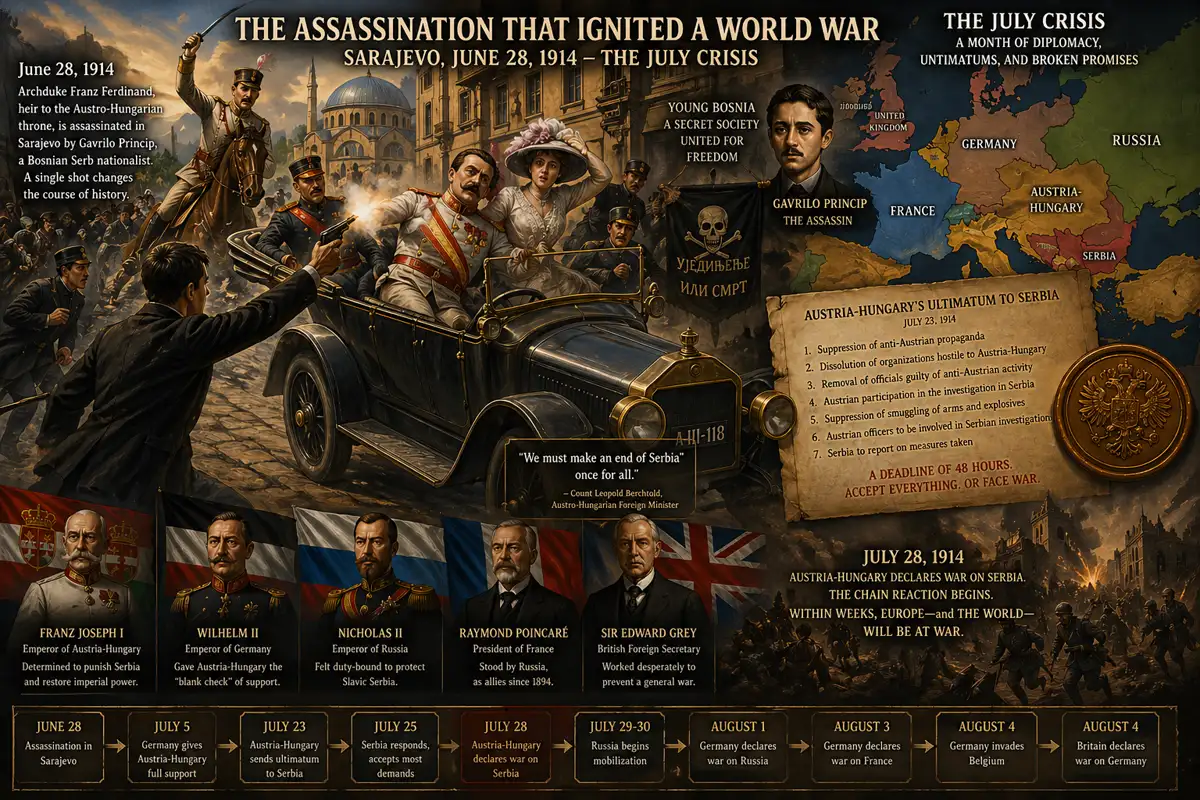
From Sarajevo to War
- The "Blank Check": Count Szögyény-Marich (Berlin) to Count Berchtold Telegram no. 237, Berlin, 5 July 1914, top secret (in English translation)Austria-Hungary's ambassador reports his lunch with Kaiser Wilhelm II: the Kaiser "authorized me to report to our most gracious Lord that in this case, too, we could count on Germany's full support." The ambassador's own report of what was said.
- The Austro-Hungarian note to Serbia, and Serbia's reply Note of 23 July 1914 and reply of 25 July 1914, with the British, French, Russian, Belgian, Serbian, German and Austro-Hungarian books; Collected Diplomatic Documents relating to the Outbreak of the European War (London: H.M. Stationery Office, 1915)The British government's collection of every government's published papers. The note's demands, Serbia's reply (British Blue Book No. 39), Goschen's report that Bethmann Hollweg spoke of going to war "just for a scrap of paper," and the chancellor's own speech of 4 August: "The wrong — I speak openly — the wrong we thereby commit we will try to make good." Read each government in its own words.
- Sir Edward Grey, Foreign Secretary, statement to the House of Commons House of Commons, 3 August 1914 (Hansard)Grey began: "we have consistently worked with a single mind, with all the earnestness in our power, to preserve peace." On Belgium, "The governing factor is the Treaty of 1839." The next day German troops crossed into Belgium and Britain declared war. Read it beside Bethmann Hollweg's speech of 4 August.
Pick two or more of these chapters to read. Finish two of the ones you choose to open Week 3.
K–5th Grade
6th–8th Grade
9th–12th Grade
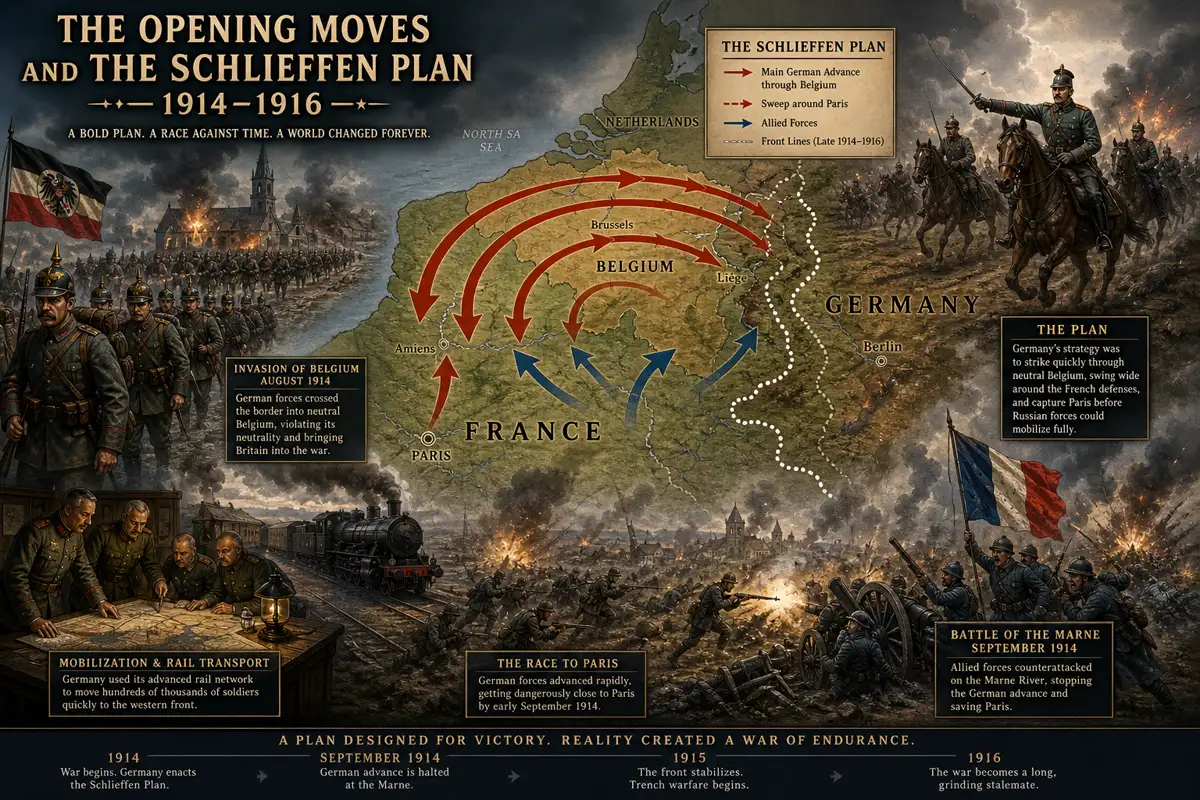
The Plan and the March
- Alfred von Schlieffen, memorandum "War against France" (the Schlieffen Plan) Berlin, December 1905 (in English translation)The retiring chief of the General Staff sets out how to fight France. It opens: "In the event of a war with Germany, France will probably restrict itself to defensive measures," behind fortresses that include "Belfort, Epinal, Toul, and Verdun." Read how he proposes to go around them, and through which countries.
- Alexander von Kluck, The March on Paris and the Battle of the Marne, 1914 London: Edward Arnold, 1920 (with notes by the Historical Section of the Committee of Imperial Defence); the author's review completed 6 February 1918The commander of the German First Army, on the right wing of the march through Belgium to the Marne. His preface: "Only opinions formed at the time are recorded." The British editors add notes where the record differs; read his orders for 5 and 6 September 1914.
- The Despatches of Lord French: Mons, the Marne, the Aisne, Flanders, Neuve Chapelle, the Second Battle of Ypres, Loos, Hohenzollern Redoubt London: Chapman & Hall, 1917 (the commander-in-chief's despatches first printed in the London Gazette, 1914–1915)The British commander's own reports. After Mons: "I determined to effect a retirement to the Maubeuge position at daybreak on the 24th." Read his despatch on the Marne beside Kluck's book: the same days, from opposite sides of the line.
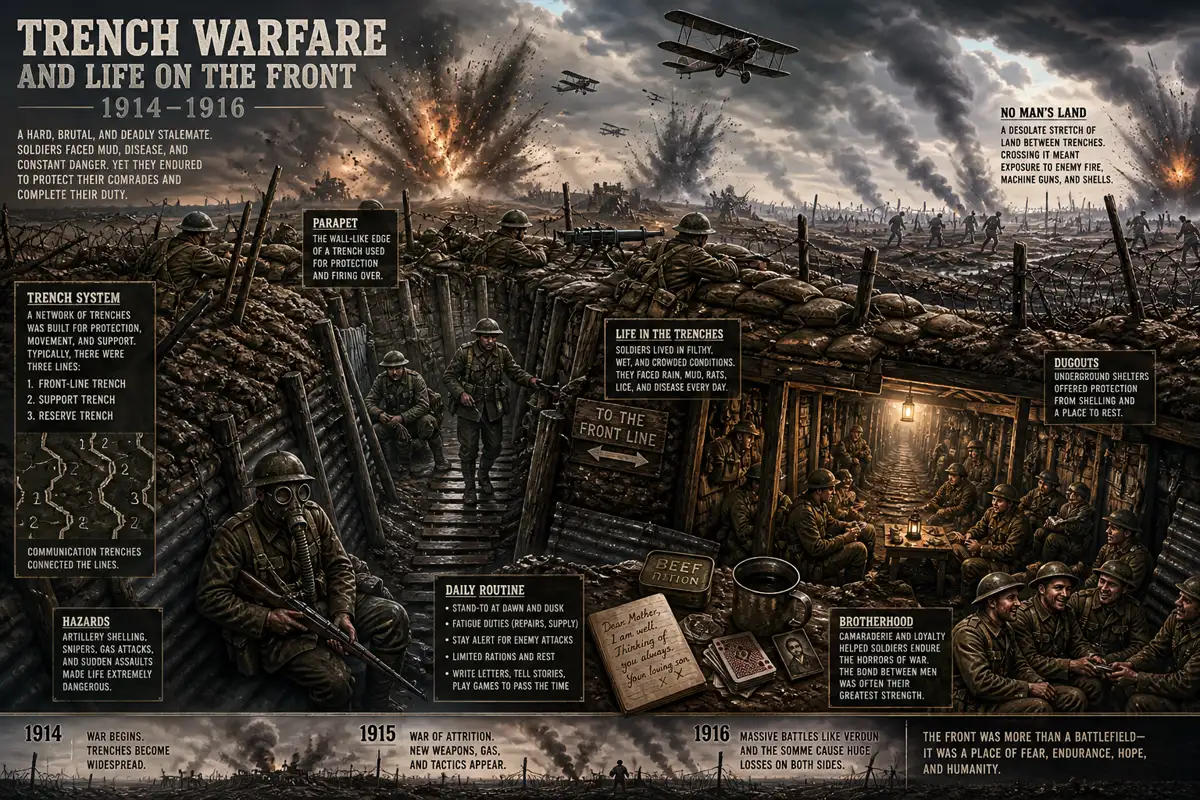
Life in the Trenches, from Both Sides
- Arthur Guy Empey, "Over the Top," by an American Soldier Who Went: Together with Tommy's Dictionary of the Trenches 1917 (the author signs himself 'Machine Gunner, Serving in France')An American who, by his own account, talked his way into the British army in London in 1915 tells of training, the trenches and going over the top. Its glossary of trench slang is a source in itself: look up "dugout," "fire step" and "no man's land."
- Soldiers Describe Combat I: Eduard Schmieder Letters of 1914–1915 from a student of Freiburg who died near Liévin, 8 May 1916 (in English translation)A German soldier writes home from France, beginning at Framonville on 23 August 1914: "I smoked cigars as we lay under shrapnel fire." The other side of the same trenches Empey and Hall describe.
- Decrees against Fraternization Decree of the Chief of the General Staff of the Field Army, 28 November 1914, and a further decree of 20 November 1916 (in English translation)The German high command heard that "at certain points in our front line, where friend and foe are particularly close to each other, a kind of fraternization has developed." "There are even said to have been agreements to cease firing at each other." An order written a month before the Christmas truce of 1914.
Verdun, the Somme and Gallipoli
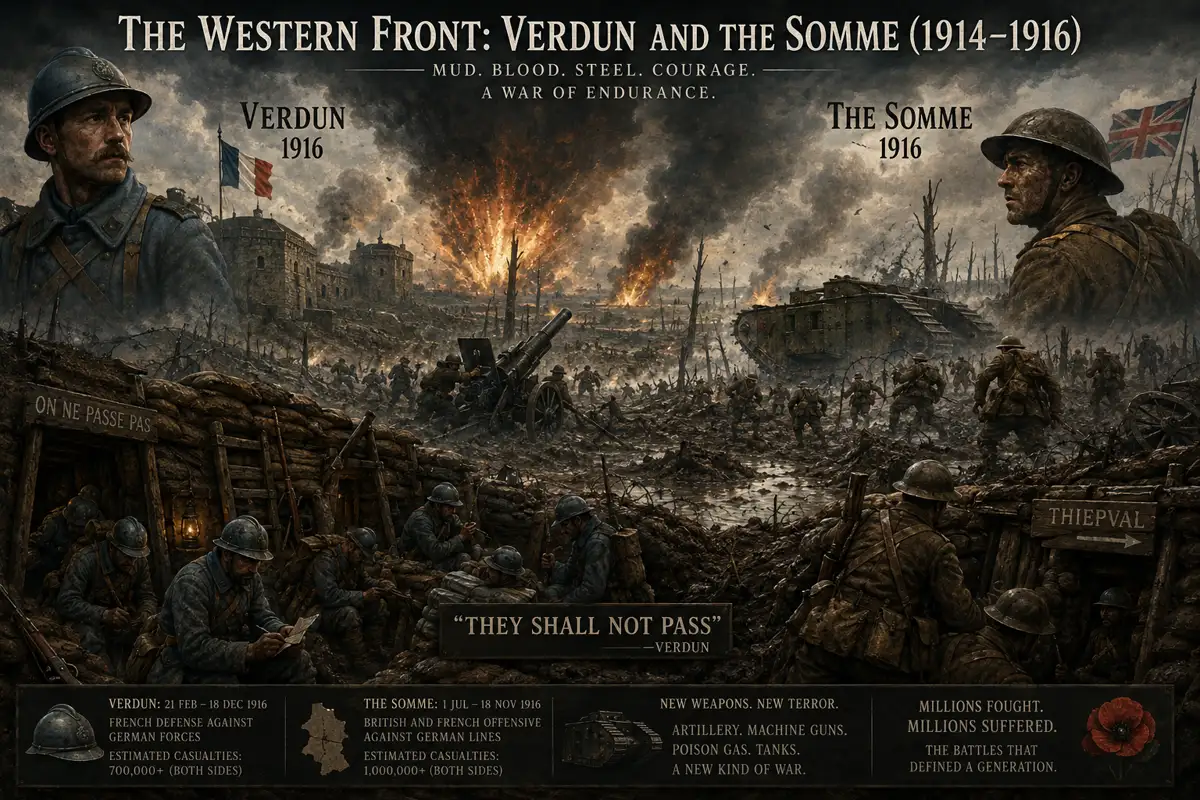
- Erich von Falkenhayn, General Headquarters, 1914–1916, and its Critical Decisions London: Hutchinson, 1919 (English translation of his book of 1919)The chief of the German General Staff of 1914–1916 explains his decisions. He prints a document he says he wrote at Christmas 1915 "to serve as a basis for the report to His Majesty the Kaiser," proposing an attack on a point the French would defend to the last: "If they do so the forces of France will bleed to death." The attack fell on Verdun in February 1916.
- 'Remember Me to All': The Archaeological Recovery and Identification of Soldiers who Fought and Died in the Battle of Fromelles, 1916 Louise Loe, Caroline Barker, Kate Brady, Margaret Cox, Helen Webb and others; Oxford: Oxford Archaeology, 2014 (project report, in eleven PDF parts)ARCHAEOLOGY. The excavators' report: "250 soldiers were buried behind enemy lines in unmarked mass graves on the outskirts of the village of Fromelles" after the battle of 19–20 July 1916. Working for the Commonwealth War Graves Commission in 2009, the team recovered them for reburial with full military honours, and DNA was used to identify them by name.
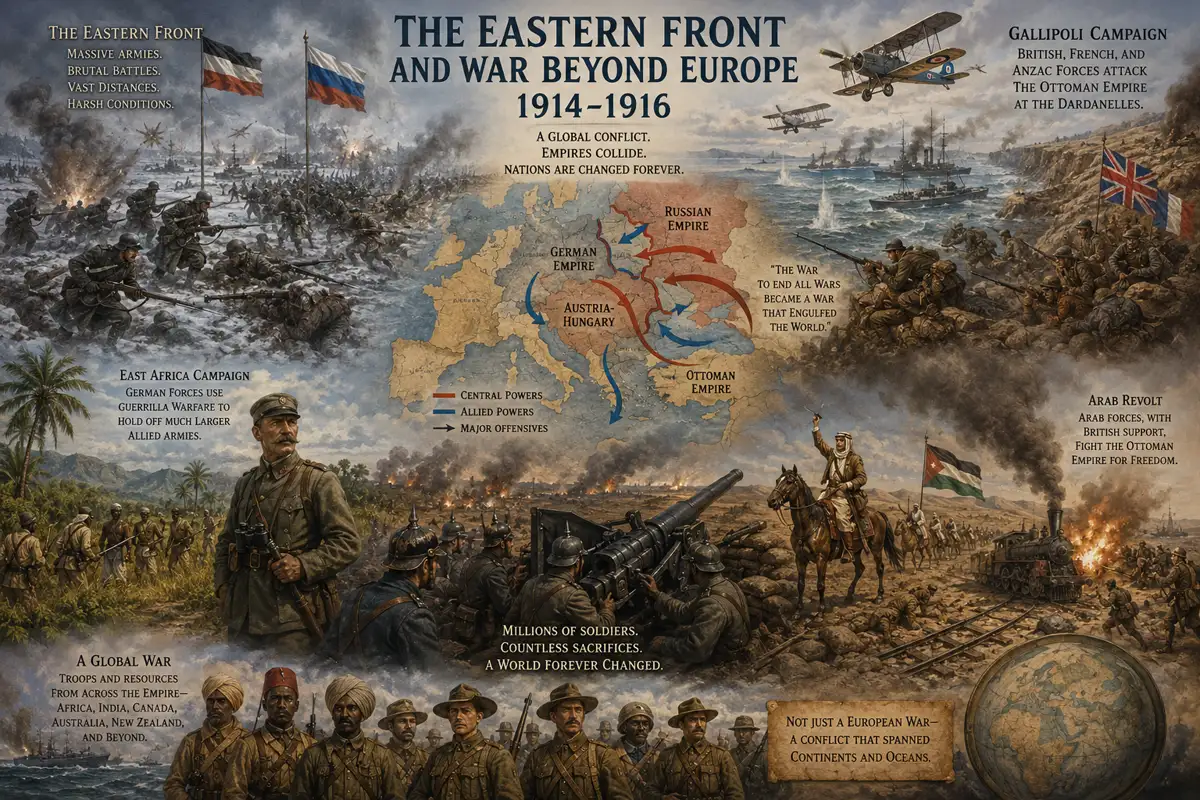
- Sir Ian Hamilton, Gallipoli Diary, volume 1 New York: George H. Doran, 1920 (two volumes; preface dated 25 April 1920)The diary of the British commander at Gallipoli, beginning before the landings of 25 April 1915. Within days he was asking for two more divisions: "otherwise I am afraid we shall degenerate into trench warfare with its resultant slowness." A commander's day-by-day record.
Pick two or more of these chapters to read. Finish two of the ones you choose to open Week 4.
K–5th Grade
6th–8th Grade
9th–12th Grade
The Home Front
- Selective Service Act ("An Act To authorize the President to increase temporarily the Military Establishment of the United States") 40 Stat. 76, chapter 15, approved 18 May 1917The draft law as printed in the Statutes at Large. All male citizens "between the ages of twenty-one and thirty, both inclusive, shall be subject to registration." Read which men it exempts and how local boards were to decide.
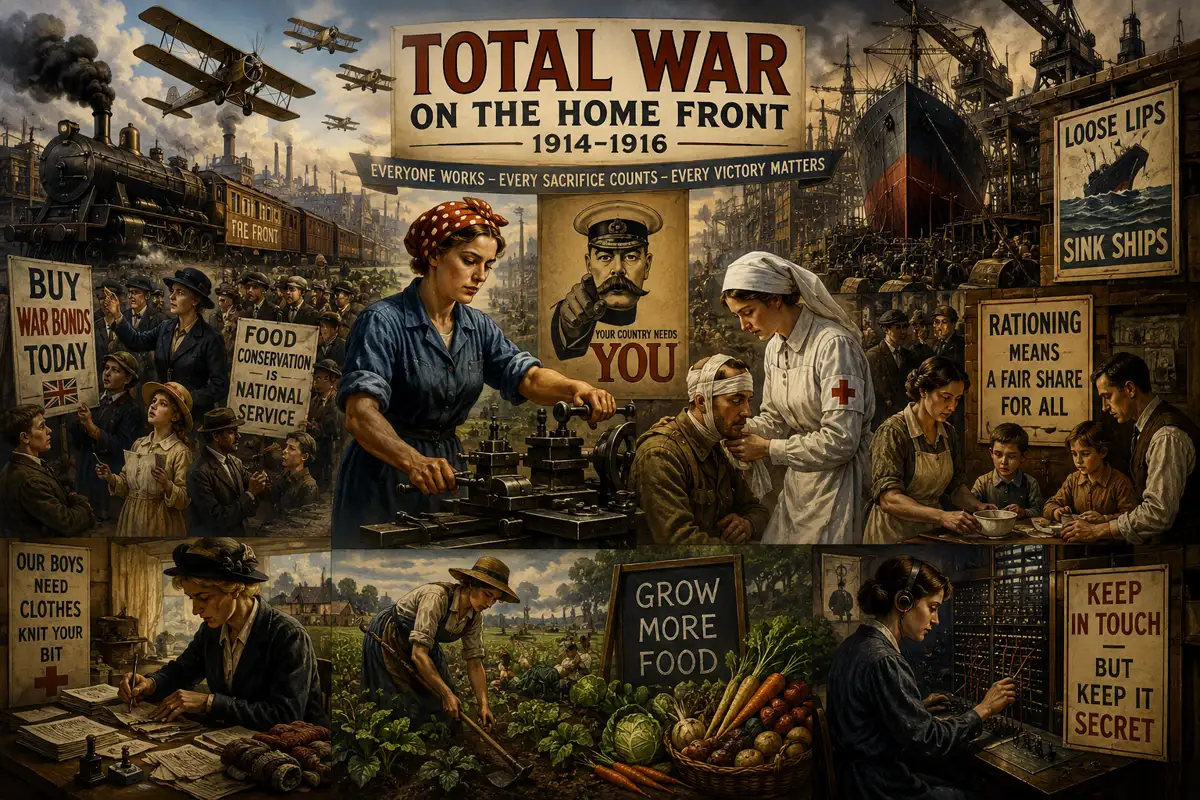
- George Creel, How We Advertised America New York and London: Harper & Brothers, 1920The chairman of the Committee on Public Information tells how the government sold the war at home and abroad — films, posters, speakers ("The Four Minute Men") and news. He called it "the fight for the minds of men." His own account, written to defend his committee's work.
- The Auxiliary Service Law (Gesetz über den vaterländischen Hilfsdienst) German Empire, 5 December 1916 (in English translation)§ 1: "every male German from the age of eighteen to sixty shall be obligated to participate in national Auxiliary Service for the duration of the war." Germany's law for putting every man not in uniform to war work. Compare the American draft law.
Submarines and the United States
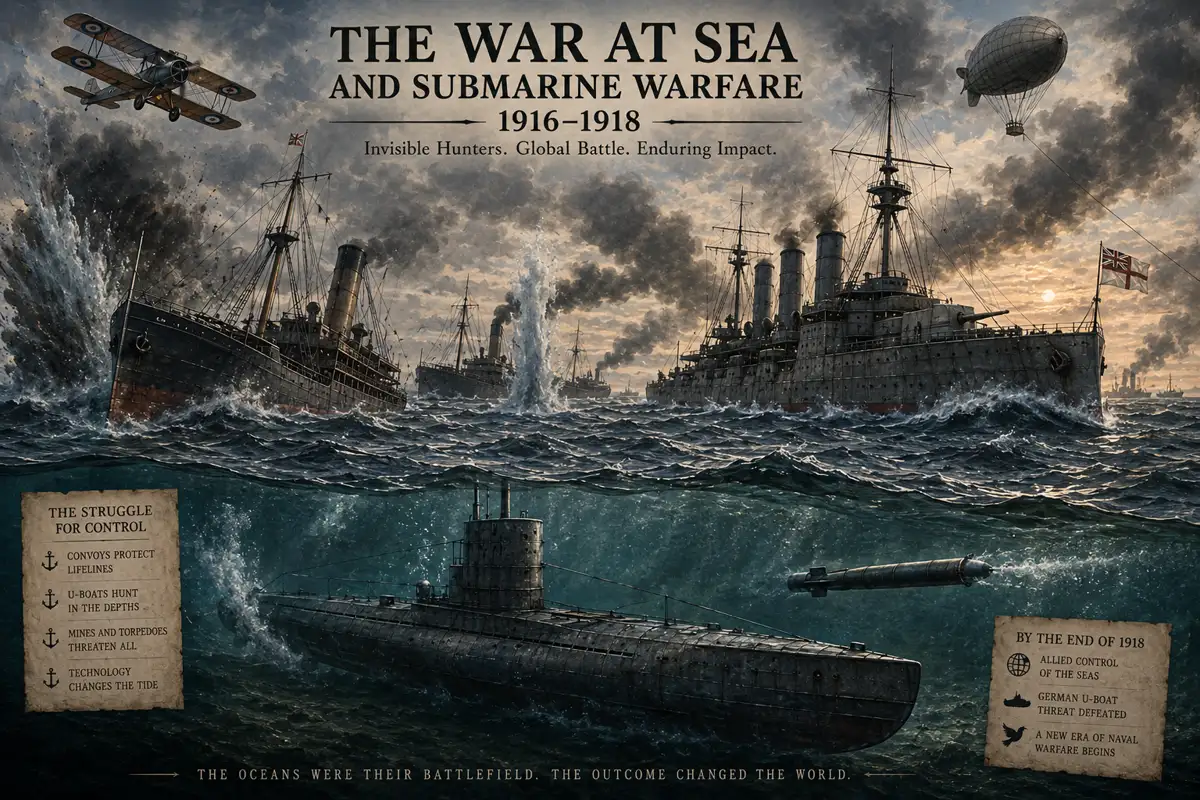
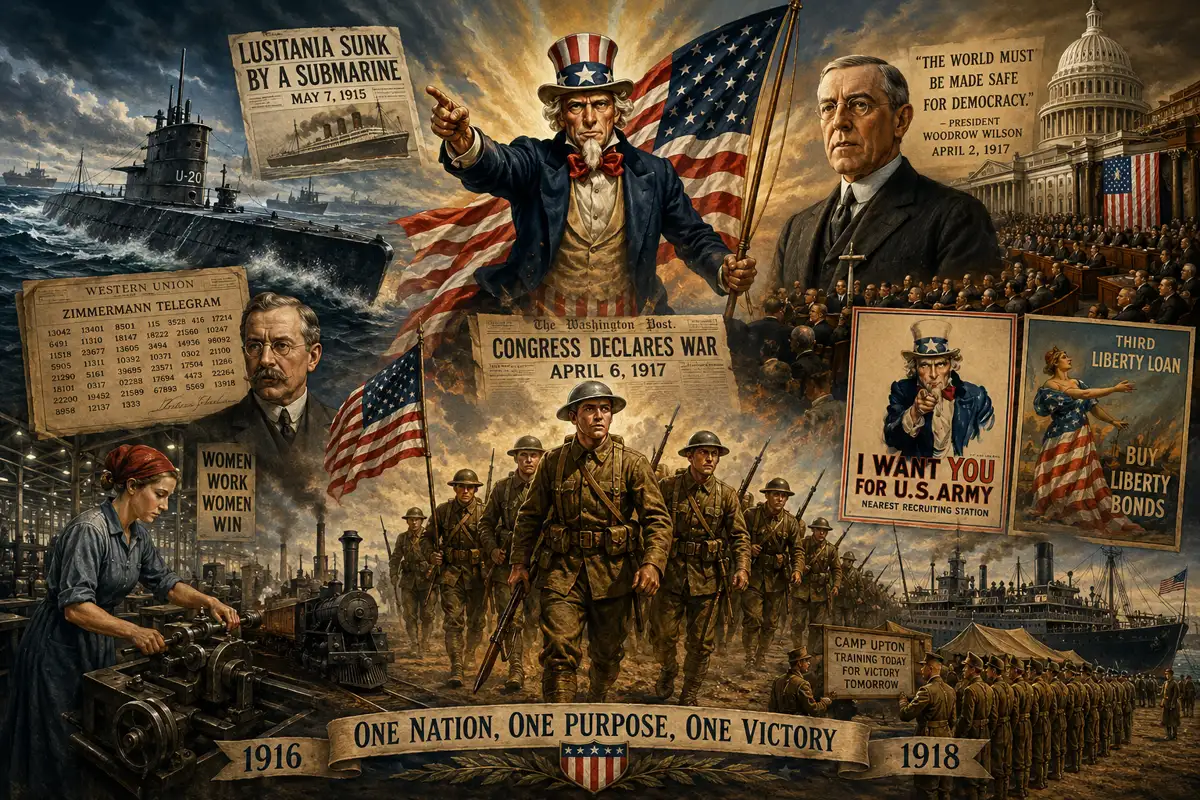
- The first Lusitania note: the Secretary of State to the Ambassador in Germany Washington, 13 May 1915 (telegram); Foreign Relations of the United States, 1915, Supplement, The World War, document 575Six days after the sinking, the United States reminded Germany that it would hold it "to a strict accountability for any infringement of those rights, intentional or incidental" — the rights of Americans travelling on merchant ships.
- The Zimmermann Telegram (decoded text) German Foreign Secretary Arthur Zimmermann to the German Minister in Mexico, January 1917; Record Group 59, General Records of the Department of State"We intend to begin on the first of February unrestricted submarine warfare. We shall endeavor in spite of this to keep the United States of America neutral." If not, Mexico was to be offered an alliance and "the lost territory in Texas, New Mexico, and Arizona." The Archives shows the coded telegram and its decoding.
- Woodrow Wilson, Address to a Joint Session of Congress Requesting a Declaration of War Against Germany 2 April 1917"The world must be made safe for democracy. Its peace must be planted upon the tested foundations of political liberty. We have no selfish ends to serve. We desire no conquest, no dominion." Note the exact words: the world "must be made safe."
Revolution in Russia and the Armistice
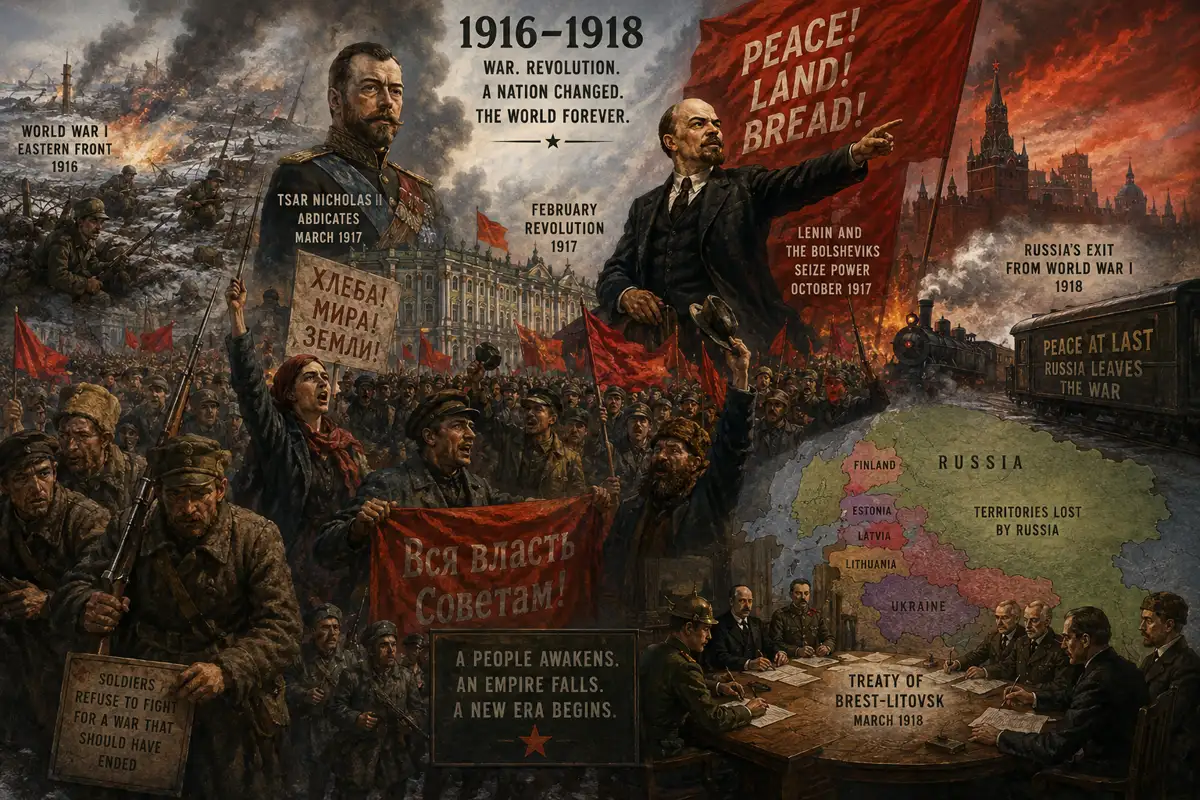
- Order No. 1 of the Petrograd Soviet Petrograd Soviet of Workers' and Soldiers' Deputies, 14 March 1917 (1 March, Old Style)The Soviet ordered soldiers and sailors in every company and ship to "immediately choose committees from the elected representatives of the soldiers and sailors." Rule 5 puts "Arms of all kinds" under the soldiers' committees, "not in any case to be given out to officers," and rule 6 abolishes "compulsory saluting outside of service."
- The Treaty of Brest-Litovsk Peace treaty between Germany, Austria-Hungary, Bulgaria and Turkey and Russia, signed 3 March 1918, as forwarded by the U.S. Consul General at Moscow (Foreign Relations of the United States, 1918, Russia, volume I)Russia's exit from the war, article by article. Article 5: "Russia will, without delay, proceed to demobilize her army, including those army units newly formed by her present government." Look at the articles on the lands Russia gave up.
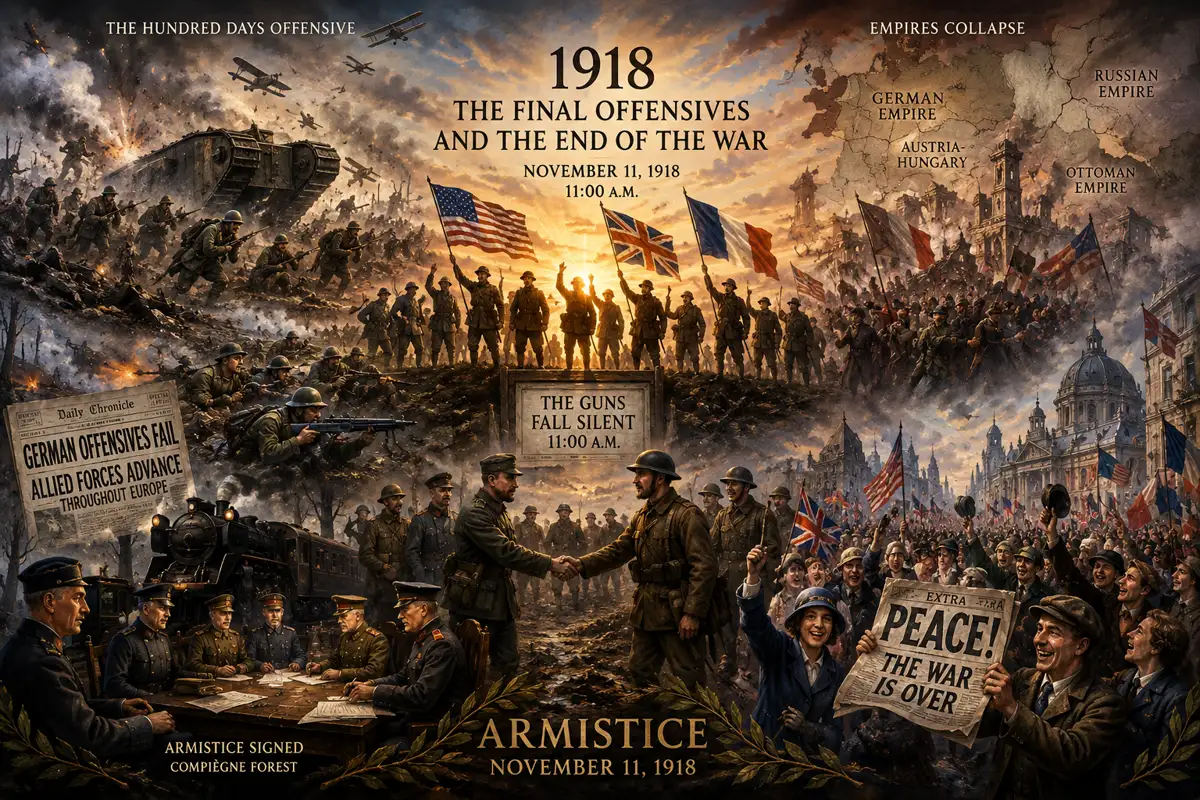
- Woodrow Wilson, Address to a Joint Session of Congress Concerning the Terms of Armistice Signed by Germany 11 November 1918Wilson read the armistice terms to Congress clause by clause, beginning "Cessation of operations by land and in the air six hours after the signature of the armistice" and the "Immediate evacuation of invaded countries: Belgium, France, Alsace Lorraine, Luxemburg." Then: "The war thus comes to an end."
Pick two or more of these chapters to read.
K–5th Grade
6th–8th Grade
9th–12th Grade
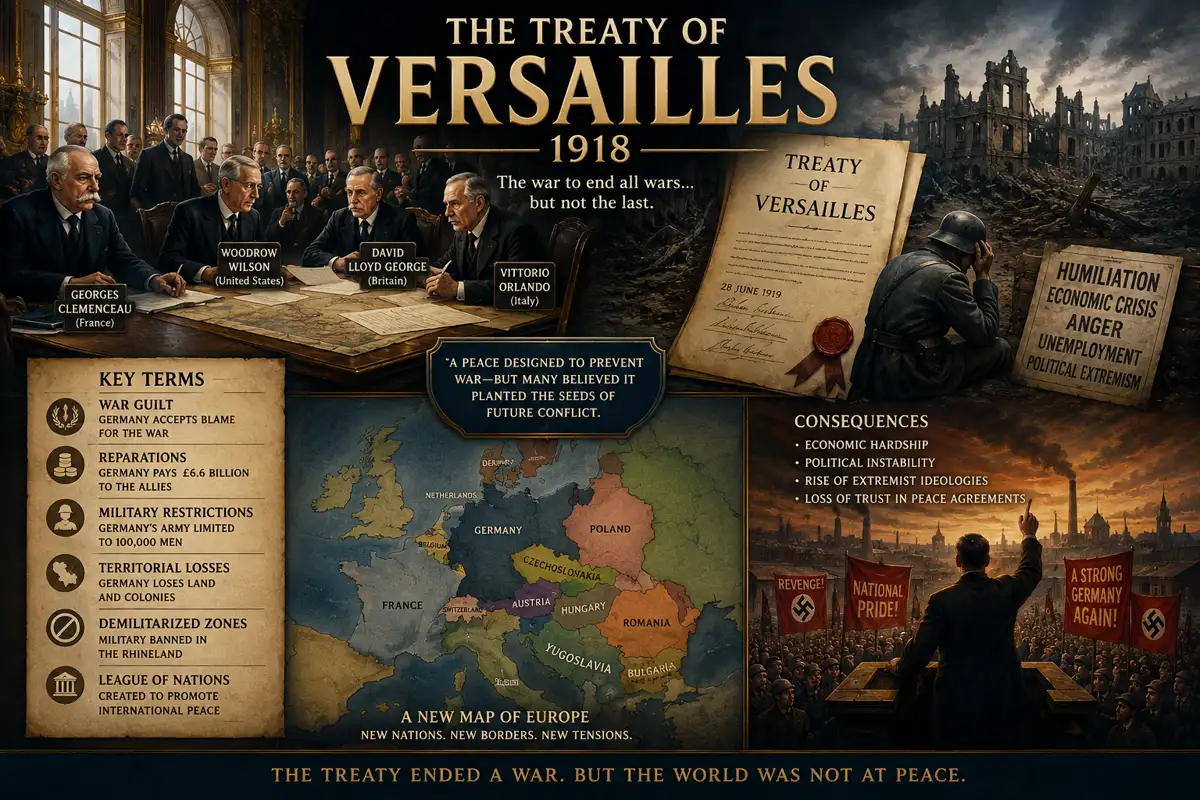
Making the Peace
- Woodrow Wilson, Address to a Joint Session of Congress on the Conditions of Peace ("The Fourteen Points") 8 January 1918Wilson's peace programme, point by point. Point XIV: "A general association of nations must be formed under specific covenants for the purpose of affording mutual guarantees of political independence and territorial integrity to great and small states alike." Read the exact words of each point; the phrases "self-determination" and "League of Nations" do not appear in them.
- Peace Congress at Versailles, Protocol No. 1: the handing of the Conditions of Peace to the German delegation Plenary session, Trianon Palace, Versailles, 7 May 1919; Foreign Relations of the United States, The Paris Peace Conference, 1919, volume III, document 11The minutes of the day the terms were handed over, with both speeches. Clemenceau: "This can be neither the time nor the place for superfluous words." Count Brockdorff-Rantzau for Germany: "We are required to admit that we alone are war-guilty; such an admission on my lips would be a lie."
- The Treaty of Versailles, Part VIII: Reparation (Article 231) Treaty of Peace between the Allied and Associated Powers and Germany, signed at Versailles, 28 June 1919Article 231 exactly: "The Allied and Associated Governments affirm and Germany accepts the responsibility of Germany and her allies for causing all the loss and damage to which the Allied and Associated Governments and their nationals have been subjected as a consequence of the war imposed upon them by the aggression of Germany and her allies." Read Article 232, which follows it, too.
The Senate Decides
- Report of the Conference between Members of the Senate Committee on Foreign Relations and the President of the United States at the White House, Tuesday, August 19, 1919 Washington: Government Printing Office, 1919Word-for-word record of the President answering the senators' questions in the East Room — Lodge, Borah, Knox, Johnson, Hitchcock and others. Wilson on Article 10: it "is in no respect of doubtful meaning when read in the light of the covenant as a whole." Both sides of the treaty fight, face to face.
- Woodrow Wilson, Address at the City Hall Auditorium in Pueblo, Colorado 25 September 1919Wilson spoke across the West to win the public for the treaty. At Pueblo: "Article 10 is the heart of the whole matter." Read what he says Article 10 means, then read what the senators' reservations (below) say about it.
- Senate debate and votes on the Treaty of Versailles with the Lodge reservations Congressional Record, 66th Congress, 1st session, Senate, 19 November 1919The day the treaty failed, printed in full (a large PDF): Senator Lodge's resolution of ratification with its reservations, Senator Borah's speech against the League — "I am not misled by the debate across the aisle into the view that this treaty will not be ratified" — and the roll calls (the resolution with reservations failed, 39 to 55). Senators for the treaty, for reservations, and against it in any form, each in their own words.
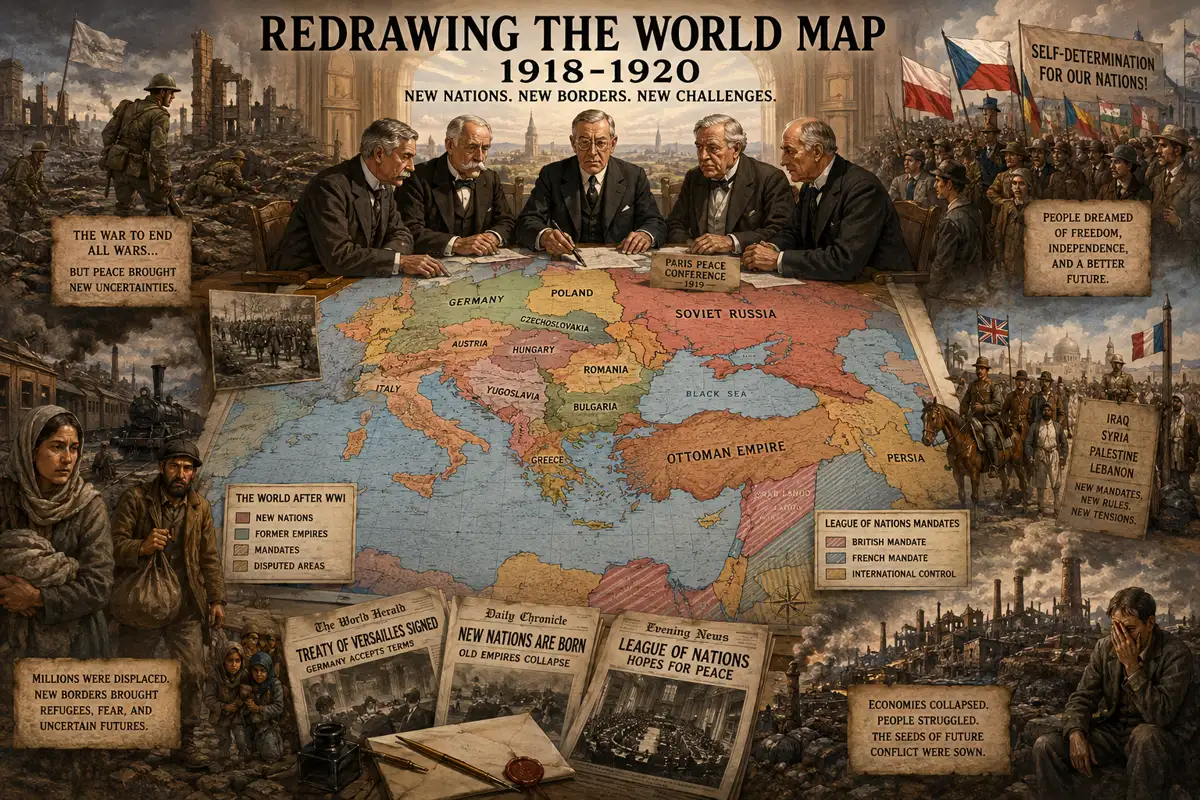
New Nations and Remembrance
- Declaration of Independence of the Czechoslovak Nation by its Provisional Government Given in Paris, 18 October 1918, signed by Masaryk, Štefánik and Beneš; printed New York: Marchbanks Press for the Czechoslovak Arts Club, 1918A new nation declares itself, from exile, three weeks before the armistice: "We make this declaration on the basis of our historic and natural right. We have been an independent State since the seventh Century." Compare its language with the American Declaration of 1776.
- Report of the American Section of the International Commission on Mandates in Turkey (the King–Crane Report) Submitted by the commissioners Henry Churchill King and Charles Crane, Paris, 28 August 1919; Foreign Relations of the United States, The Paris Peace Conference, 1919, volume XII, document 380The American commissioners asked the people of Syria and Palestine what they wanted, and counted their petitions: "1157 petitions were received from O. E. T. A. East" alone. They report the propaganda and some fraudulent petitions too. The people's own wishes, as two outsiders recorded them.
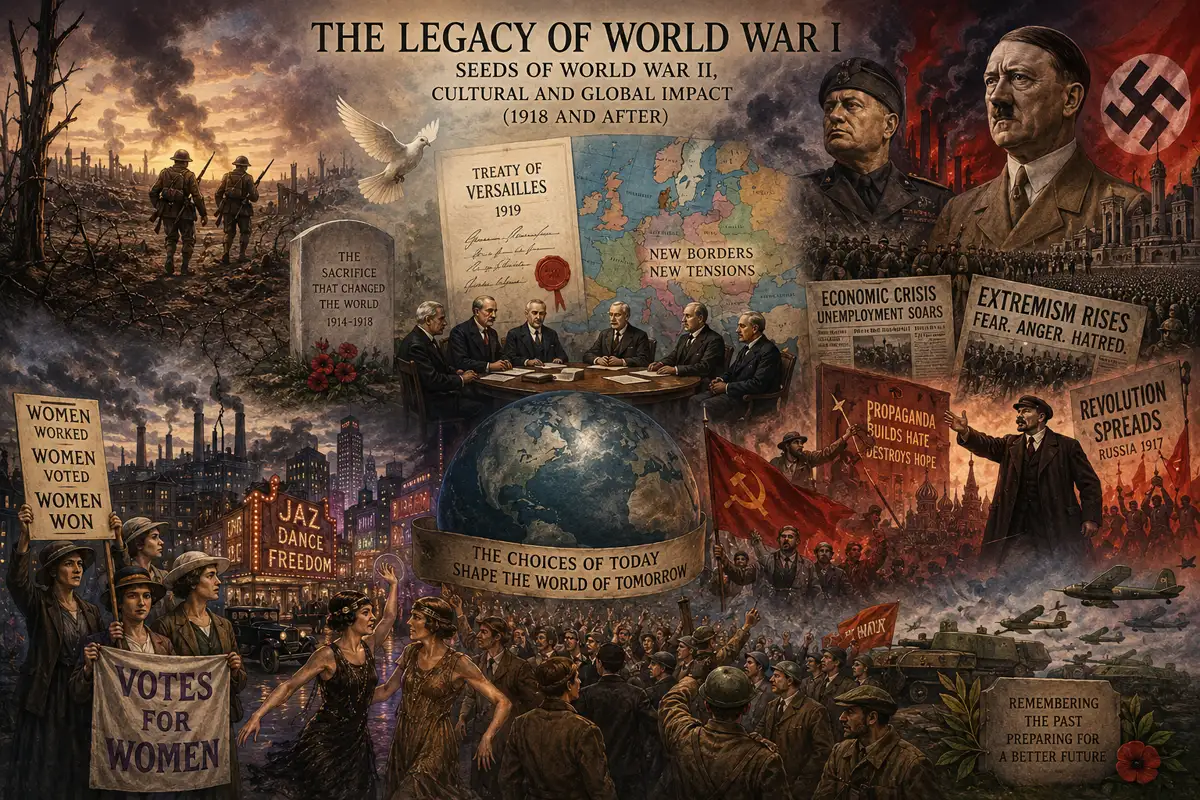
- John McCrae, In Flanders Fields, and Other Poems, with an Essay in Character by Sir Andrew Macphail New York edition of 1919 (the poem first printed in Punch, 8 December 1915)The poem by a Canadian army doctor that made the poppy the flower of remembrance, as Punch first printed it on 8 December 1915: "In Flanders fields the poppies blow" — "Between the crosses, row on row." Macphail's essay says it "first appeared in 'Punch' in the issue of December 8th, 1915." McCrae died at No. 3 General Hospital, Boulogne, on 28 January 1918.
What comes with the book
The Ultimate Guide
The textbook itself — the nineteen chapters these lessons are built from.
Living History
Heroes and Villains Series: World War I — Told By Those Who Were There. The Heroes & Villains series, in the first person.
The Adventure Box
Cards, lesson plans, activities, coloring pages and the craft kit for this era.