Adena c. 1000 BC – 200 AD; Hopewell c. 200 BC – 500 AD
What this chapter covers
In the Ohio and Mississippi valleys, people built earthworks on a scale that later settlers refused to believe Native Americans had built. The Adena came first, raising conical burial mounds. The Hopewell followed and went much further — enormous geometric enclosures, perfect circles and squares, embankments running for miles.
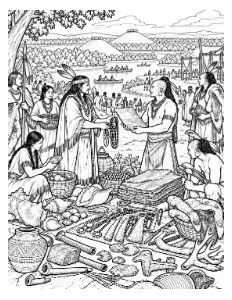
The Hopewell are best understood not as an empire but as an *interaction sphere*: a vast trade and ceremonial network. Obsidian from Yellowstone, copper from Lake Superior, mica from the Appalachians, shark teeth and conch from the Gulf — all of it converging on Ohio and turning up in burials.
Some Hopewell earthworks are aligned to the moon's 18.6-year cycle. Building that requires generations of patient observation, and it settles any question about whether these were sophisticated people.
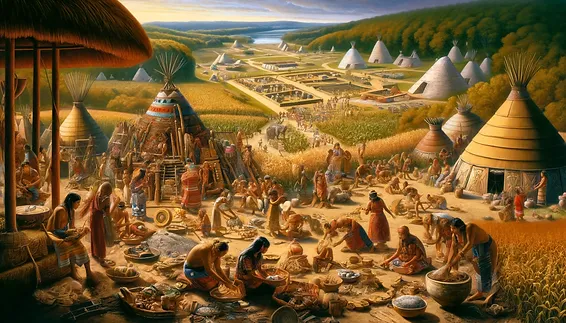
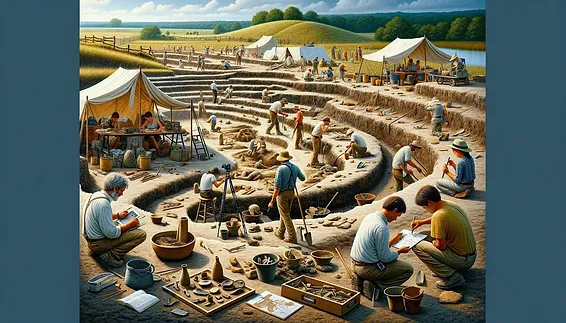
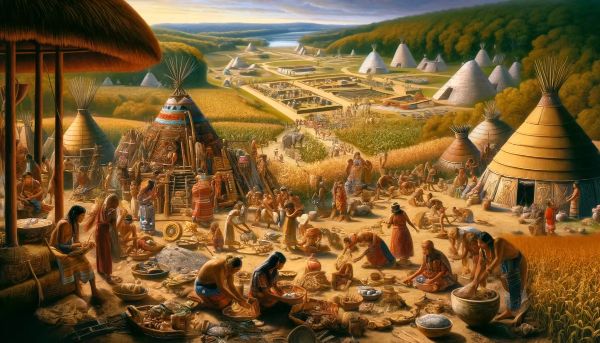
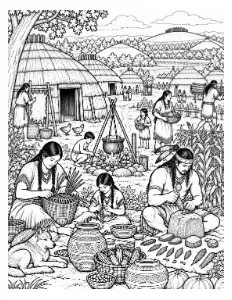
An Adena villageExcavating an Adena mound
Look for these
Trade networks without wheels, writing, or pack animals
While this was happening in the Americas, these were happening everywhere else.
The Iron Age
c. 1200 – 500 BC
The Zhou Dynasty in China
c. 1046 – 256 BC
The Greek Archaic Period
c. 750 – 480 BC
The Roman Empire
c. 27 BC – 476 AD
How to use this lesson. Read the chapter first — then work across the tabs in
order. The music hands you the era in a song, the subject matter expert puts a face to the
history, the reading takes you past the chapter, the video teaches it, the activity puts it
in your hands, and the exam at the end is how you check it stuck.
Read first
pages 65–74 —
The History of Ancient America: Ultimate Guide to Learning, the lesson plan and
activity book. This is where the activity on tab six comes from.
pages 40–57 —
Living History: Ancient America, Told By Those Who Were There, where the people
on the Subject Matter Expert tab tell it themselves.
The Music of This Era
Nothing sticks like a song. Written for this chapter, and worth having on while you do the activity.
Listen for the details. A specialist tells the story as someone who was there. The
things they mention in passing — what they ate, how they travelled, what they made, who
ruled them — are the details worth writing down.
Heroes & Villains — told in the first person
An Adena Priestess
An Adena priestess tells her story and her role in the tribe
0:00
What this video covers
An Adena priestess · Ohio Valley, c. 1000 BC – 200 AD not a specific person
Not a named woman — the Adena left no writing — but the role is drawn from what the burials show. The video is about ritual life and the mounds: who was buried in them, what went into the grave, and why a community with no kings would move that much earth by hand. Worth holding onto: the mounds were built in stages over generations, with new burials and new layers of earth added on top of the old, so a mound grew taller over many lifetimes.
More voices from this chapter
0:00
Kewa, a Hopewell trader, on his far-off expeditions
What this video covers
Kewa, a Hopewell trader · Ohio Valley, c. 200 BC – 500 AD not a specific person
Kewa is a character the book invented to walk a route we know existed. Hopewell burials contain obsidian from Yellowstone, copper from Lake Superior, mica from the Appalachians and shark teeth from the Gulf — with no wheels, no pack animals, no money and no writing. The video follows one of those journeys by river and trail, from the far places where the obsidian, copper and shells were gathered to the great earthwork centres of Ohio where they were buried.
These are from Living History: Ancient America, Told By Those Who Were
There, which carries the same accounts in print.
Beyond the chapter
Additional Reading
The earthworks of the Ohio and Mississippi valleys were measured, drawn and dug into by Americans from Thomas Jefferson onward, and the record they made explains who built them.
Excavating an Adena mound
European settlers moving into the Ohio Valley found tens of thousands of earthworks, some enormous and geometrically exact. Thomas Jefferson had already cut a trench through a burial mound near his home in Virginia, and recorded in his Notes on the State of Virginia (1781) the layers of bones inside it, laid down at different times. In 1848 Ephraim Squier and Edwin Davis published Ancient Monuments of the Mississippi Valley, the first book of the new Smithsonian Institution, with careful survey drawings of the Ohio works. Through the nineteenth century some writers claimed the mounds had been raised by a vanished people from overseas. In 1894 Cyrus Thomas, whose teams had surveyed thousands of mounds for the Smithsonian, published his report: the mounds had been built by the ancestors of the American Indians.
At Newark, Ohio, the earthworks enclose an area that could hold four Roman Colosseums. The Octagon there is aligned to the northernmost rising of the moon in its 18.6-year cycle. Building that alignment required watching moonrise for a generation and recording it accurately enough to build on. The Newark works are now a UNESCO World Heritage Site, and for most of the twentieth century part of the Octagon was a golf course.
Hopewell burials contain obsidian from the Yellowstone region, copper from Lake Superior, mica from the southern Appalachians, silver from Ontario, shark teeth and whelk shells from the Gulf coast, and grizzly bear teeth from the Rockies. There were no wheels, no draft animals and no money. A hand cut from a sheet of mica in Ohio was made of stone that had travelled six hundred miles.
Four things worth knowing
The Great Serpent Mound in Ohio is about 411 metres long, shaped like a snake with a coiled tail and an open mouth. Its head points toward the summer solstice sunset.
Hopewell copper was cold-hammered, not smelted — beaten into sheets and cut into earspools, panpipes and falcon figures without any furnace.
The Adena and Hopewell were not empires. The names describe shared styles of burial, earthwork and craft across many communities.
Thousands of mounds were ploughed flat in the nineteenth century. For many, the survey drawings of Squier and Davis are all that remain.
Excavating an Adena mound
The Adena (about 1000 BC to AD 200) and the Hopewell (about 200 BC to AD 500) lived in the Ohio and Mississippi valleys. They built earthworks — mounds, walls and enclosures made of earth. Americans have been measuring, drawing and digging into these earthworks since Thomas Jefferson, and the record they made explains who built them.
Who built the mounds?
European settlers moving into the Ohio Valley found tens of thousands of earthworks. Some were enormous and geometrically exact. Thomas Jefferson had already cut a trench through a burial mound near his home in Virginia. In his Notes on the State of Virginia (1781) he recorded the layers of bones inside it, laid down at different times.
In 1848 Ephraim Squier and Edwin Davis published Ancient Monuments of the Mississippi Valley, the first book of the new Smithsonian Institution. It contained careful survey drawings of the Ohio works. Thousands of mounds were ploughed flat in the nineteenth century, and for many of them these drawings are all that remain.
Through the nineteenth century some writers claimed the mounds had been raised by a vanished people from overseas. Cyrus Thomas and his teams surveyed thousands of mounds for the Smithsonian. In 1894 he published his report: the mounds had been built by the ancestors of the American Indians.
Newark and the moon
At Newark, Ohio, the earthworks enclose an area that could hold four Roman Colosseums. The Octagon there is lined up with the northernmost rising of the moon in its 18.6-year cycle. To build that alignment, people had to watch moonrise for a generation and record it accurately enough to build on. The Newark works are now a UNESCO World Heritage Site. For most of the twentieth century, part of the Octagon was a golf course.
The Great Serpent Mound in Ohio is about 411 metres long, shaped like a snake with a coiled tail and an open mouth. Its head points toward the summer solstice sunset — the sunset on the longest day of the year.
Goods from far away
Hopewell burials contain obsidian (volcanic glass) from the Yellowstone region, copper from Lake Superior, mica from the southern Appalachians, silver from Ontario, shark teeth and whelk shells from the Gulf coast, and grizzly bear teeth from the Rockies. There were no wheels, no draft animals to pull loads, and no money. A hand cut from a sheet of mica in Ohio was made of stone that had travelled six hundred miles.
Hopewell copper was cold-hammered, not smelted. It was beaten into sheets and cut into earspools, panpipes and falcon figures without any furnace.
Not an empire
The Adena and Hopewell were not empires with one ruler. The names describe shared styles of burial, earthwork and craft across many communities.
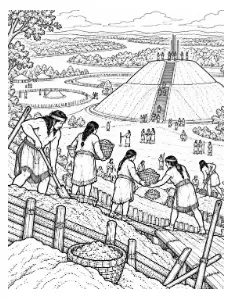
Excavating an Adena mound
Long ago, in the valleys of the Ohio and Mississippi rivers, people built great hills of earth called mounds. The Adena came first, and the Hopewell came after them. Many of their mounds are still standing today.
People in the village
Mound builders dug earth and carried it, basket by basket, to raise mounds and long earth walls.
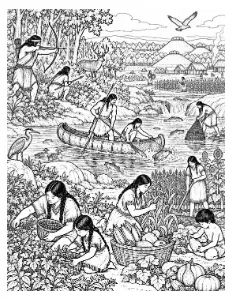
Hunters and fishers brought home deer, other animals and fish from the rivers.
Gardeners grew plants such as squash and sunflowers.
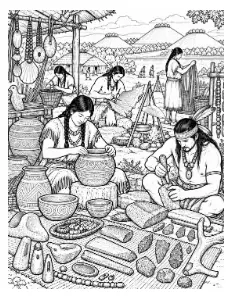
Potters shaped clay into pots.
Craftworkers hammered copper into thin sheets and cut shiny mica into shapes, such as a human hand.
Traders passed along special things from far away: copper from Lake Superior, shells and shark teeth from the Gulf of Mexico, and black glassy obsidian from the Yellowstone region.
Sky-watchers watched the moon and sun. At Newark, Ohio, one earthwork lines up with the moon at a special point in its long 18.6-year cycle.
Animals
Snakes — the Great Serpent Mound in Ohio is shaped like a snake with a curled tail.
Falcons — craftworkers cut falcon shapes out of copper.
Grizzly bears — their teeth came all the way from the Rocky Mountains.
Sharks — their teeth came from the Gulf coast.
Things they made
Burial mounds — round hills of earth where people were buried with special objects.
Earthworks — huge walls of earth in perfect circles, squares and even an eight-sided octagon.
Great Serpent Mound — longer than four football fields. Its head points toward where the sun sets on the longest day of summer.
Copper ear spools and panpipes — copper was hammered cold, without any furnace.
Mica hands — cut from a clear, shiny stone that travelled about six hundred miles to Ohio.
Long afterwards, Thomas Jefferson dug a trench through a mound in Virginia and wrote down the layers he saw inside. People have been studying the mounds ever since.
Where this comes from. Everything on this page is drawn from the records of the time —
letters, logs, chronicles, codices and laws — and from what excavations have found. Where a
fact rests on a single account, the page names it.
Living books for Week 1 — North America
Arctic peoples, Adena and Hopewell, Poverty Point, Great Basin, Plateau, and Northwest Coast cultures
The chapter taught on video — from the Adventure Box podcast series,
week 1 of Ancient America.
W2:D4 — The Adena and Hopewell cultures and their earthworks
🎧 Podcast episode — Coming soon
From the Ultimate Guide — pages 65–74
Activity
Hands-on work from The Ultimate Ancient America Lesson Plan and
Activity Book. Pick one — you do not need to do all of them.
Build a Model EarthworkAges 8–12
Using damp sand or modelling clay on a board, build a conical Adena burial mound and then a Hopewell geometric enclosure — a circle and a square of the same area, as the Hopewell often built. Measure them.
Why it is worth doing. Students discover the geometry problem the Hopewell solved, and that they solved it deliberately.
Objective
Provide students with modeling clay or playdough and encourage them to create miniature replicas of Adena or Hopewell earthworks.
Instructions
Show them pictures or diagrams of actual earthwork sites for inspiration.
Discuss the purpose and significance of these structures as students build their own versions.
Encourage creativity and attention to detail, and allow students to share their creations with the class.
Learning Outcome
Students discover the geometry problem the Hopewell solved, and that they solved it deliberately.
Trade Network MappingAges 10–15
On a map of North America, mark where Hopewell burial goods came from: obsidian from Yellowstone, copper from Lake Superior, mica from the Appalachians, shark teeth and conch from the Gulf. Draw the lines. Total the distance.
Why it is worth doing. Students grasp the scale of a trade network that had no wheels, no writing and no pack animals.
Objective
Have students research the trade networks of the Hopewell culture, and create visual maps or diagrams illustrating the exchange of goods across different regions.
Instructions
Provide them with historical maps, archaeological findings, and primary sources to inform their work.
Encourage students to identify key trade routes, trading hubs, and major commodities traded by the Hopewell people.
As a follow-up activity, facilitate a discussion about the economic, social, and cultural significance of trade networks in ancien t societies, and their relevance to modern globalization.
Learning Outcome
Students grasp the scale of a trade network that had no wheels, no writing and no pack animals.
The Monthly Adventure Box ships
the craft kit for this era, so most of these arrive with the materials already cut.
Activity journal
Write about doing this activity. What did you actually make or do? What surprised you? What was harder than you expected, and what would you do differently next time? Then say one thing about Adena and Hopewell Cultures that you understand better now than you did before you started.
Saved on this device as you type. Send to my parent account submits it to the
Xogos parent/teacher grade page — you can keep editing and send again.
Extra
Do not have the book with you? These cover the same chapter, free, on
our blog — read them on a phone at a kitchen table or in the back of a car.
8 questions drawn from a pool of 16, plus one to
write in your own words. Open book — you are meant to look things up.
How this one works. You get four attempts. Each retake takes 5 points off
the top, never more than 20 — so a perfect paper passes however many tries it took. The
pass mark is 80%, and passing is what opens the next chapter. Every attempt draws
a different paper.
Sign in to take the exam
Your attempts, your score and your place in the course are kept on your
account, so the exam needs to know who you are.