The Great Basin is dry, and the Plateau above it is cut by great rivers. Neither offered the abundance of the coast, and the cultures there answered that with the deepest environmental knowledge on the continent.
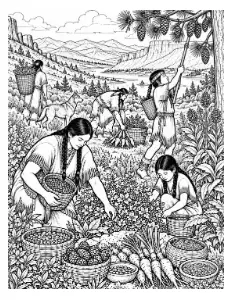
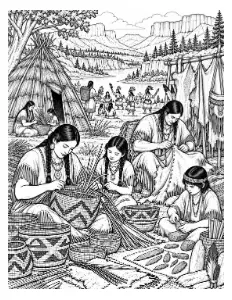
Great Basin peoples — Shoshone, Paiute, Ute, Washoe — moved in a seasonal round, timed to when particular plants ripened and particular animals could be taken. Piñon nuts, seeds and small game mattered more than big game. Their basketry is among the finest ever made anywhere, and it was a technology, not a craft: baskets woven tightly enough to hold water and to cook in with heated stones.
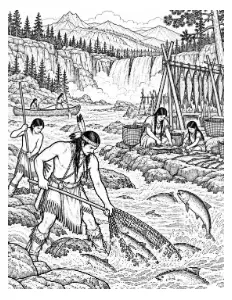
On the Plateau, the Nez Perce, Yakama, Spokane and their neighbours built life around the salmon rivers and the root grounds, and later became formidable horse peoples — the Nez Perce in particular famous for the horses they bred.
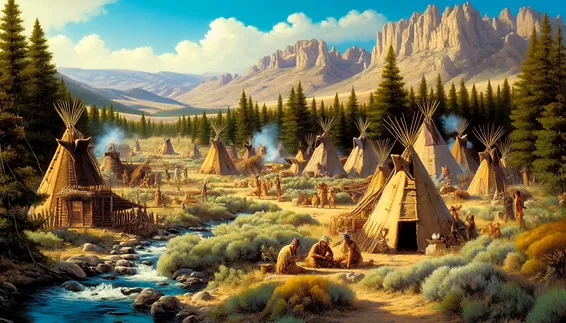
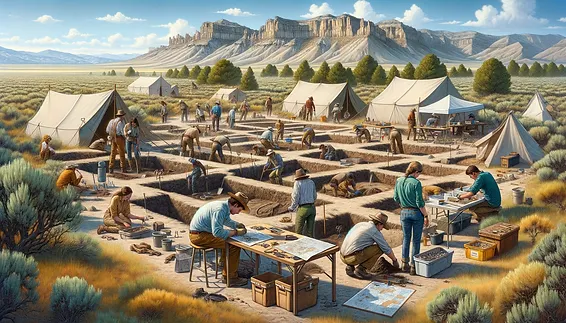
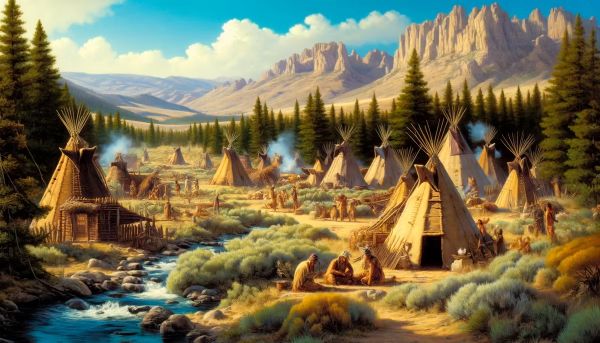
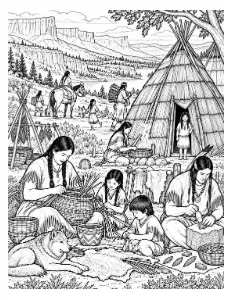
A Great Basin campExcavating a Great Basin site
Look for these
Knowledge as the main technology in a scarce environment
The seasonal round — reading a calendar written in plants
How the horse transformed a culture within a single lifetime
What this chapter teaches
Every member of the band had a role the others depended on
Who you will meet
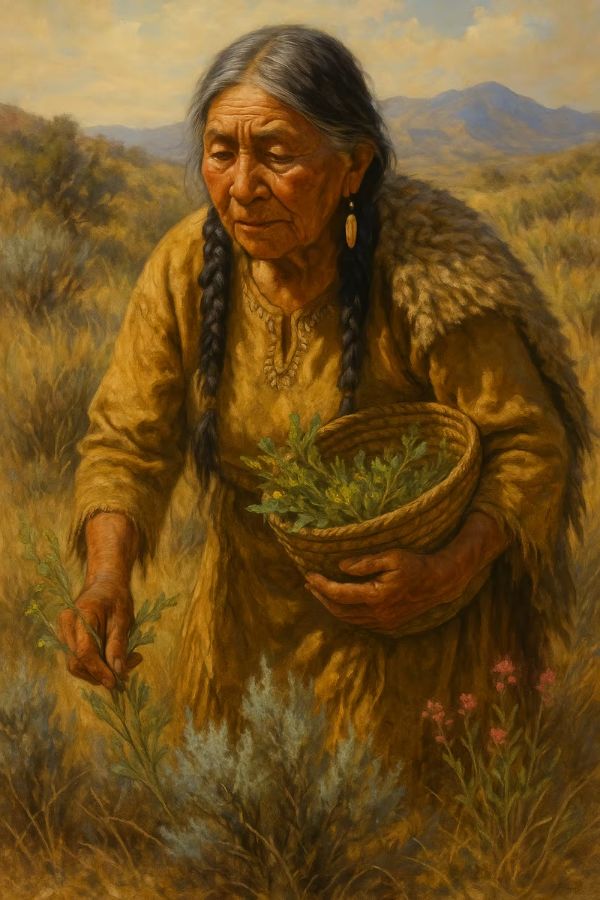
Women's rolesGathering, processing and the basketry that made storage possible
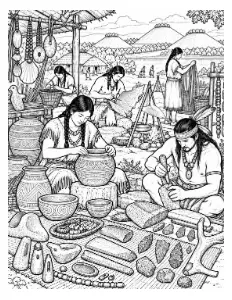
Men's rolesHunting, toolmaking and long-distance travel
While this was happening in the Americas, these were happening everywhere else.
Çatalhöyük, a town of mud-brick houses in Anatolia
c. 7400 – 6000 BC
Farming and herding begin in the Fertile Crescent
c. 9000 BC onward
Rice cultivation under way along the Yangtze in China
c. 7000 – 5000 BC
The Medieval Period
c. 500 – 1500 AD
How to use this lesson. Read the chapter first — then work across the tabs in
order. The music hands you the era in a song, the subject matter expert puts a face to the
history, the reading takes you past the chapter, the video teaches it, the activity puts it
in your hands, and the exam at the end is how you check it stuck.
Read first
pages 88–101 —
The History of Ancient America: Ultimate Guide to Learning, the lesson plan and
activity book. This is where the activity on tab six comes from.
pages 75–90 —
Living History: Ancient America, Told By Those Who Were There, where the people
on the Subject Matter Expert tab tell it themselves.
The Music of This Era
Nothing sticks like a song. Written for this chapter, and worth having on while you do the activity.
Listen for the details. A specialist tells the story as someone who was there. The
things they mention in passing — what they ate, how they travelled, what they made, who
ruled them — are the details worth writing down.
Heroes & Villains — told in the first person
Chief Winnemucca of the Northern Paiute
Chief Winnemucca on negotiating with the strangers arriving on Paiute land
0:00
Who they were
Chief Winnemucca · Northern Paiute, c. 1820–1882
A Northern Paiute leader of the Great Basin, in what is now Nevada and Oregon, and the father of Sarah Winnemucca. He led his people in the years when emigrant trails, mining towns and ranches spread across their land, and he met with U.S. officials many times on their behalf. In 1880 he travelled to Washington, D.C., with Sarah and his son Natchez to ask that their people be allowed to return to the Malheur Reservation in Oregon. Note the date. He speaks from the 1800s, while the rest of this chapter describes a way of life thousands of years old: the Great Basin peoples carried that desert knowledge into modern times. Listen for how his people used the land through the seasons.
More voices from this chapter
0:00
Sarah Winnemucca on the settlers pushing west, and writing the first book by a Native American woman
Who they were
Sarah Winnemucca · Northern Paiute, c. 1844–1891
The daughter of Chief Winnemucca and granddaughter of Captain Truckee. She spoke English and Spanish as well as Paiute, and served as an interpreter and scout for the U.S. Army during the Bannock War of 1878. She lectured in San Francisco and across the eastern states, and in 1883 published Life Among the Piutes: Their Wrongs and Claims, the first autobiography published by a Native American woman. In 1884 she opened a school near Lovelock, Nevada, where Paiute children were taught in their own language as well as in English. Listen for how she describes speaking for her people.
These are from Living History: Ancient America, Told By Those Who Were
There, which carries the same accounts in print.
Beyond the chapter
Additional Reading
In a dry land with little to spare, knowledge was the most important tool, and the peoples of the Great Basin and Plateau held a great deal of it.
Excavating a Great Basin site
A Great Basin family had to know, precisely, when the piñon nuts would ripen in a particular range of hills, how long the harvest would last before the cones opened and the nuts fell, and where else to go if it failed. Piñon produces a heavy crop only every few years, and not everywhere at once. Living by it meant carrying a map of hundreds of square miles and many years of harvests in the mind.
Their basketry was engineering. A water bottle was coiled tightly and sealed with piñon pitch, and would carry water across the desert. Cooking baskets were woven tight enough to hold water without any sealant, and food was boiled in them by dropping in stones heated in a fire. The Washoe weaver Dat So La Lee, also called Louisa Keyser, made baskets in the early twentieth century with more than thirty stitches to the inch, and they are now in museums across the United States.
On the Plateau the horse arrived in the early 1700s, and the Nez Perce became famous for their herds. Meriwether Lewis wrote in 1806 that their horses were of an excellent breed — lofty, elegantly formed, active and durable — and that they gelded their stallions with skill. The Appaloosa breed takes its name from the Palouse River country where the Nez Perce and their neighbours kept horses.
In 1877 bands of the Nez Perce, refusing to move onto a reservation, travelled some 1,170 miles in about three months with their families, elders and herds, fighting a series of battles with the pursuing army. At the Bear Paw Mountains in Montana, forty miles from Canada, Chief Joseph surrendered with the words recorded that day: "From where the sun now stands I will fight no more forever."
Four things worth knowing
Piñon nuts are rich in fat and store for months, which made them a staple for the winter.
Spirit Cave Man, found in Nevada, is about 10,600 years old and was buried wrapped in a woven mat, with moccasins on his feet.
Great Basin peoples made duck decoys from tule reeds with feathers attached. Examples found in Lovelock Cave are about 2,000 years old.
The camas bulb, a Plateau staple, has a poisonous relative, death camas. Children were taught to tell them apart by their flowers.
Excavating a Great Basin site
In a dry land with little to spare, knowledge was the most important tool. The peoples of the Great Basin — Shoshone, Paiute, Ute and Washoe — and of the Plateau — Nez Perce, Yakama, Spokane and their neighbours — held a great deal of it.
Reading the land
Great Basin families moved in a seasonal round: a yearly circuit timed to when particular plants ripened and particular animals could be taken. A family had to know, precisely, when the piñon nuts would ripen in a particular range of hills, how long the harvest would last before the cones opened and the nuts fell, and where else to go if it failed.
Piñon pines produce a heavy crop only every few years, and not everywhere at once. Living by them meant carrying a map of hundreds of square miles, and many years of harvests, in the mind. Piñon nuts are rich in fat and store for months, which made them a staple — a main food — for the winter.
On the Plateau, the camas bulb was a staple too. It has a poisonous relative, death camas, and children were taught to tell them apart by their flowers.
Baskets as engineering
Their basketry was engineering. A water bottle was coiled tightly and sealed with piñon pitch, and would carry water across the desert. Cooking baskets were woven tight enough to hold water without any sealant. Food was boiled in them by dropping in stones heated in a fire. The Washoe weaver Dat So La Lee, also called Louisa Keyser, made baskets in the early twentieth century with more than thirty stitches to the inch. They are now in museums across the United States.
Great Basin peoples also made duck decoys from tule reeds with feathers attached. Examples found in Lovelock Cave are about 2,000 years old. Spirit Cave Man, found in Nevada, is about 10,600 years old. He was buried wrapped in a woven mat, with moccasins on his feet.
The horse on the Plateau
On the Plateau the horse arrived in the early 1700s, and the Nez Perce became famous for their herds. Meriwether Lewis wrote in 1806 that their horses were of an excellent breed — lofty, elegantly formed, active and durable — and that they gelded their stallions with skill. The Appaloosa breed takes its name from the Palouse River country, where the Nez Perce and their neighbours kept horses.
1877
In 1877 bands of the Nez Perce refused to move onto a reservation. They travelled some 1,170 miles in about three months with their families, elders and herds, and fought a series of battles with the army that pursued them. At the Bear Paw Mountains in Montana, forty miles from Canada, Chief Joseph surrendered. His words were recorded that day: "From where the sun now stands I will fight no more forever."
Excavating a Great Basin site
The Great Basin is a dry land of deserts and mountains in the western United States. North of it is the Plateau, a high country cut by big rivers. The Shoshone, Paiute, Ute and Washoe lived in the Great Basin. The Nez Perce, Yakama and Spokane lived on the Plateau.
People in the band
Families moved through the year in a seasonal round, going wherever food was ready: nuts in one place, seeds in another, fish in the rivers.
Gatherers collected seeds, nuts, roots and berries, and ground seeds into flour on flat stones.
Basket weavers made baskets for carrying, storing and even cooking. The Washoe weaver Dat So La Lee put more than thirty stitches into every inch.
Hunters hunted deer, rabbits and birds with bows and spears. Sometimes many people worked together to drive animals toward the hunters.
Decoy makers made pretend ducks from reeds to bring real ducks close.
Horse breeders — the Nez Perce raised fine herds of horses.
Chiefs spoke for their people. Chief Joseph of the Nez Perce is one of the best known.
Animals
Rabbits and deer — for meat and skins.
Ducks — caught with the help of decoys.
Salmon — caught in the Plateau rivers.
Horses — they reached the Plateau in the early 1700s. The spotted Appaloosa is named after the Palouse River country.
Plants and things they made
Piñon nuts — rich, oily nuts from pine trees that kept for months and fed families through the winter.
Camas — a root with blue flowers, good to eat. It has a poisonous cousin, death camas, and children were taught to tell them apart by their flowers.
Water bottles — baskets coiled tight and sealed with sticky pine pitch, to carry water across the desert.
Cooking baskets — woven so tightly they held water. Hot stones from the fire were dropped in to boil the food.
Duck decoys — made of tule reeds with real feathers. Ones found in Lovelock Cave, Nevada, are about 2,000 years old.
Woven mats and moccasins — found with Spirit Cave Man in Nevada, who lived about 10,600 years ago.
In a dry land, knowing where and when to find food was the most important tool of all.
Where this comes from. Everything on this page is drawn from the records of the time —
letters, logs, chronicles, codices and laws — and from what excavations have found. Where a
fact rests on a single account, the page names it.
Living books for Week 1 — North America
Arctic peoples, Adena and Hopewell, Poverty Point, Great Basin, Plateau, and Northwest Coast cultures
The chapter taught on video — from the Adventure Box podcast series,
week 1 of Ancient America.
W2:D5 — The Great Basin, Plateau and Poverty Point cultures
🎧 Podcast episode — Coming soon
From the Ultimate Guide — pages 88–101
Activity
Hands-on work from The Ultimate Ancient America Lesson Plan and
Activity Book. Pick one — you do not need to do all of them.
Basket Weaving ActivityAges 8–14
Weave a small coiled basket from raffia, reed or paper strips. Try to make it tight enough to hold water — then discuss cooking with hot stones dropped into a watertight basket.
Why it is worth doing. Students learn that basketry here was a technology, not a craft: the basket was the cooking pot.
Objective
To help students understand the importance of basketry in the Great Basin and Plateau cultures, and to develop fine motor skills and creativity.
Materials Needed
Reed or raffia (easily obtainable from craft stores)
Scissors
Large beads (optional)
Instructional guides or examples of traditional basket patterns
Instructions
Introduction : Start by explaining the significance of basketry in these cultures. Show images or actual examples of traditional baskets, if available.
Preparation : Cut reed or raffia into manageable lengths (approximately 12-18 inches).
Basic Weaving Technique : Demonstrate the basic weaving technique, starting with a simple over-and-under pattern.
Learning Outcome
Students learn that basketry here was a technology, not a craft: the basket was the cooking pot.
Hunter-Gatherer Role-Playing GameAges 6–12
Assign each student a season and a territory. Using cards for plants and animals that are only available at certain times, plan a year's seasonal round. Anyone who arrives in the wrong place at the wrong time goes hungry.
Why it is worth doing. Students discover that mobility here was precise scheduling, not wandering.
Objective
To give students a hands-on understanding of the seasonal mobility and subsistence strategies of hunter-gatherer societies.
Materials Needed
Large outdoor space or gymnasium
Picture cards of different plants, animals, and natural resources
Baskets or bags for collecting resources
Maps showing seasonal migration patterns
Instructions
Introduction : Explain the concept of hunter-gatherer societies, and their seasonal mobility. Show a map of the Great Basin and Plateau regions, highlighting different ecological zones.
Role-Playing Setup : Divide students into small groups and assign each group a different "season," with corresponding resources (e.g., spring with wildflowers, summer with berries, fall with nuts).
Resource Collection : Scatter picture cards of plants, animals, and other resources around the designated area. Each group must "migrate" to different parts of the area to collect resources suitable for their season.
Discussion : After the activity, gather the students to discuss what resources they found, and how they might be used.
Learning Outcome
Students discover that mobility here was precise scheduling, not wandering.
Archaeological Dig SimulationAges 10–15
Bury objects in layers in a tub of sand. Excavate in levels, recording depth and position before removing anything, then interpret what the layers say about the order of events.
Why it is worth doing. Students learn that context, not the object, is what carries the information.
Objective
To introduce students to the field of archaeology and the process of uncovering historical artifacts.
Materials Needed
Sand or soil
Small artifacts or replicas (e.g., arrowheads, pottery shards, small baskets)
Brushes, trowels, and sifters
Grid markers and notebooks
Instructions
Introduction : Discuss the role of archaeologists in uncovering the history of ancient cultures. Explain the importance of sites like Danger Cave and Lovelock Cave.
Setup : Create a mock dig site, by burying artifacts in a sandbox or designated outdoor area. Mark the site with a grid system.
Excavation : Divide students into small groups, and assign each group a section of the grid. Provide them with tools, and instruct them on careful excavation techniques.
Recording Finds : Have students record their finds in notebooks, noting the location and possible use of each artifact.
Discussion : After the excavation, discuss what they found, and how these artifacts provide insights into the lives of the Great Basin and Plateau people. Extension : For older students (13-15 years), introduce more detailed recording methods, and discuss the importance of context and preservation in archaeology.
Learning Outcome
Students learn that context, not the object, is what carries the information.
Storytelling and Oral History SessionAges 6–12
Tell a short story around the group, each person repeating it and adding one detail. Compare the last version with the first, then discuss how oral tradition both preserves and changes.
Why it is worth doing. Students understand the strengths and limits of oral history as evidence.
Objective
To help students appreciate the oral traditions of the Great Basin and Plateau cultures, and develop their listening and storytelling skills.
Materials Needed
Traditional stories and legends from the Great Basin and Plateau cultures
Comfortable seating area
Drawing materials (optional)
Instructions
Introduction : Explain the importance of oral traditions in preserving the history and culture of indigenous people. Share a brief background on the Great Basin and Plateau cultures.
Storytelling : Read or tell traditional stories and legends from these cultures. Encourage students to listen carefully, and visualize the events.
Discussion : Discuss the themes and lessons of the stories. Ask students what they learned, and how these stories might have been used to teach important values.
Learning Outcome
Students understand the strengths and limits of oral history as evidence.
The Monthly Adventure Box ships
the craft kit for this era, so most of these arrive with the materials already cut.
Activity journal
Write about doing this activity. What did you actually make or do? What surprised you? What was harder than you expected, and what would you do differently next time? Then say one thing about Great Basin and Plateau Cultures that you understand better now than you did before you started.
Saved on this device as you type. Send to my parent account submits it to the
Xogos parent/teacher grade page — you can keep editing and send again.
Extra
Do not have the book with you? These cover the same chapter, free, on
our blog — read them on a phone at a kitchen table or in the back of a car.
8 questions drawn from a pool of 16, plus one to
write in your own words. Open book — you are meant to look things up.
How this one works. You get four attempts. Each retake takes 5 points off
the top, never more than 20 — so a perfect paper passes however many tries it took. The
pass mark is 80%, and passing is what opens the next chapter. Every attempt draws
a different paper.
Sign in to take the exam
Your attempts, your score and your place in the course are kept on your
account, so the exam needs to know who you are.