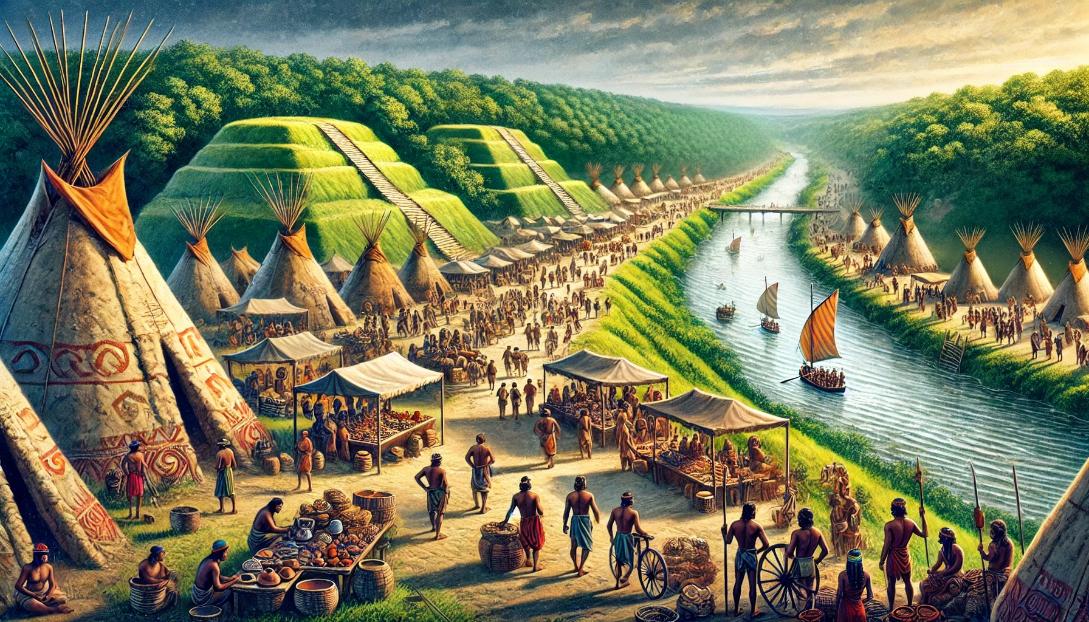
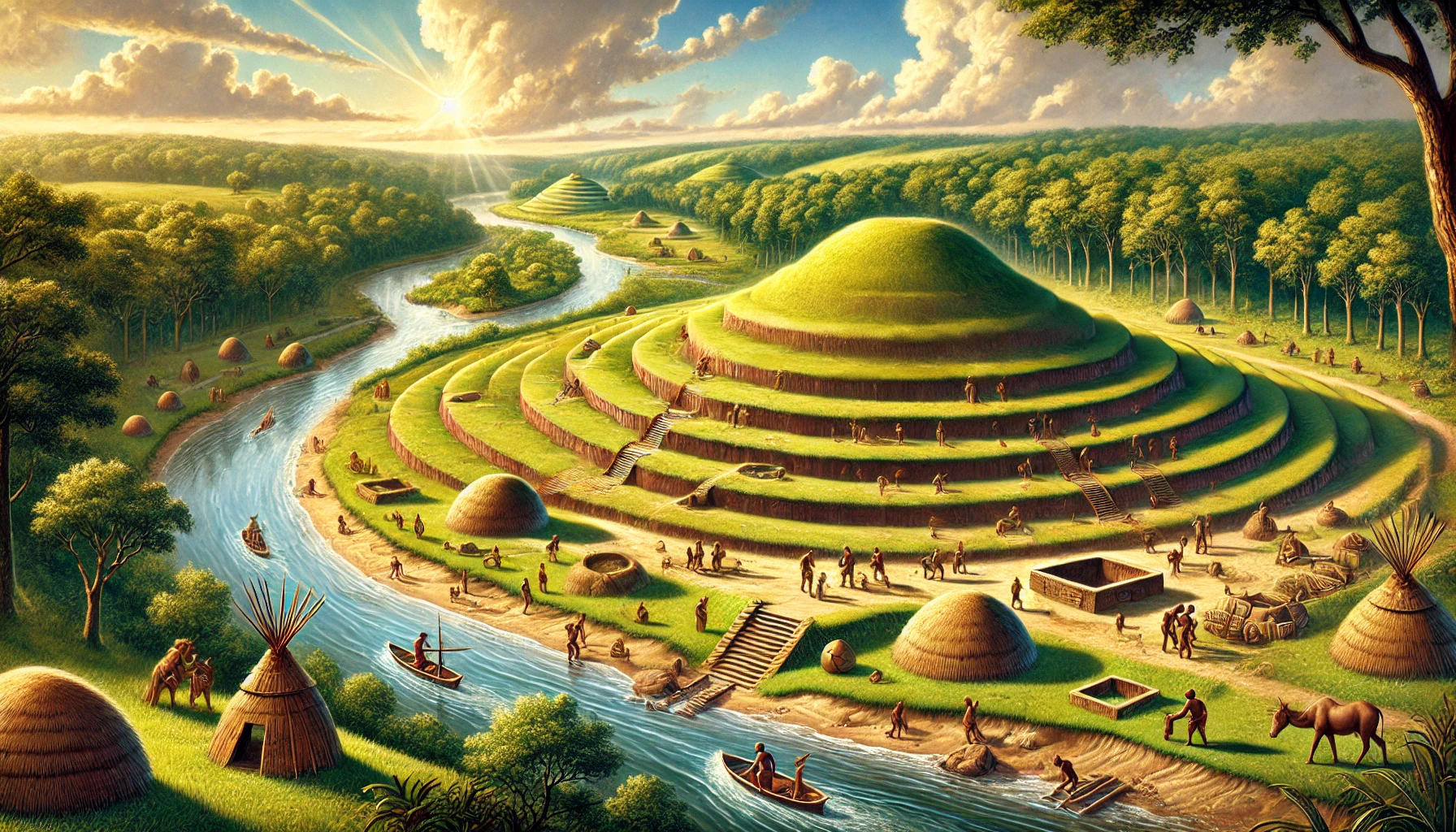
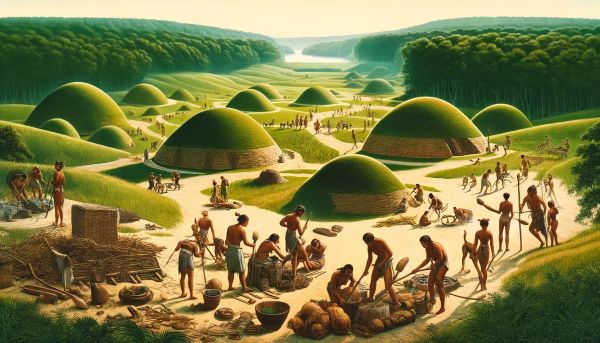
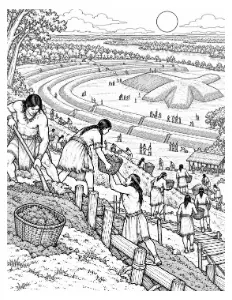
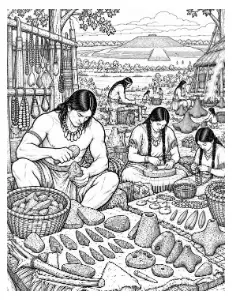
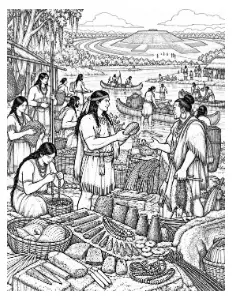
Poverty Point, in northeastern Louisiana, is one of the most surprising sites in the Americas. Around 1700–1100 BC, people built six enormous concentric earthen ridges in a half-circle, with mounds alongside — an estimated 750,000 to a million cubic yards of soil, carried basket by basket.
The surprise is who built it. Poverty Point was raised by hunter-fisher-gatherers, not farmers. It overturns the assumption that monumental construction has to wait for agriculture and a surplus.
Mound A appears to have been built in a matter of months, not generations — the soil layers show no weathering between them. Poverty Point is a UNESCO World Heritage Site, and it is roughly contemporary with the Egyptian New Kingdom.
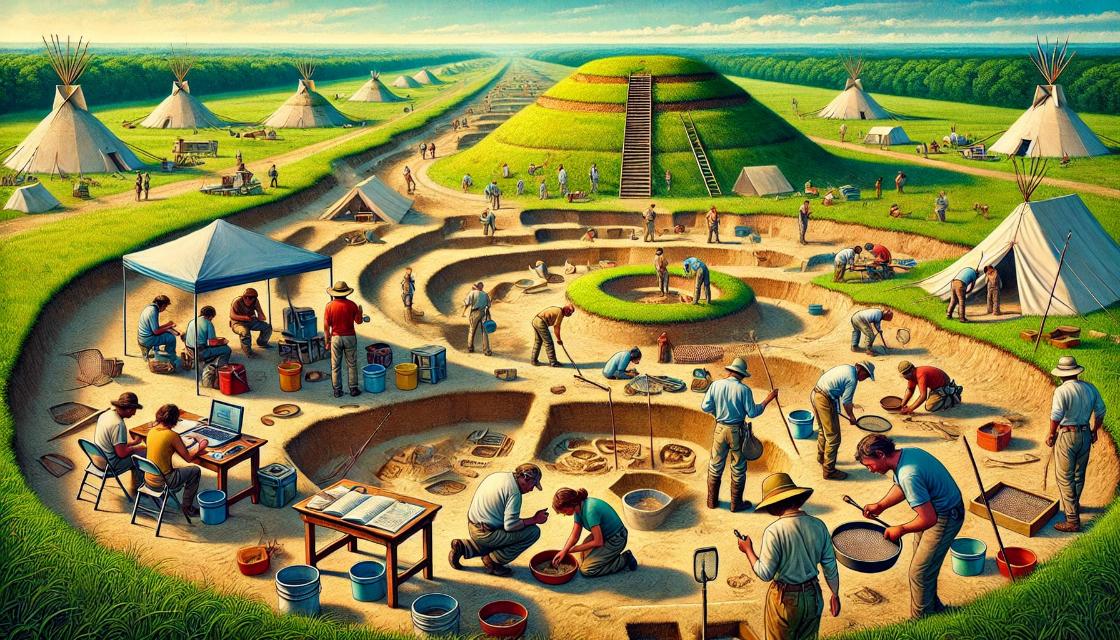
Poverty Point on the riverExcavating the Poverty Point ridgesThe great mound from the air
Look for these
Monumental building before agriculture
What a trade network looks like in the archaeological record
Reading how fast something was built from the dirt itself
What this chapter teaches
What a people can build before they farm
Trade as the engine of a culture
Who you will meet
The chief or paramount leaderWho could call a workforce together
Priests and spiritual leadersWho gave the earthworks their meaning
Trade leaders and merchantsWho brought stone from a thousand miles away
Master builders and engineersWho laid out the ridges
Female leaders and artisansWhose work fills the site
Words this chapter introduces
earthwork ridgesMound AUNESCO World Heritage SiteArchaic periodplummet
Meanwhile, elsewhere in the world
While this was happening in the Americas, these were happening everywhere else.
The late Harappan period in the Indus Valley
c. 1900 – 1300 BC
The Hittite Empire in Anatolia
c. 1650 – 1180 BC
The Shang Dynasty
c. 1600 – 1046 BC
Mycenaean Greece
c. 1600 – 1100 BC
Egypt, the New Kingdom
c. 1550 BC – 1077 BC
How to use this lesson. Read the chapter first — then work across the tabs in
order. The music hands you the era in a song, the subject matter expert puts a face to the
history, the reading takes you past the chapter, the video teaches it, the activity puts it
in your hands, and the exam at the end is how you check it stuck.
Read first
pages 102–116 —
The History of Ancient America: Ultimate Guide to Learning, the lesson plan and
activity book. This is where the activity on tab six comes from.
pages 91–107 —
Living History: Ancient America, Told By Those Who Were There, where the people
on the Subject Matter Expert tab tell it themselves.
The Music of This Era
Nothing sticks like a song. Written for this chapter, and worth having on while you do the activity.
Listen for the details. A specialist tells the story as someone who was there. The
things they mention in passing — what they ate, how they travelled, what they made, who
ruled them — are the details worth writing down.
Heroes & Villains — told in the first person
Tohni of the Poverty Point Culture
Tohni tells how he learned to be a great hunter
0:00
What this video covers
Tohni · Poverty Point culture, c. 1700–1100 BC not a specific person
Another invented character, and the video says so itself. The subject is learning to hunt in the lower Mississippi valley — an environment so rich in fish, birds and game that the people here built a monumental site without ever taking up farming, which is the thing that makes Poverty Point so difficult to explain. Listen for how much of hunting turns out to be patience and reading the ground, and how little of it is the spear.
More voices from this chapter
0:00
Ena on the knowledge he gained from his elders
What this video covers
Ena · Poverty Point culture, c. 1700–1100 BC not a specific person
A character rather than a person, carrying something real: how knowledge moved before writing. Everything Ena knows about which plants are food, which are medicine and which will kill you came from an elder who learned it the same way, and the chain runs back further than anyone can count. The video is about that inheritance. It is also the answer to a question this chapter raises — how people with no farming and no metal organised the largest earthworks in North America.
These are from Living History: Ancient America, Told By Those Who Were
There, which carries the same accounts in print.
Beyond the chapter
Additional Reading
Poverty Point was built by people who did not farm, and its soil shows how quickly and how carefully they built it.
Excavating the Poverty Point ridges
Poverty Point was raised between roughly 1700 and 1100 BC by people who fished, hunted and gathered in the rich river country of north-eastern Louisiana. They moved somewhere between 750,000 and a million cubic yards of earth — by hand, in baskets holding perhaps fifty pounds each. That is on the order of thirty million basket-loads.
Mound A is about 22 metres high and holds some 238,000 cubic metres of earth. When archaeologists cut into it, they looked for the signs of time passing between layers — weathering, root growth, soil washed by rain. There were none. The layers sit directly on one another, which shows the mound was built in one continuous effort; the archaeologists who studied it estimate a few months. That meant gathering and feeding thousands of workers at one place.
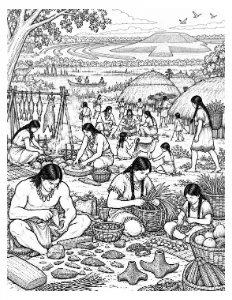
The site produced great quantities of Poverty Point Objects — balls of fired clay in several shapes, made because the region has almost no natural stone. Heated in a fire and dropped into a cooking pit, they cook food as hot stones would, and experiments show the different shapes hold and give off heat at different rates.
The stone that is there came from far away: galena from Missouri, copper from the Great Lakes, soapstone from the Appalachians, and quartz and novaculite from the Ouachita Mountains. Poverty Point sits near where six river systems come together, and the rivers were the roads that brought it.
Four things worth knowing
The six ridges form a C shape about 1.2 km across. Straightened end to end they would run roughly 12 km.
Poverty Point was named after a nineteenth-century plantation on the site. The builders' own name for it is not known.
It became a UNESCO World Heritage Site in 2014.
Fired clay cooking balls have been found there in the millions.
Excavating the Poverty Point ridges
Poverty Point, in northeastern Louisiana, was built by people who did not farm. The soil itself shows how quickly and how carefully they built it.
Builders who did not farm
Poverty Point was raised between roughly 1700 and 1100 BC by people who fished, hunted and gathered in the rich river country of northeastern Louisiana. Archaeologists estimate that they moved between 750,000 and a million cubic yards of earth, by hand, in baskets holding around fifty pounds each. That is on the order of thirty million basket-loads.
The six earthen ridges form a C shape about 1.2 km across. They are set one inside another, like the rings of a half-target, and each stands between 3 and 6 feet high. Straightened out end to end, they would run roughly 12 km.
Mound A
Mound A is about 22 metres high and holds some 238,000 cubic metres of earth. When archaeologists cut into it, they looked for signs of time passing between the layers: weathering, root growth, or soil washed by rain. There were none. The layers sit directly on one another. That shows the mound was built in one continuous effort, and the archaeologists who studied it estimate that it took a few months. Building it that way meant gathering thousands of workers in one place, and feeding them.
At its base Mound A measures about 710 by 660 feet. It is also called the Bird Mound, because from the air its shape resembles a bird in flight.
Cooking without stone
The site has produced great quantities of Poverty Point Objects. These are balls of fired clay in several shapes, made because the region has almost no natural stone. Heated in a fire and dropped into a cooking pit, they cook food the way hot stones would. Experiments show that the different shapes hold and give off heat at different rates. These cooking balls have been found there in the millions.
Stone from far away
The stone that is there came from far away: galena (a heavy, shiny lead ore) from Missouri, copper from the Great Lakes, soapstone from the Appalachians, and quartz and novaculite from the Ouachita Mountains. Poverty Point sits near where six river systems come together, and the rivers were the roads that brought it.
Much of that stone was worked on the site. Spear points of chert and jasper came from the Ouachita Mountains, the Ozarks and the Ohio River Valley. Copper was made into beads and small tools. Large numbers of plummets — stone weights, often of stone brought from elsewhere — have been found, which the book describes as used in fishing and weaving.
The name
Poverty Point was named after a nineteenth-century plantation on the site. The builders' own name for it is not known. It became a UNESCO World Heritage Site in 2014. It is roughly as old as the New Kingdom of ancient Egypt.
Excavating the Poverty Point ridges
Poverty Point is in northeastern Louisiana, near where six river systems come together. More than 3,000 years ago, people built giant earthworks there. They did not farm. They fished, hunted and gathered wild food — and still they built one of the biggest earth monuments in North America.
People at Poverty Point
Builders carried earth in baskets, one load after another, to raise the ridges and mounds.
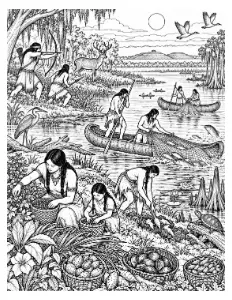
Fishers caught fish in the rivers and swamps nearby.
Hunters hunted deer, small animals and birds.
Gatherers collected wild plants, nuts and seeds.
Cooks heated clay balls in the fire and put them in cooking pits.
Traders brought in stone and metal from far away, because there is almost no stone near Poverty Point.
Crafters made beads and pendants from copper and other special stones.
Animals
Fish — an important food from the many waterways.
Deer — hunted for meat and skins.
Birds — hunted for food. Mound A is sometimes called the Bird Mound, because from above its shape reminds people of a bird.
Things they made
Six ridges — long, low earth rings that form a giant C shape about 1.2 kilometres across.
Mound A — about 22 metres high. The layers inside it sit right on top of each other, which shows it was built all in one go. The archaeologists who studied it estimate it took just a few months.
Poverty Point Objects — balls of baked clay in different shapes, used like hot stones for cooking. They have been found by the millions.
Plummets — heavy stone weights, used for fishing and weaving.
Spear points and tools — made from stone that came from far-off mountains.
Treasures from far away
Copper from the Great Lakes.
Galena, a shiny grey stone, from Missouri.
Soapstone from the Appalachian Mountains.
The rivers were their roads. Today Poverty Point is a UNESCO World Heritage Site, a place the whole world has agreed to protect.
Where this comes from. Everything on this page is drawn from the records of the time —
letters, logs, chronicles, codices and laws — and from what excavations have found. Where a
fact rests on a single account, the page names it.
Living books for Week 1 — North America
Arctic peoples, Adena and Hopewell, Poverty Point, Great Basin, Plateau, and Northwest Coast cultures
The chapter taught on video — from the Adventure Box podcast series,
week 1 of Ancient America.
W2:D5 — The Great Basin, Plateau and Poverty Point cultures
🎧 Podcast episode — Coming soon
From the Ultimate Guide — pages 102–116
Activity
Hands-on work from The Ultimate Ancient America Lesson Plan and
Activity Book. Pick one — you do not need to do all of them.
Constructing Model EarthworksAges 8–12
Build the six concentric C-shaped ridges of Poverty Point in sand or clay. Then work out, from the real figures, how many basket-loads of earth it took — and how many people, for how long.
Why it is worth doing. Students turn an abstract 'million cubic yards' into a number of human beings.
Objective
This hands-on activity involves students creating miniature models of the Poverty Point earthworks, using clay or playdough.
Materials Needed
Clay or playdough
Cardboard base
Popsicle sticks (for shaping)
Reference images of Poverty Point mounds
Instructions
Introduction : Begin with a short presentation on Poverty Point, focusing on the earthworks' construction and purpose.
Model Building : Provide students with clay or playdough and a cardboard base. Show them how to shape the material into mounds and ridges, mimicking the layout of Poverty Point.
Discussion : As students work, discuss the significance of the mounds, and the possible reasons they were built. Encourage students to think about the effort and organization needed to create such structures.
Learning Outcome
Students will gain a tactile understanding of the Poverty Point earthworks and appreciate the complexity of ancient engineering.
Trade Network SimulationAges 10–14
Split into regional groups, each holding a different raw material. Trade to assemble a complete toolkit, with no group allowed to travel more than one region at a time.
Why it is worth doing. Students see why exchange networks form, and how goods travel further than any individual.
Objective
This interactive activity simulates the extensive trade networks of the Poverty Point culture.
Materials Needed
Small objects to represent trade goods (beads, stones, shells, etc.)
Map of ancient trade routes
Cards with information about different trade items and their origins
Instructions
Setup : Divide the class into small groups, each representing a different trading community. Distribute the trade goods and information cards to each group.
Trade Simulation : Have students trade their goods with other groups. Encourage them to negotiate and discuss why certain items are valuable.
Debrief : After the simulation, discuss what items were most sought after, and why. Relate the activity to how the Poverty Point people obtained materials from distant regions.
Learning Outcome
Students will understand the role of trade in the Poverty Point culture and how it facilitated the exchange of goods and ideas across vast distances.
Storytelling and Oral TraditionsAges 6–10
Invent and pass on an origin story for the earthworks, then compare versions.
Why it is worth doing. Students think about how a people explains its own monuments.
Objective
In this activity, students will listen to-and create their own-stories, inspired by the Poverty Point culture.
Materials Needed
Books or resources with stories from Native American cultures
Art supplies (paper, crayons, markers)
Recording device (optional)
Instructions
Storytelling Session : Read or tell a story inspired by the Poverty Point culture or other Native American traditions. Discuss the story's themes and characters.
Create a Story : Ask students to create their own stories, based on what they've learned about Poverty Point. They can illustrate their stories with drawings, or act them out in small groups.
Sharing : Allow students to share their stories with the class.
Learning Outcome
Students will develop an appreciation for oral traditions, and understand how stories can convey cultural values and historical knowledge.
Archaeological Dig SimulationAges 12–16
Excavate a prepared site in recorded layers, then write a short site report arguing what the evidence does and does not prove.
Why it is worth doing. Students practise the difference between evidence and interpretation.
Objective
This activity simulates an archaeological dig, giving students a hands-on experience of how archaeologists uncover and analyze artifacts.
Materials Needed
Sandbox or large container filled with sand or soil
Small tools (brushes, spoons, sieves)
Replica artifacts (pottery shards, beads, stones)
Notebooks for recording findings
Instructions
Setup : Bury the replica artifacts in the sandbox. Divide the students into small groups, each assigned a section of the dig site.
Excavation : Students use the tools to carefully excavate the artifacts. They should record their findings and observations in their notebooks.
Analysis and Presentation : After the dig, students analyze their artifacts and present their findings to the class, discussing what the artifacts might reveal about the Poverty Point culture.
Learning Outcome
Students will learn about archaeological methods, and the importance of careful analysis in uncovering historical information.
Cultural Artifacts CraftingAges 8–12
Make Poverty Point objects — the fired clay cooking balls the site is known for — and discuss what they were for.
Why it is worth doing. Students engage with an artifact whose purpose has to be reasoned out.
Objective
Students create their own versions of artifacts inspired by the Poverty Point culture, such as pottery, beads, or figurines.
Materials Needed
Clay or air-dry clay
Paint and brushes
Beads and string
Reference images of Poverty Point artifacts
Instructions
Introduction : Show examples of Poverty Point artifacts and discuss their significance.
Crafting : Provide materials for students to create their own artifacts. They can shape clay into pots or figurines, paint designs, or create bead jewelry.
Exhibition : Organize an exhibition where students display their creations and explain the inspiration behind them.
Learning Outcome
Students will develop a deeper connection to the Poverty Point culture, through creative expression and hands-on crafting.
The Monthly Adventure Box ships
the craft kit for this era, so most of these arrive with the materials already cut.
Activity journal
Write about doing this activity. What did you actually make or do? What surprised you? What was harder than you expected, and what would you do differently next time? Then say one thing about Poverty Point Culture that you understand better now than you did before you started.
Saved on this device as you type. Send to my parent account submits it to the
Xogos parent/teacher grade page — you can keep editing and send again.
Extra
Do not have the book with you? These cover the same chapter, free, on
our blog — read them on a phone at a kitchen table or in the back of a car.
8 questions drawn from a pool of 16, plus one to
write in your own words. Open book — you are meant to look things up.
How this one works. You get four attempts. Each retake takes 5 points off
the top, never more than 20 — so a perfect paper passes however many tries it took. The
pass mark is 80%, and passing is what opens the next chapter. Every attempt draws
a different paper.
Sign in to take the exam
Your attempts, your score and your place in the course are kept on your
account, so the exam needs to know who you are.