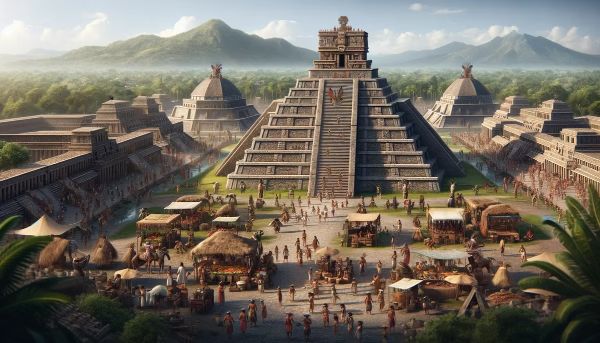
This chapter is the map before the detail: what Mesoamerica is, and what its civilizations shared. Mesoamerica runs roughly from central Mexico through Guatemala, Belize, and into Honduras and El Salvador — not a political unit, but a cultural region whose peoples shared a recognisable set of ideas across three thousand years.
The shared inheritance is specific: maize agriculture, the 260-day ritual calendar running alongside a 365-day solar year, stepped pyramids, the ballgame, a bar-and-dot number system including zero, screenfold books, and long-distance trade in obsidian, jade, cacao and quetzal feathers.
The usual sequence — Olmec, then Maya, then Aztec — is a simplification worth correcting early. These cultures overlapped, borrowed from each other, and were separated by enormous spans of time. More time separates the Olmec from the Aztec than separates the Aztec from us.
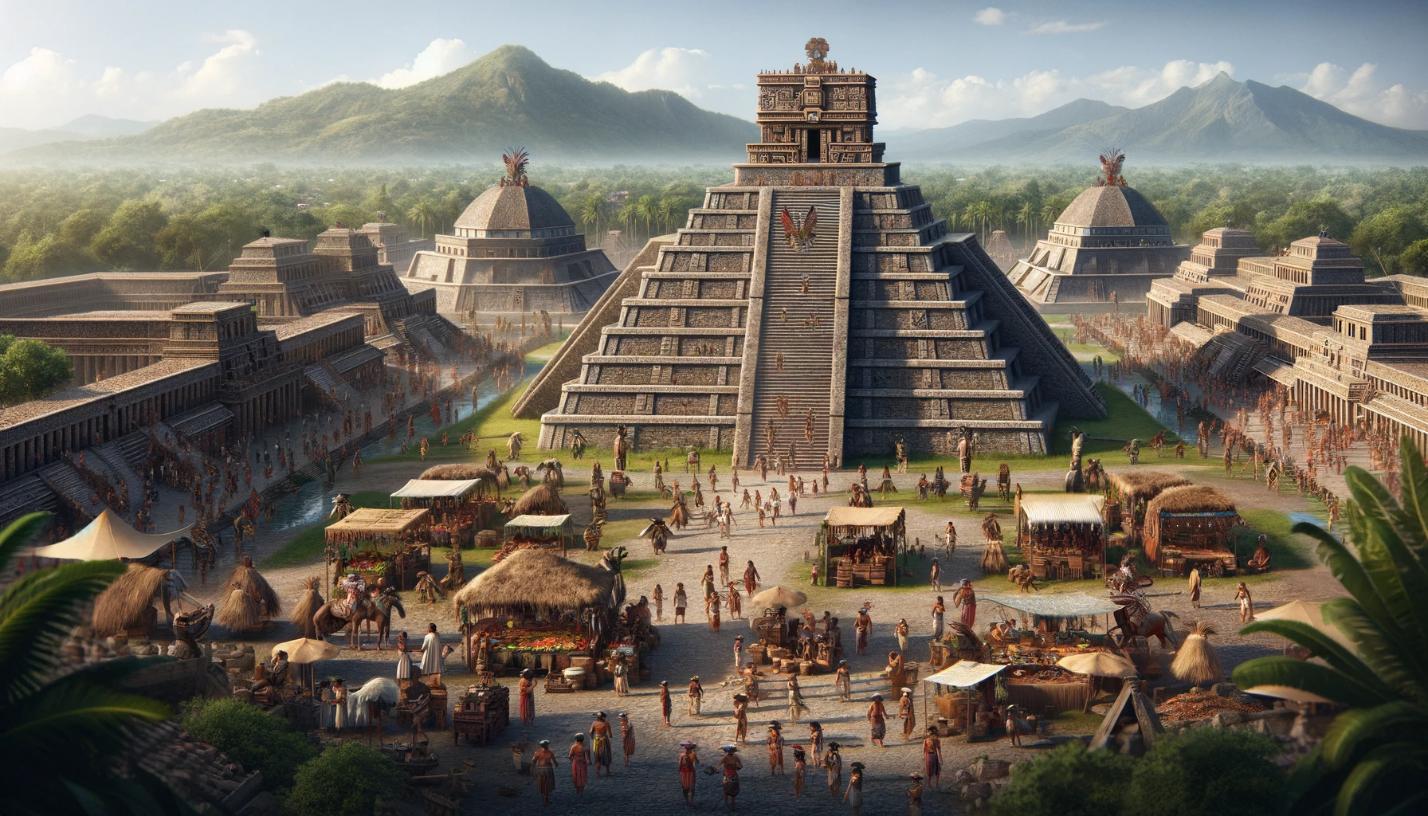
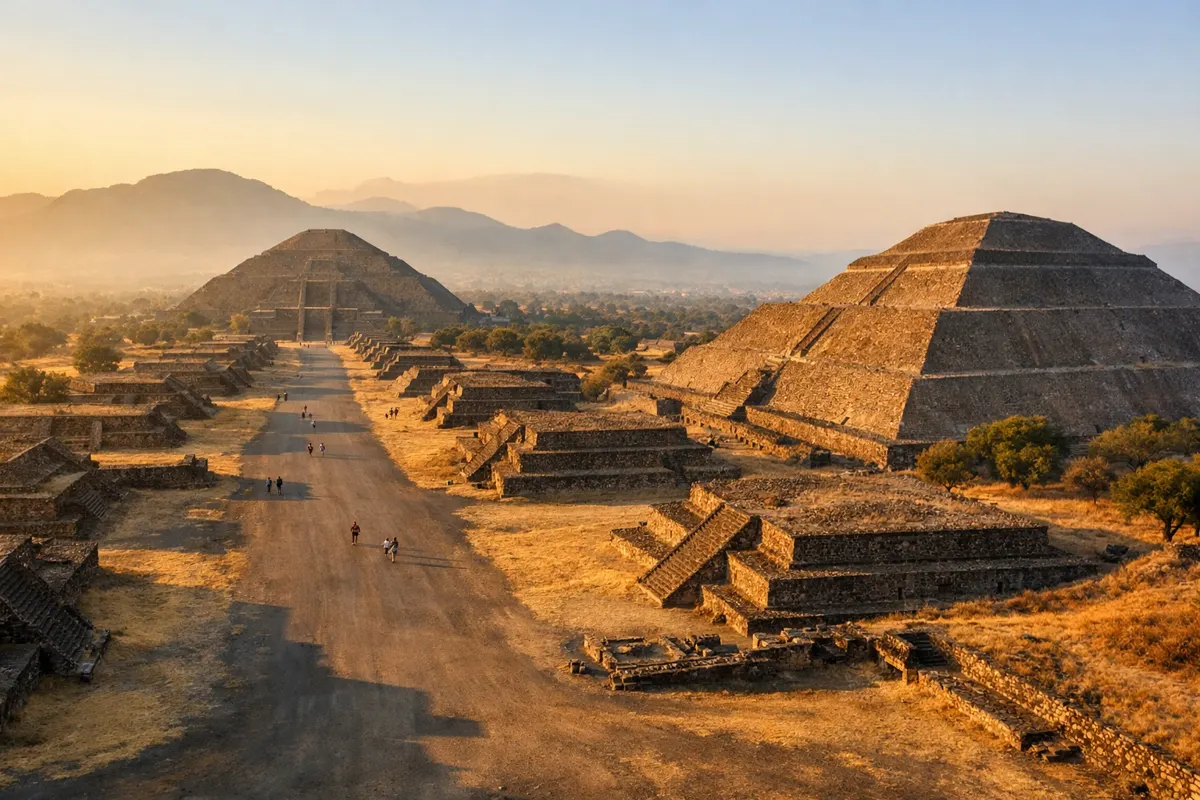
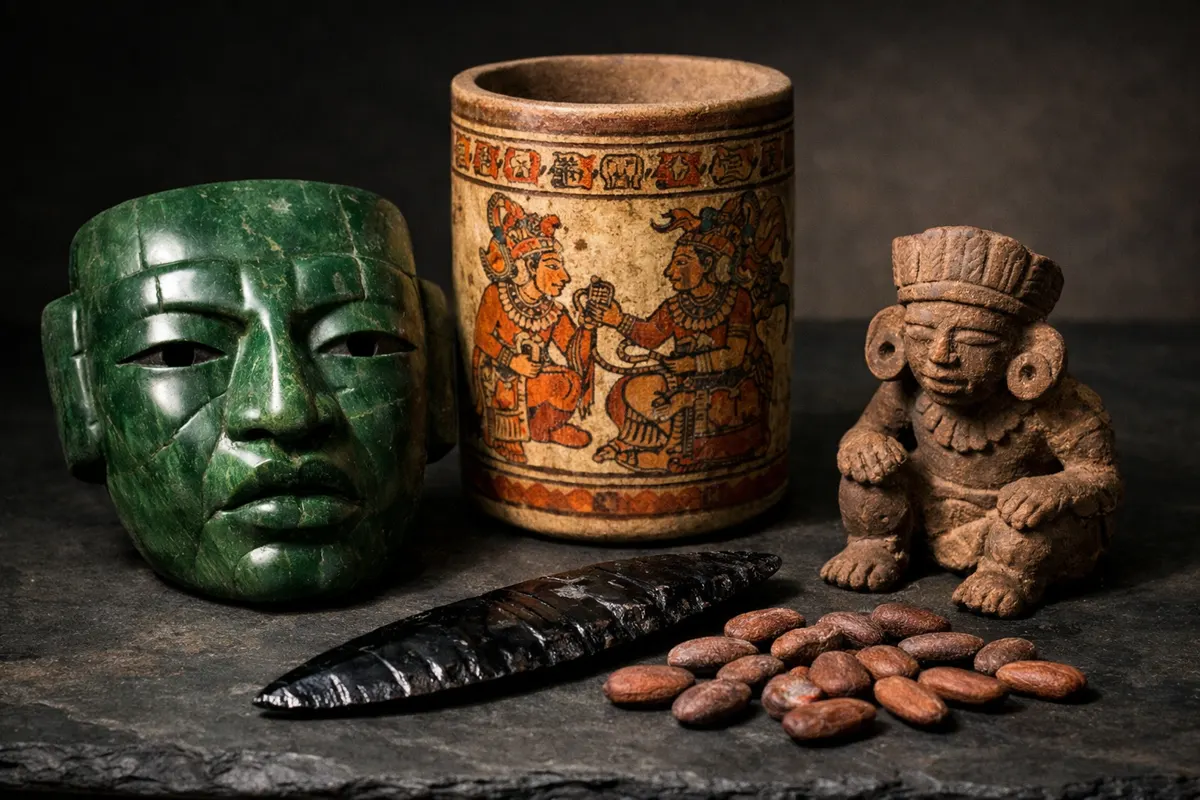
The monumental cities of MesoamericaTeotihuacan and the Avenue of the Dead todayJade, obsidian, painted pottery and cacao beans from Mesoamerica
Look for these
What makes a culture *area* rather than an empire
Ideas travelling further and lasting longer than any single state
The scale of time involved — and why the usual sequence misleads
What this chapter teaches
What the Mesoamerican cultures shared, and why that matters
While this was happening in the Americas, these were happening everywhere else.
The Shang Dynasty
c. 1600 – 1046 BC
Egypt, the New Kingdom
c. 1550 BC – 1077 BC
The Roman Empire
c. 27 BC – 476 AD
The fall of Constantinople
1453 AD
How to use this lesson. Read the chapter first — then work across the tabs in
order. The music hands you the era in a song, the subject matter expert puts a face to the
history, the reading takes you past the chapter, the video teaches it, the activity puts it
in your hands, and the exam at the end is how you check it stuck.
Read first
pages 117–118 —
The History of Ancient America: Ultimate Guide to Learning, the lesson plan and
activity book. This is where the activity on tab six comes from.
pages 159–175 —
Living History: Ancient America, Told By Those Who Were There, where the people
on the Subject Matter Expert tab tell it themselves.
The Music of This Era
Nothing sticks like a song. Written for this chapter, and worth having on while you do the activity.
Listen for the details. A specialist tells the story as someone who was there. The
things they mention in passing — what they ate, how they travelled, what they made, who
ruled them — are the details worth writing down.
Heroes & Villains — told in the first person
A leader of the Olmec people
An Olmec leader tells the story of their thriving civilization
0:00
What this video covers
An Olmec leader · Gulf coast, c. 1600–400 BC not a specific person
A composite — we cannot name a single Olmec, and "Olmec" is not even their word for themselves; it is an Aztec term for people who lived in that region two thousand years later. The video is an overview of the first Mesoamerican civilization and what it handed on: the ballgame, the calendar, the were-jaguar, pyramid-building, and possibly writing. Almost everything here comes from the objects they left — the colossal heads, the jade, the buried offerings — because there is no Olmec text that can be read.
These are from Living History: Ancient America, Told By Those Who Were
There, which carries the same accounts in print.
Beyond the chapter
Additional Reading
Before the individual civilizations, it is worth understanding what made Mesoamerica one cultural world, though it was never one state.
Teotihuacan and the Avenue of the Dead today
The first shared inheritance is maize. It was bred from a wild grass called teosinte, which looks nothing like corn: a handful of hard kernels in a brittle spike, each in a shell hard enough to break a tooth. Farmers in the Balsas River valley of Mexico began selecting it around 9,000 years ago, and over thousands of years turned it into the cob — one of the great feats of plant breeding in history, done without any written science.
Maize eaten alone can make people ill, because the body cannot use the niacin it contains. Mesoamerican cooks soaked and cooked the grain in water with lime or wood ash — nixtamalization — which releases the niacin, adds calcium, and makes the dough for tortillas. When maize was carried to Europe and Africa without the technique, the disease called pellagra followed it.
The second shared inheritance is the calendar. A 260-day ritual count runs alongside a 365-day solar year, and the two return to the same starting day together only once every 52 years — the Calendar Round. The Mexica marked its completion with the New Fire ceremony, putting out every fire in the land and kindling a new one on a hilltop at midnight.
Hold on to the timescale. About 2,700 years separate the height of the Olmec from the fall of the Aztec, and about 500 years separate the Aztec from us. The Aztec knew they were heirs of older peoples: excavations at their Great Temple have found Olmec masks and figures they buried there as offerings.
Four things worth knowing
Mesoamericans made wheels — on clay toys — but had no draft animals, so wheeled carts were never built.
Cacao beans were used as money. Spanish records list prices in cacao beans, and describe counterfeiters filling empty husks with earth.
Rubber was being made in Mesoamerica more than 3,000 years before Charles Goodyear, by mixing latex with the juice of the morning glory vine.
The oldest known ball court, at Paso de la Amada in Chiapas, is about 3,650 years old.
Teotihuacan and the Avenue of the Dead today
Mesoamerica runs roughly from central Mexico through Guatemala, Belize, and into Honduras and El Salvador. It was one cultural world, but it was never one state. Before studying each civilization, it helps to know what they all shared.
Maize
The first shared inheritance is maize, or corn. It was bred from a wild grass called teosinte, which looks nothing like corn. Teosinte has a handful of hard kernels in a brittle spike, each in a shell hard enough to break a tooth. Farmers in the Balsas River valley of Mexico began selecting it around 9,000 years ago. Over thousands of years, by choosing which seeds to plant, they turned it into the cob. It was one of the great feats of plant breeding in history, done without any written science.
Maize eaten alone can make people ill, because the body cannot use the niacin (a B vitamin) it contains. Mesoamerican cooks soaked and cooked the grain in water with lime or wood ash. This process is called nixtamalization. It releases the niacin, adds calcium, and makes the dough for tortillas. When maize was carried to Europe and Africa without the technique, the disease called pellagra followed it.
The calendar
The second shared inheritance is the calendar. A 260-day ritual count runs alongside a 365-day solar year. The two return to the same starting day together only once every 52 years. This cycle is called the Calendar Round. The Mexica (the Aztec) marked its completion with the New Fire ceremony: every fire in the land was put out, and a new one was kindled on a hilltop at midnight.
Other shared ideas
The book lists more that these peoples held in common: stepped pyramids, the ballgame, a bar-and-dot number system that included zero, screenfold books, and long-distance trade in obsidian, jade, cacao and quetzal feathers.
Mesoamericans made wheels — on clay toys — but had no draft animals, so wheeled carts were never built.
Cacao beans were used as money. Spanish records list prices in cacao beans, and describe counterfeiters filling empty husks with earth.
Rubber was being made in Mesoamerica more than 3,000 years before Charles Goodyear, by mixing latex (the sap of the rubber tree) with the juice of the morning glory vine.
The oldest known ball court, at Paso de la Amada in Chiapas, is about 3,650 years old.
Keep the timescale in mind
These cultures are often listed in a simple order — Olmec, then Maya, then Aztec — but they overlapped and were separated by enormous spans of time. About 2,700 years separate the height of the Olmec from the fall of the Aztec. About 500 years separate the Aztec from us. The Aztec knew they were heirs of older peoples: excavations at their Great Temple have found Olmec masks and figures that the Aztec buried there as offerings.
Teotihuacan and the Avenue of the Dead today
Mesoamerica is a big region that stretches from central Mexico through Guatemala and Belize into Honduras and El Salvador. It was never one country. But for thousands of years its peoples — the Olmec, the Maya, the Aztec and others — shared many of the same foods, ideas and games.
People in town and field
Farmers grew maize (corn), their most important food.
Cooks soaked and cooked the maize with lime or wood ash. This made it healthier and turned it into dough for tortillas.
Day-keepers knew the calendar. Their job was to know what day it was and what that day meant.
Ballplayers played a ball game with a heavy rubber ball on a long court.
Traders carried obsidian, jade, cacao beans and bright feathers over long distances.
Builders raised stepped pyramids that rise like giant staircases.
Writers painted books that fold up like an accordion, called screenfold books.
Animals and plants
Teosinte — a wild grass with a few hard kernels. Farmers slowly changed it, over thousands of years, into maize.
Cacao — the tree whose beans make chocolate. The beans were also used as money!
Morning glory vine — its juice was mixed with the milky sap of rubber trees to make bouncy rubber.
Quetzal — a bird whose long green feathers were a treasure.
There were no horses, oxen or other big animals to pull carts.
Things they made
Calendars — one count of 260 days ran beside a year of 365 days. The two lined up again only once every 52 years.
Rubber balls — made more than 3,000 years before rubber was made in Europe or the United States.
Ball courts — the oldest known one, at Paso de la Amada in Chiapas, Mexico, is about 3,650 years old.
Wheels — on little clay toys! With no animals to pull carts, they never built wheeled carts.
Obsidian blades — made from sharp volcanic glass.
The Aztec knew they came after older peoples. At their Great Temple, they buried Olmec masks and figures as special gifts.
Where this comes from. Everything on this page is drawn from the records of the time —
letters, logs, chronicles, codices and laws — and from what excavations have found. Where a
fact rests on a single account, the page names it.
The chapter taught on video — from the Adventure Box podcast series,
week 2 of Ancient America.
W3:D4 — A deep dive into MesoamericaMesoamerica and the Olmecs — promo podcast
🎧 Podcast episode — Coming soon
From the Ultimate Guide — pages 117–118
Activity
Hands-on work from The Ultimate Ancient America Lesson Plan and
Activity Book. Pick one — you do not need to do all of them.
Build a Mesoamerican Timeline WallAges 10–16
On a long strip of paper, place the Olmec, Maya and Aztec to scale, then add Egypt, Greece and Rome above them. Mark how many years separate the Olmec from the Aztec, and compare that with how long ago the Aztec were.
Why it is worth doing. Students correct the commonest misconception in this unit: that these were three consecutive peoples.
Objective
To put the Olmec, Maya and Aztec in the right order and at the right distance from one another, and from the ancient civilisations students already know.
Instructions
On a long strip of paper, place the Olmec, Maya and Aztec to scale.
Add Egypt, Greece and Rome above them on the same scale.
Mark how many years separate the Olmec from the Aztec, and compare that with how long ago the Aztec were.
Learning Outcome
Students correct the commonest misconception in this unit: that these were three consecutive peoples.
Play the Mesoamerican BallgameAges 8–14
Using a soft ball and no hands, keep it aloft with hips and forearms. Then read about the ballgame's ritual and political role.
Why it is worth doing. Students connect a sport to law, religion and diplomacy.
Objective
Students can recreate a simplified version of the ancient Mesoamerican ballgame, learning about its rules, significance, and the physical skills required.
Instructions
Explain the historical significance and basic rules of the ballgame.
Set up a makeshift court, in a gym or outdoor space.
Use a rubber ball and encourage students to use their hips to keep the ball in play.
Discuss the cultural and religious importance of the game.
Learning Outcome
Students gain a physical appreciation of the game, understanding its role in Mesoamerican culture and the athleticism it required.
The Monthly Adventure Box ships
the craft kit for this era, so most of these arrive with the materials already cut.
Activity journal
Write about doing this activity. What did you actually make or do? What surprised you? What was harder than you expected, and what would you do differently next time? Then say one thing about Major Ancient Civilizations in Mesoamerica that you understand better now than you did before you started.
Saved on this device as you type. Send to my parent account submits it to the
Xogos parent/teacher grade page — you can keep editing and send again.
Extra
Do not have the book with you? These cover the same chapter, free, on
our blog — read them on a phone at a kitchen table or in the back of a car.
8 questions drawn from a pool of 16, plus one to
write in your own words. Open book — you are meant to look things up.
How this one works. You get four attempts. Each retake takes 5 points off
the top, never more than 20 — so a perfect paper passes however many tries it took. The
pass mark is 80%, and passing is what opens the next chapter. Every attempt draws
a different paper.
Sign in to take the exam
Your attempts, your score and your place in the course are kept on your
account, so the exam needs to know who you are.