c. 750 BC – 1500s AD; Classic Period c. 250 – 900 AD
What this chapter covers
The Maya built the most complete writing system in the pre-Columbian Americas, and used it across hundreds of cities in the Yucatán, Guatemala, Belize and Honduras. Tikal, Palenque, Copán and Calakmul were not one empire but competing city-states, allied and at war with each other in shifting patterns.
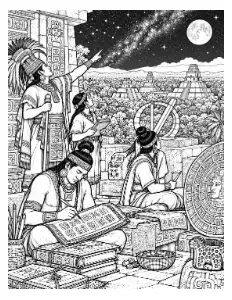
Maya astronomy was exact. The Dresden Codex follows the 584-day cycle of Venus and sets out tables for predicting eclipses, and the Long Count — a calendar that counts days continuously from a fixed starting point — fixes a date precisely across thousands of years.
Two things are worth knowing. First, the great southern lowland cities were abandoned around AD 900, but the Maya people were not — millions of Maya live in the region today and speak Mayan languages. Second, Diego de Landa burned the Maya books he found in 1562; only four survive, which is why reading the glyphs again took so long.
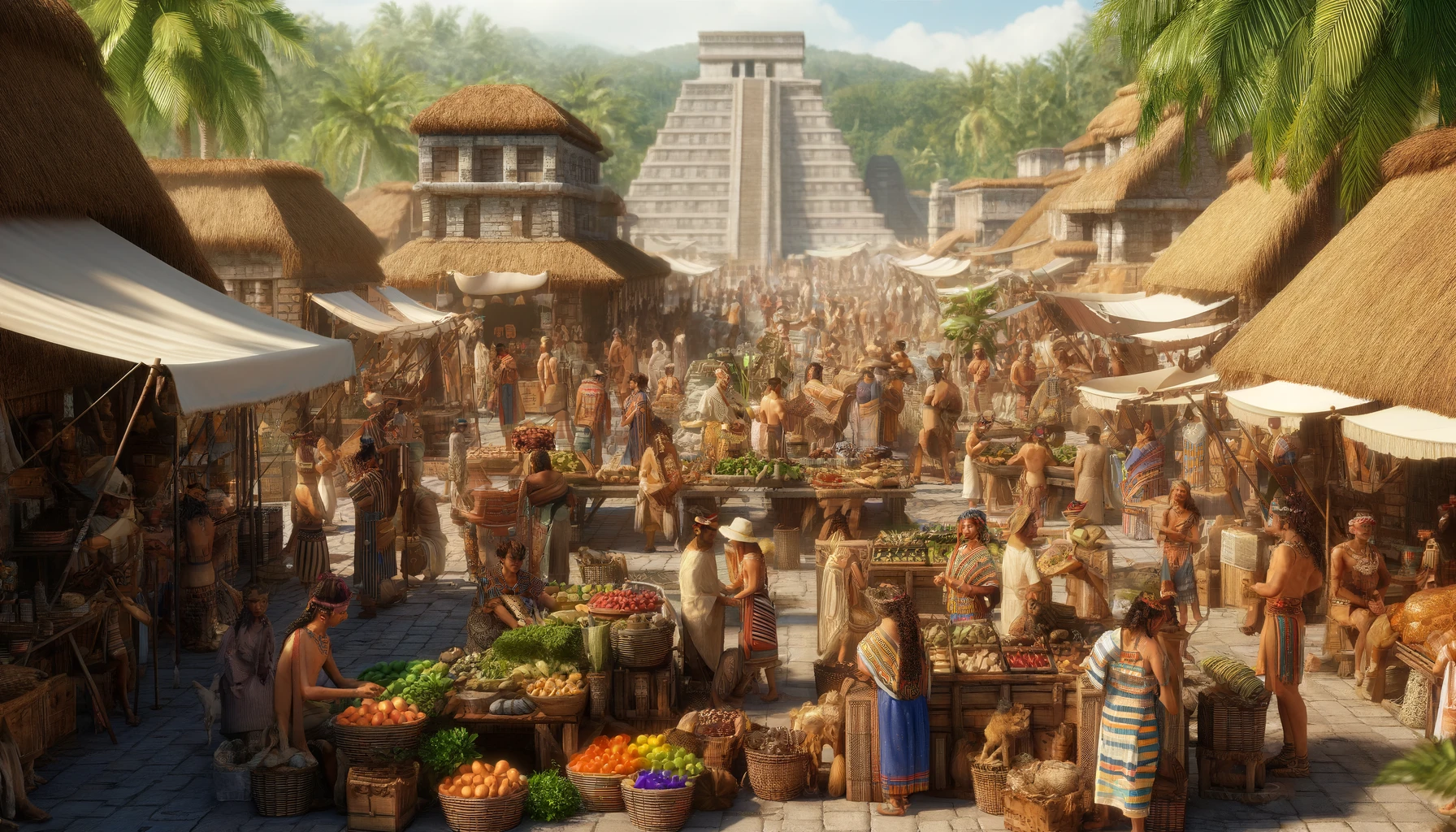
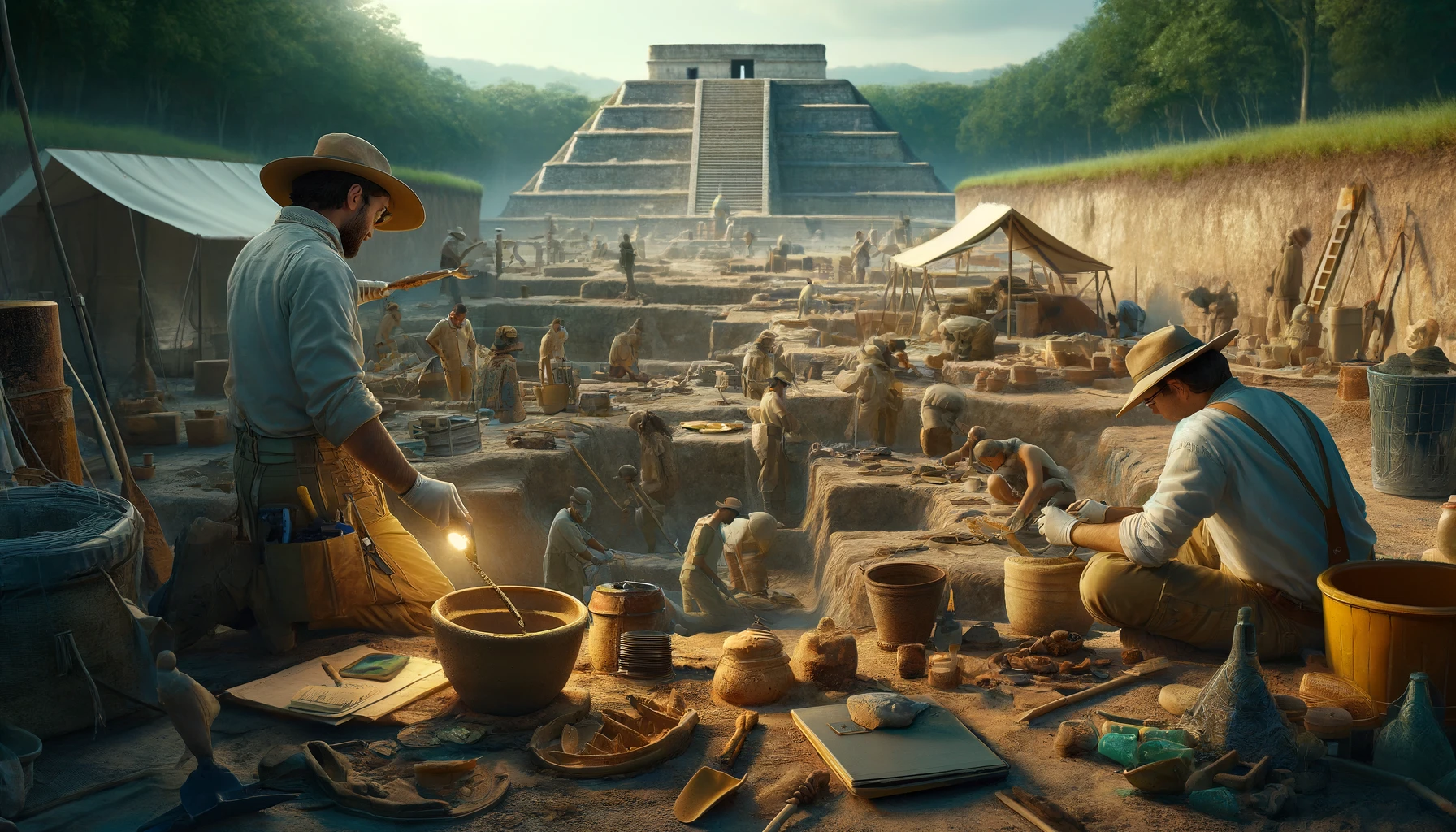
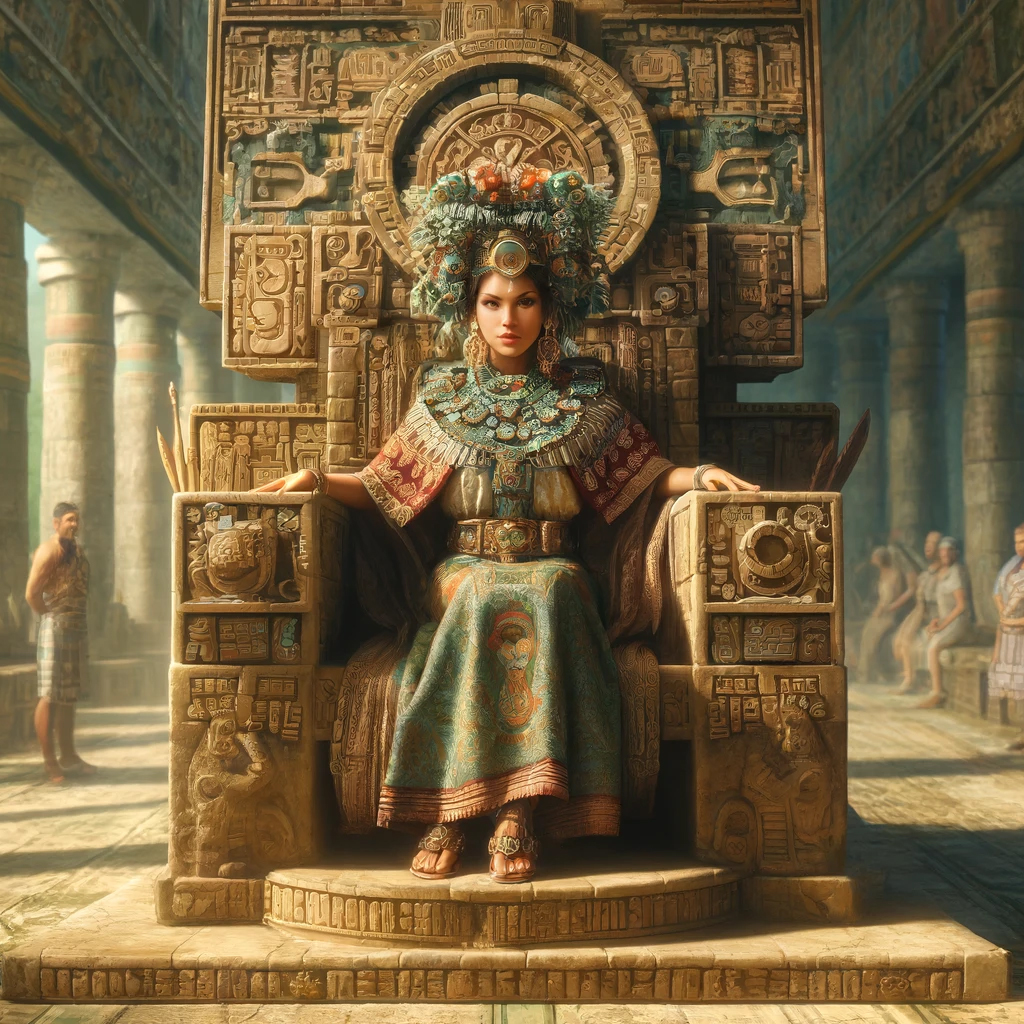
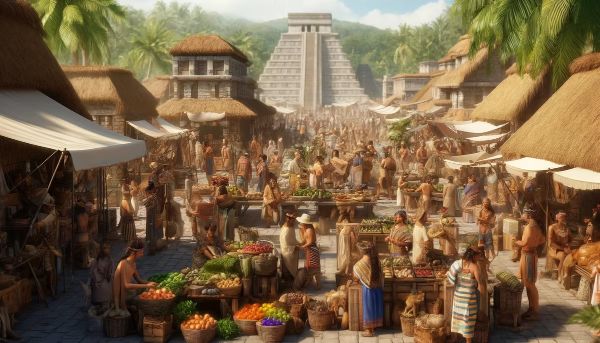
A Maya marketplaceExcavating a Maya siteLady Sak K'uk' of Palenque
Look for these
The only fully-developed writing system in the ancient Americas
How a script is lost and then recovered
"Collapse" — what actually ended, and what did not
What this chapter teaches
The importance of knowledge and learning
Environmental stewardship
Social and political organization
Cultural and artistic expression
Resilience and adaptability
Who you will meet
Lady Sak K'uk'Queen of Palenque, who held the throne and passed it to her son Pakal
Words this chapter introduces
Long CountglyphstelaTikalPopol VuhDresden Codexcity-state
Meanwhile, elsewhere in the world
While this was happening in the Americas, these were happening everywhere else.
The Greek Archaic Period
c. 750 – 480 BC
Rome founded, as the Romans dated it
753 BC
The Persian Empire
c. 550 – 330 BC
The Roman Republic and Empire
c. 509 BC – 476 AD
The Maurya Empire
c. 322 – 185 BC
The Byzantine Empire
c. 330 – 1453 AD
How to use this lesson. Read the chapter first — then work across the tabs in
order. The music hands you the era in a song, the subject matter expert puts a face to the
history, the reading takes you past the chapter, the video teaches it, the activity puts it
in your hands, and the exam at the end is how you check it stuck.
Read first
pages 137–151 —
The History of Ancient America: Ultimate Guide to Learning, the lesson plan and
activity book. This is where the activity on tab six comes from.
pages 126–142 —
Living History: Ancient America, Told By Those Who Were There, where the people
on the Subject Matter Expert tab tell it themselves.
The Music of This Era
Nothing sticks like a song. Two songs for this chapter — one for the people, one for what became of them.
Echoes of the Jungle SkyEchoes of the Jade Kingdom — the fall of the Maya
Listen for the details. A specialist tells the story as someone who was there. The
things they mention in passing — what they ate, how they travelled, what they made, who
ruled them — are the details worth writing down.
Heroes & Villains — told in the first person
Lady Sak K'uk' of Palenque
A queen of the ancient Maya city of Palenque tells her story
0:00
Who they were
Lady Sak K'uk' · Queen of Palenque, ruled c. 612–615 AD
A Maya queen named in Palenque's own inscriptions. In 611 AD the kingdom of Calakmul attacked Palenque, and the city's inscriptions record the loss. Sak K'uk' ruled from 612 to 615 and then passed the throne to her son K'inich Janaab' Pakal, who was twelve years old. Pakal ruled for sixty-eight years and built the palace and the Temple of the Inscriptions, where he was buried; Sak K'uk' is shown beside him on the carved panels of the palace. Listen for how she kept the kingdom together for her son.
More voices from this chapter
0:00
Lady K'abel on ruling as a woman and a warrior leader
Who they were
Lady K'abel · Maya warrior queen of El Perú-Waka', c. 672–692 AD
A Maya queen of the city of El Perú-Waka' in Guatemala, and a princess of the Snake kingdom of Calakmul. She held the title Kaloomte', "Supreme Warrior", which ranked above that of her husband, King K'inich Bahlam II, and she is shown on Stela 34 holding a war shield. She ruled alongside her husband for about twenty years. In 2012 archaeologists found her tomb, identified by a small alabaster jar carved with her name. Listen for what her title meant.
0:00
Gonzalo Guerrero, shipwrecked among the Maya
Who they were
Gonzalo Guerrero · Spanish sailor among the Maya, c. 1511–1536
A Spanish sailor shipwrecked on the coast of Yucatán in 1511. He lived among the Maya, married Zazil Há, the daughter of a lord of Chetumal, took on Maya dress and customs, and became a war captain. When Hernán Cortés sent word for the Spanish survivors in 1519, Gerónimo de Aguilar went to Cortés, and Bernal Díaz del Castillo recorded Guerrero's reply: he had a wife and three children and would stay. A 1536 report from Honduras records that a Spaniard living among the Maya was killed there fighting with them. His children with Zazil Há are remembered in Mexico as some of the first mestizo children. Listen for why he chose to stay.
These are from Living History: Ancient America, Told By Those Who Were
There, which carries the same accounts in print.
Beyond the chapter
Additional Reading
The Maya wrote on stone, on painted pottery and in folding books. How their writing came to be read again, after four hundred years, is one of the great detective stories of the twentieth century.
Excavating a Maya site
In 1562 Bishop Diego de Landa gathered the books of the Maya at Maní and burned them. He wrote afterwards: "We found a large number of books in these characters and, as they contained nothing in which there were not to be seen superstition and lies of the devil, we burned them all, which they regretted to an amazing degree." Four books survive. Landa also wrote a long account of Maya life, with what he took to be an alphabet: he asked a Maya writer for the sign for each Spanish letter, and wrote down the answers.
For much of the twentieth century the leading Mayanist, Sir Eric Thompson, held that the glyphs recorded calendars, astronomy and religion, and did not spell out words by sound. In 1952 a Russian scholar, Yuri Knorozov, working in Moscow with a copy of Landa's list, showed that many of the signs stood for syllables — and that Landa's writer had given him the syllables that sounded like the names of Spanish letters.
In 1960 Tatiana Proskouriakoff, an architect and scholar at the Carnegie Institution, showed that the dates on the monuments of Piedras Negras fell into groups the length of a human life: a birth, an accession to the throne, anniversaries, and a death. The inscriptions were history. As more signs were read, they gave the names of kings and queens, their wars, alliances and captives, and the long rivalry between Tikal and Calakmul.
The Maya did not predict that the world would end in 2012. A cycle of the Long Count completed on 21 December 2012, as an odometer turns over, and Maya inscriptions refer to dates far beyond it. One at Palenque refers to a date in the year 4772.
Four things worth knowing
Maya blue, the pigment on their murals, has survived 1,200 years of jungle damp without fading. Its chemistry — indigo bonded into a clay mineral — was worked out in the 1960s.
The Maya used a sign for zero in their calendar centuries before zero reached Europe.
K'inich Janaab' Pakal ruled Palenque for 68 years, and his tomb inside the Temple of the Inscriptions was found in 1952.
About seven million Maya live today, speaking some 30 Mayan languages.
Excavating a Maya site
The Maya wrote on stone monuments, on painted pottery and in folding books called codices. Their writing uses signs called glyphs. For about four hundred years nobody could read them. How they came to be read again is one of the great detective stories of the twentieth century.
The books that were burned
In 1562 Bishop Diego de Landa gathered the Maya books at the town of Maní and burned them. He wrote afterwards that the books held nothing but "superstition and lies of the devil," so "we burned them all, which they regretted to an amazing degree." Only four Maya books survive today.
Landa also wrote a long account of Maya life. In it he set down what he took to be a Maya alphabet. He had asked a Maya writer to show him the sign for each Spanish letter, and he wrote down the answers. That list became the key to the whole puzzle.
Sounds, not just pictures
For much of the twentieth century the leading expert on the Maya, Sir Eric Thompson, held that the glyphs recorded calendars, astronomy and religion, and did not spell out words by sound. In 1952 a Russian scholar, Yuri Knorozov, working in Moscow with a copy of Landa's list, showed that many signs stood for syllables — sounds such as "ka" or "ba." He also showed what had happened at Maní: when Landa said a Spanish letter, the Maya writer had given him the syllable that sounded like the name of that letter.
The stones tell history
In 1960 Tatiana Proskouriakoff, an architect and scholar at the Carnegie Institution, studied the dates carved on the monuments of Piedras Negras. She saw that they fell into groups about as long as a human life: a birth, the day someone became ruler, anniversaries, and a death. The inscriptions were history — the stories of real people. As more signs were read, they gave the names of kings and queens, their wars, their alliances and their captives, and the long rivalry between the great cities of Tikal and Calakmul.
What about 2012?
The Maya did not predict that the world would end in 2012. The Long Count is a calendar that counts days one after another from a fixed starting point. One of its great cycles finished on 21 December 2012, the way a car's mileage counter rolls over to a new number. Maya inscriptions refer to dates far beyond it — one at Palenque names a date in the year 4772.
Four things worth knowing
Maya blue, the paint on their murals, has lasted 1,200 years of jungle damp without fading. It is made of indigo dye bonded into a clay mineral, which was worked out in the 1960s.
The Maya used a sign for zero in their calendar centuries before zero reached Europe.
K'inich Janaab' Pakal ruled Palenque for 68 years. His tomb inside the Temple of the Inscriptions was found in 1952.
About seven million Maya live today, speaking some 30 Mayan languages.
Excavating a Maya site
The Maya lived in the rainforests and hills of what are now southern Mexico, Guatemala, Belize and Honduras. They built many cities, such as Tikal, Palenque and Copán. Each city had its own ruler. About seven million Maya still live there today.
People and their jobs
The king ruled a city. Pakal became king of Palenque when he was a boy and ruled for 68 years.
The queen. Women could rule too. Lady Sak K'uk' held the throne of Palenque and passed it to her son, Pakal.
The scribe wrote with a brush, using picture-signs called glyphs. Scribes wrote on stone, on painted pots and in books.
The sky-watcher watched the Sun, the Moon and the planet Venus, and kept the calendars.
The carver cut pictures and writing into stone.
The farmer grew maize (corn), beans and squash to feed the city.
Animals
The jaguar is the big spotted cat of the rainforest. Maya kings wore jaguar skins, and some kings had "jaguar" in their names.
The quetzal is a bird with long, shining green tail feathers. Rulers wore its feathers in their tall headdresses.
Things they made
Pyramid temples are tall stone buildings with steps, and a small temple on top. Pakal was buried inside one, the Temple of the Inscriptions.
A stela is a tall carved stone that tells who the king was and what he did, with the dates.
A codex is a book of bark paper that folds up like a fan. Only four Maya books are left.
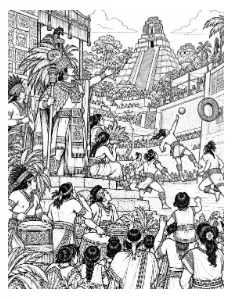
A ball court is a long, narrow court with sloping walls. Players hit a heavy rubber ball with their hips.
Maya blue is a bright blue paint. On old wall paintings it has stayed blue for 1,200 years.
Zero. The Maya had a sign for zero in their calendar, long before people in Europe used zero.
Where this comes from. Everything on this page is drawn from the records of the time —
letters, logs, chronicles, codices and laws — and from what excavations have found. Where a
fact rests on a single account, the page names it.
The chapter taught on video — from the Adventure Box podcast series,
week 2 of Ancient America.
W3:D2 — The Maya, one of the most advanced civilizations of their time
🎧 Podcast episode — Coming soon
From the Ultimate Guide — pages 137–151
Activity
Hands-on work from The Ultimate Ancient America Lesson Plan and
Activity Book. Pick one — you do not need to do all of them.
Create a Maya Hieroglyphic CodexAges 8–12
Fold paper accordion-style to make a screenfold book, then write a short account of your week using a handout of real Maya glyphs.
Why it is worth doing. Students understand what a codex physically is, and why only four survived.
Objective
Students can create their own Maya codex using hieroglyphic symbols.
Materials Needed
Paper Markers or colored pencils Examples of Maya hieroglyphs
Instructions
Introduce students to the Maya writing system and show examples of Maya codices.
Provide a handout with common Maya glyphs and their meanings.
Have students fold a piece of paper accordion-style to create pages.
Ask students to write simple sentences or stories using the glyphs and illustrate their codices.
Learning Outcome
Students will gain an understanding of Maya hieroglyphic writing and appreciate the complexity of ancient communication systems.
Construct a Maya Pyramid ModelAges 10–15
Build a stepped pyramid from cardboard or sugar cubes, studying photographs of Tikal and Palenque first. Note the temple on top and the stairway alignment.
Why it is worth doing. Students see that the structure is a platform for a building, not a tomb like Egypt's.
Objective
Students can build a model of a Maya pyramid using cardboard, clay, or sugar cubes.
Materials Needed
Cardboard or clay (or sugar cubes for a simple version) Glue Paints and brushes Ruler and scissors
Instructions
Show students pictures and diagrams of Maya pyramids.
Discuss the architectural features and significance of these structures.
Have students design and construct their own pyramid models using the materials provided.
Allow them to paint and decorate their pyramids to resemble ancient Maya temples.
Learning Outcome
Students will learn about Maya architectural techniques and the cultural significance of pyramids in Maya society.
Maya Astronomy and Calendar ActivityAges 12–16
Build interlocking paper wheels for the 260-day ritual round and the 365-day solar year. Turn them and find how long it takes before the same pair of dates recurs.
Why it is worth doing. Students derive the 52-year Calendar Round themselves instead of being told it.
Objective
Students can explore the Maya calendar system by creating their own calendar based on the Long Count calendar.
Materials Needed
Large paper or poster board Markers or pens Research materials on the Maya Long Count calendar
Instructions
Teach students about the Maya calendar system, focusing on the Long Count calendar. Provide resources for students to research the calendar's structure and significance. Have students create a large calendar on paper or poster board, marking important dates and explaining their relevance. Encourage students to present their calendars to the class, discussing what they learned.
Learning Outcome
Students will understand the complexity and accuracy of Maya astronomical and calendar systems, as well as their cultural importance.
Maya Cuisine Cooking ActivityAges 8–14
Make tortillas from masa, and drink unsweetened cacao as the Maya did. Discuss maize as both food and deity.
Why it is worth doing. Students connect a staple crop to a religion.
Objective
Students can learn about Maya culture by preparing traditional Maya foods such as tamales, tortillas, or hot chocolate.
Materials Needed
Ingredients for chosen recipes (corn masa, chocolate, etc.) Cooking utensils Recipe cards with historical context
Instructions
Introduce students to traditional Maya foods and their ingredients.
Provide recipe cards with instructions and historical context.
Guide students through the preparation of the chosen dishes, ensuring safety and supervision.
Discuss the significance of these foods in Maya culture while enjoying the prepared dishes.
Learning Outcome
Students will gain an appreciation for the culinary traditions of the Maya and understand the role of food in cultural identity.
The Monthly Adventure Box ships
the craft kit for this era, so most of these arrive with the materials already cut.
Activity journal
Write about doing this activity. What did you actually make or do? What surprised you? What was harder than you expected, and what would you do differently next time? Then say one thing about Mayan Civilization that you understand better now than you did before you started.
Saved on this device as you type. Send to my parent account submits it to the
Xogos parent/teacher grade page — you can keep editing and send again.
Extra
Do not have the book with you? These cover the same chapter, free, on
our blog — read them on a phone at a kitchen table or in the back of a car.
8 questions drawn from a pool of 16, plus one to
write in your own words. Open book — you are meant to look things up.
How this one works. You get four attempts. Each retake takes 5 points off
the top, never more than 20 — so a perfect paper passes however many tries it took. The
pass mark is 80%, and passing is what opens the next chapter. Every attempt draws
a different paper.
Sign in to take the exam
Your attempts, your score and your place in the course are kept on your
account, so the exam needs to know who you are.