In 1542 Francisco de Orellana's party became the first Europeans to travel the length of the Amazon, and his chaplain Gaspar de Carvajal recorded long stretches of villages along its banks. This chapter follows the peoples of north-eastern and Amazonian South America through that record and through what has since been found in the ground.
Terra preta, the dark earth found across the Amazon basin, is soil made by people: enriched with charcoal, pottery and household waste, and still fertile centuries later. Satellite and lidar surveys have revealed geoglyphs, causeways, raised fields and the remains of large settlements beneath the canopy.
The peoples here — Tupinambá, Arawak, Carib and many others — were also the first in South America to meet Europeans at length. Hans Staden's account of his captivity among the Tupinambá and the Jesuits' letters are vivid and detailed, and among the earliest written descriptions of these peoples.
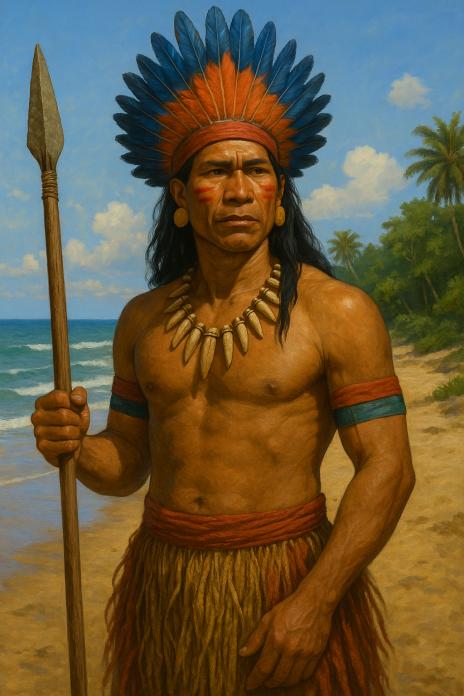
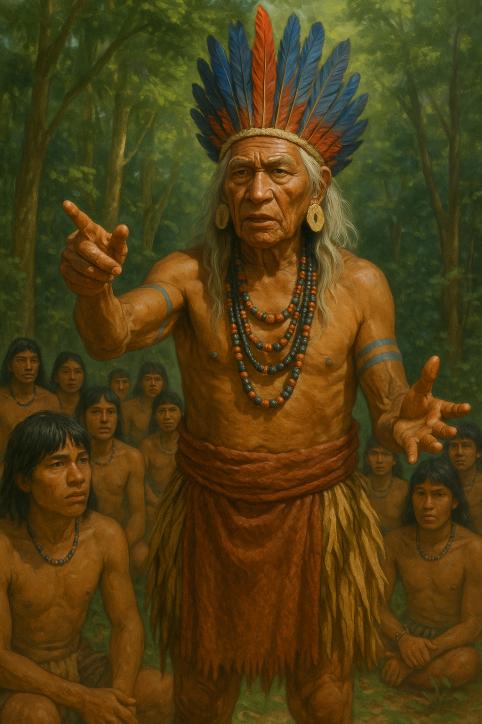
Chief Tabajara of the TupiChief Anhangá of the Guarani
Look for these
How a forest can hide the works of the people who lived in it
Terra preta — soil as a human invention
The first written accounts: Carvajal, Staden and the Jesuits
What this chapter teaches
The power of storytelling and oral tradition
Adaptability and resilience
Words this chapter introduces
terra pretaTupinambáArawakCaribgeoglyphlidarmanioc
Meanwhile, elsewhere in the world
While this was happening in the Americas, these were happening everywhere else.
The Roman Empire
c. 27 BC – 476 AD
The Kingdom of Ghana in West Africa
c. 830 – 1235 AD
The Ming Dynasty in China
1368 – 1644 AD
Columbus's first voyage
1492 AD
How to use this lesson. Read the chapter first — then work across the tabs in
order. The music hands you the era in a song, the subject matter expert puts a face to the
history, the reading takes you past the chapter, the video teaches it, the activity puts it
in your hands, and the exam at the end is how you check it stuck.
Read first
The Ultimate Guide does not cover this chapter — it goes straight from the Inca to the Caribbean. Everything for this one is in Living History.
pages 213–229 —
Living History: Ancient America, Told By Those Who Were There, where the people
on the Subject Matter Expert tab tell it themselves.
The Music of This Era
Nothing sticks like a song. Written for this chapter, and worth having on while you do the activity.
Nations of the Earth — indigenous cultures before European contact
Listen for the details. A specialist tells the story as someone who was there. The
things they mention in passing — what they ate, how they travelled, what they made, who
ruled them — are the details worth writing down.
Heroes & Villains — told in the first person
A chief of the Arawakan Lokono
A Lokono chief on his people and their dealings with neighbouring tribes
0:00
What this video covers
A chief of the Lokono · Arawakan people of the Guianas not a specific person
A representative chief rather than a named one. The Lokono are an Arawakan people of the Guianas and the Orinoco — coastal Guyana, Suriname, French Guiana and Venezuela — and they are still there. The video is about how they lived alongside their neighbours, which is the useful part: this region was never a set of isolated tribes but a network of peoples trading, intermarrying and fighting along the rivers. That network is why the Arawakan languages ended up spread from the Amazon to the Caribbean, and it is the same web the next chapters follow out to the islands.
These are from Living History: Ancient America, Told By Those Who Were
There, which carries the same accounts in print.
Beyond the chapter
Additional Reading
The first European to travel the whole Amazon wrote down what he saw in 1542. What has since been found in its soil and beneath its forest adds to his account.
Chief Anhangá of the Guarani
In 1542 Francisco de Orellana went down the Amazon from the Andes to the Atlantic, and his chaplain Gaspar de Carvajal wrote the account. He describes towns along the banks for many leagues, roads leading inland from the river, great stores of food, fine painted pottery, and warriors who came out against the boats in fleets of canoes. It was Carvajal who told of women who led the fighting, and the river was named after the Amazons of Greek legend.
Across the basin there are patches of deep black, very fertile soil called terra preta, often a metre or more deep and covering many hectares. It was made by people, over centuries, from charcoal, broken pottery, bone and household waste mixed into the poor red soil of the rainforest. The charcoal holds nutrients and does not break down. Terra preta made two thousand years ago is still more fertile than the ground beside it, and people dig it up and sell it as garden soil.
Lidar — laser pulses fired from aircraft, which slip through gaps in the canopy — lets the ground be mapped under the trees. In the Llanos de Mojos in Bolivia and the Upano valley in Ecuador, surveys have mapped raised fields, canals, causeways and platform mounds joined by straight roads. In Acre state in Brazil, where forest has been cleared, hundreds of geoglyphs have come to light: great ditched circles and squares, some hundreds of metres across.
On the Atlantic coast, the German gunner Hans Staden was captured by the Tupinambá in 1554 and lived among them for nine months before a French ship took him home. His True History of 1557, with its woodcuts, describes their villages, longhouses, hammocks, feasts and wars, and his own captivity, in detail.
Four things worth knowing
Terra preta can be over 2 metres deep and still productive after two thousand years.
Lidar surveys in the Upano valley, Ecuador, published in 2024, mapped thousands of earthen platforms joined by straight roads.
Carvajal lost an eye in one of the fights on the river, as he records in his account.
Bitter manioc, the staple of the region, contains a poison and must be grated, pressed and cooked before it is safe to eat.
Chief Anhangá of the Guarani
The first European to travel the whole Amazon had his journey written down in 1542. What has since been found in the Amazon's soil and beneath its forest adds to that account.
Down the river in 1542
In 1542 Francisco de Orellana went down the Amazon all the way from the Andes to the Atlantic Ocean. His chaplain, the priest Gaspar de Carvajal, wrote the account of the journey. He describes towns along the banks stretching for many leagues (a league is about three miles), roads leading inland from the river, great stores of food, fine painted pottery, and warriors who came out against the Spanish boats in fleets of canoes. It was Carvajal who told of women who led the fighting. Because of this, the river was named after the Amazons, women warriors of Greek legend.
Soil made by people
Across the Amazon basin there are patches of deep, black, very fertile soil called terra preta, Portuguese for "black earth." It is often a metre or more deep and covers many hectares. It was made by people, over centuries, from charcoal, broken pottery, bone and household waste mixed into the poor red soil of the rainforest. The charcoal holds on to nutrients and does not break down. Terra preta made two thousand years ago is still more fertile than the ground beside it, and people dig it up and sell it as garden soil.
Seeing under the trees
Lidar works by firing laser pulses from aircraft. Some pulses slip through gaps in the leaves and bounce off the ground, so the ground can be mapped under the trees. In the Llanos de Mojos in Bolivia and the Upano valley in Ecuador, lidar surveys have mapped raised fields, canals, causeways and platform mounds joined by straight roads. In Acre state in Brazil, where forest has been cleared, hundreds of geoglyphs have come to light — huge circles and squares marked out by ditches, some hundreds of metres across.
A captive on the coast
On the Atlantic coast, a German gunner named Hans Staden was captured by the Tupinambá in 1554. He lived among them for nine months before a French ship took him home. His book, the True History, printed in 1557 with woodcut pictures, describes in detail their villages, longhouses, hammocks, feasts and wars, and his own captivity.
Four things worth knowing
Terra preta can be over 2 metres deep and still good for farming after two thousand years.
Lidar surveys in the Upano valley, Ecuador, published in 2024, mapped thousands of earthen platforms joined by straight roads.
Carvajal lost an eye in one of the fights on the river, as he records in his account.
Bitter manioc, the main food of the region, contains a poison. It must be grated, pressed and cooked before it is safe to eat.
Chief Anhangá of the Guarani
The great Amazon River runs across South America through the biggest rainforest in the world. Many peoples lived along its banks and on the Atlantic coast, among them the Tupinambá, the Arawak and the Carib.
People and their jobs
The village leader spoke for the village and led it in war.
The farmer grew manioc, a root that was the main food.
The cook grated, pressed and cooked the manioc. Some manioc has poison in it, and this work made it safe to eat.
The potter made fine painted pots. The first Europeans on the river wrote about how beautiful they were.
The canoe warrior paddled out in big groups of canoes to guard the village.
The women warriors. A Spanish priest on the river, Gaspar de Carvajal, wrote that women led some of the fighting. That is how the Amazon River got its name.
Animals
The jaguar is the great spotted cat of the rainforest.
Parrots fill the forest with colour and noise.
Fish from the river were an important food.
Things they made and used
Canoes were the way to travel. The river was the main road.
Hammocks were beds that hung between posts. A German sailor, Hans Staden, lived with the Tupinambá and wrote about their hammocks in his book.
Longhouses were long houses where many families lived together.
Rattles. Staden also wrote about gourd rattles used in their ceremonies.
Black earth (terra preta) is dark, rich soil that people made over hundreds of years from charcoal, broken pots and kitchen scraps. It is still good for growing plants today.
Earthworks. Big ditches, roads and mounds lie hidden under the trees. Today lasers fired from airplanes can map them through gaps in the leaves.
Where this comes from. Everything on this page is drawn from the records of the time —
letters, logs, chronicles, codices and laws — and from what excavations have found. Where a
fact rests on a single account, the page names it.
Living books for Week 3 — South America
The Inca Empire, the Mapuche, and other South American tribes
The chapter taught on video — from the Adventure Box podcast series,
week 3 of Ancient America.
W4:D3 — South American tribes and the Mapuche
🎧 Podcast episode — Coming soon
From the Ultimate Guide
Activity
Hands-on work from The Ultimate Ancient America Lesson Plan and
Activity Book. Pick one — you do not need to do all of them.
Make Terra PretaAges 10–16
Mix charcoal, crushed pottery and compost into poor soil in one pot, and leave a second pot with the poor soil alone. Plant the same seeds in both and compare growth over several weeks.
Why it is worth doing. Students test the Amazon's most surprising invention: soil that people made.
Objective
To test, in two pots, what the chapter says the peoples of the Amazon did to poor forest soil.
Instructions
Mix charcoal, crushed pottery and compost into poor soil in one pot.
Leave a second pot with the poor soil alone.
Plant the same seeds in both pots.
Compare growth over several weeks.
Learning Outcome
Students test the Amazon's most surprising invention: soil that people made.
Read the Forest from AboveAges 12–16
Compare aerial photographs of the Amazon canopy with lidar images of the same ground. Mark the geoglyphs and causeways that appear only in the lidar.
Why it is worth doing. Students see how a technology can overturn a settled historical conclusion.
Objective
To see what lidar shows of the Amazon that a photograph of the canopy cannot.
Instructions
Compare aerial photographs of the Amazon canopy with lidar images of the same ground.
Mark the geoglyphs and causeways that appear only in the lidar.
Learning Outcome
Students see how a technology can overturn a settled historical conclusion.
The Monthly Adventure Box ships
the craft kit for this era, so most of these arrive with the materials already cut.
Activity journal
Write about doing this activity. What did you actually make or do? What surprised you? What was harder than you expected, and what would you do differently next time? Then say one thing about The Northeast Tribes of South America that you understand better now than you did before you started.
Saved on this device as you type. Send to my parent account submits it to the
Xogos parent/teacher grade page — you can keep editing and send again.
Extra
Do not have the book with you? These cover the same chapter, free, on
our blog — read them on a phone at a kitchen table or in the back of a car.
8 questions drawn from a pool of 16, plus one to
write in your own words. Open book — you are meant to look things up.
How this one works. You get four attempts. Each retake takes 5 points off
the top, never more than 20 — so a perfect paper passes however many tries it took. The
pass mark is 80%, and passing is what opens the next chapter. Every attempt draws
a different paper.
Sign in to take the exam
Your attempts, your score and your place in the course are kept on your
account, so the exam needs to know who you are.