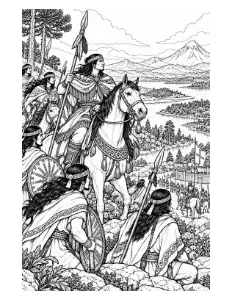
The Mapuche of south-central Chile and Argentina are the great exception in South American history: they stopped the Inca, and then they stopped Spain for nearly three hundred years.
Inca expansion south was halted around the Maule River. When the Spanish came, the Mapuche fought the Arauco War — and after the uprising led by Lautaro, who had learned Spanish tactics while held as a servant, and the death of the governor Pedro de Valdivia in 1553, Spain was forced into something remarkable: the Treaty of Quilín in 1641, in which the Spanish Crown recognised Mapuche independence and a border at the Bío Bío River.
They did not hold out by refusing to change. They adopted the horse rapidly, learned Spanish tactics, and reorganised their politics for sustained war. Mapuche independence lasted until the Chilean and Argentine campaigns of the 1880s, and the Mapuche remain a large and politically active people today.
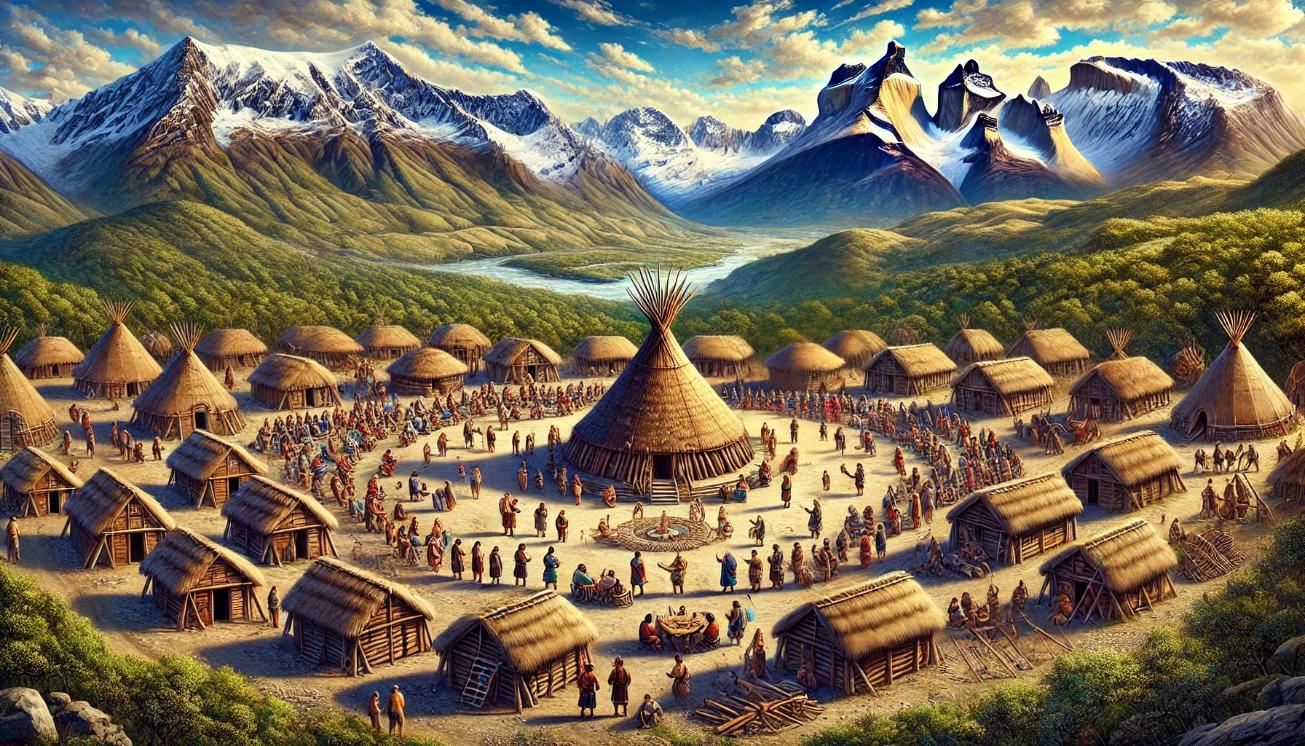
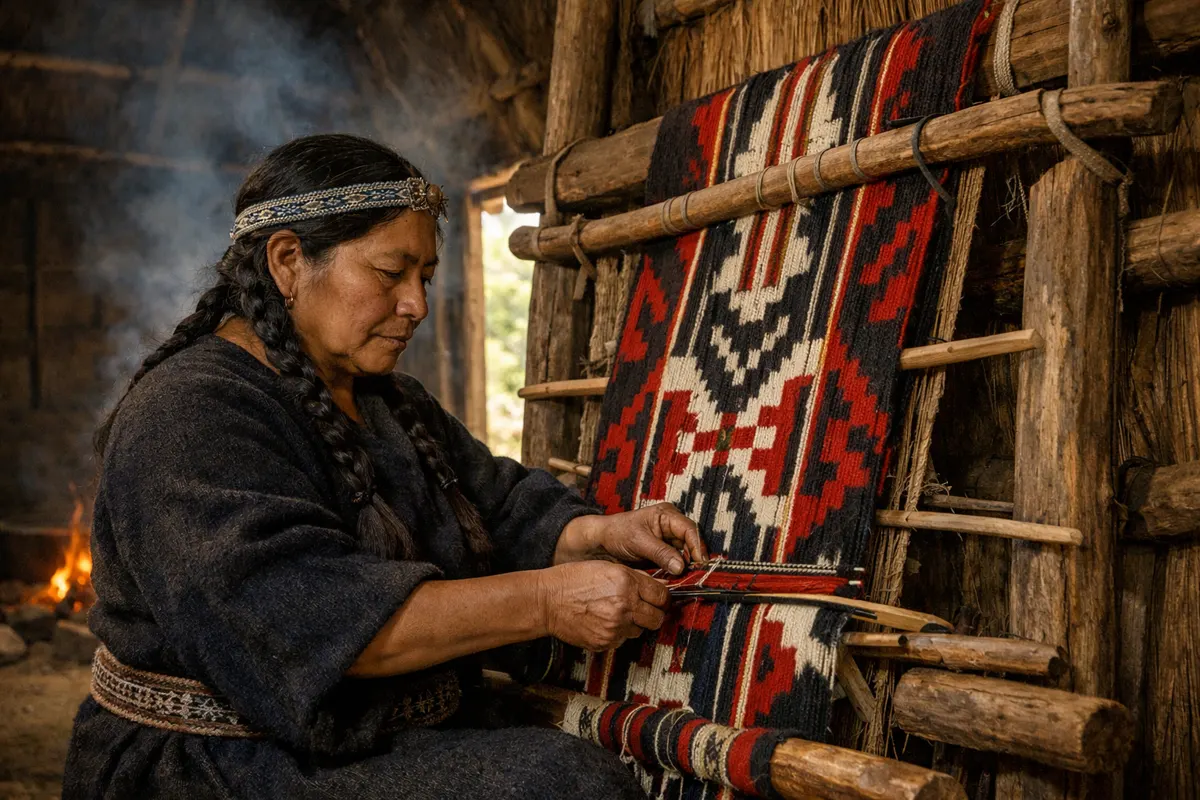
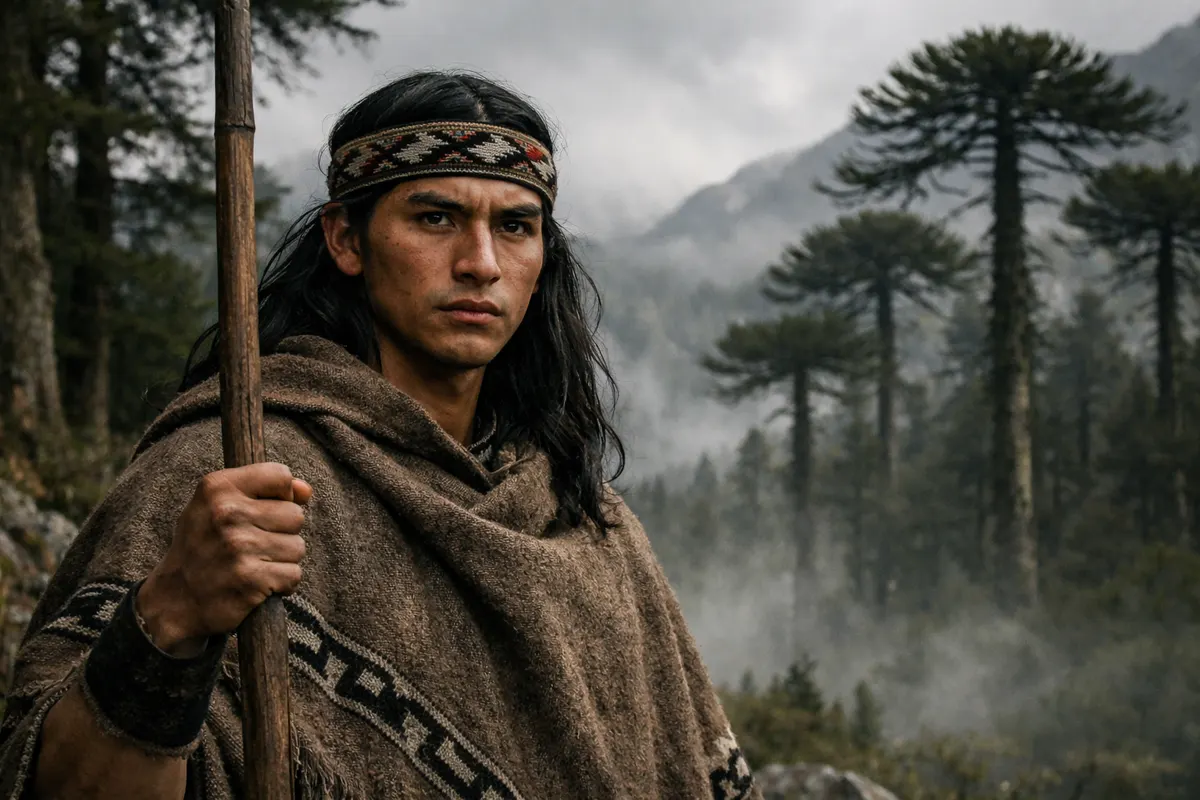
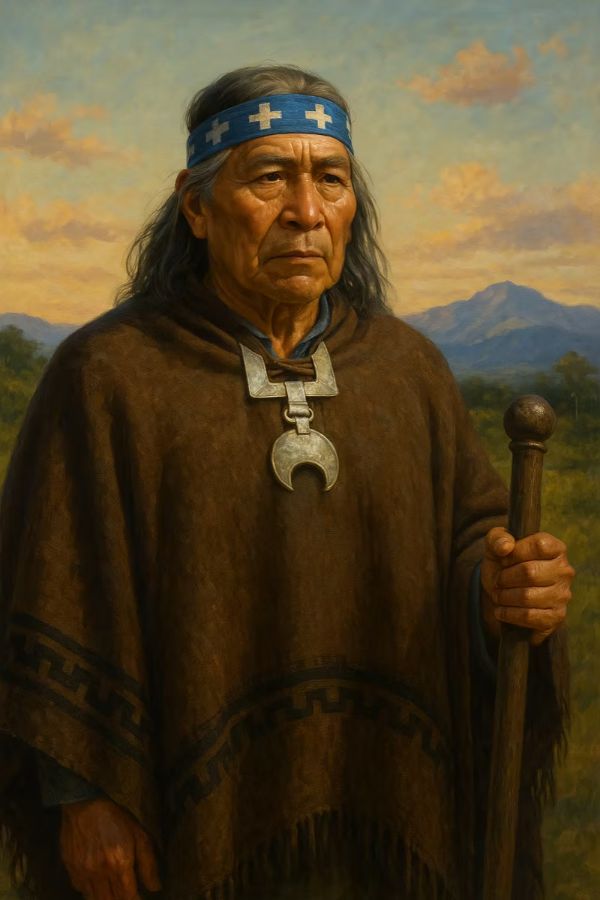
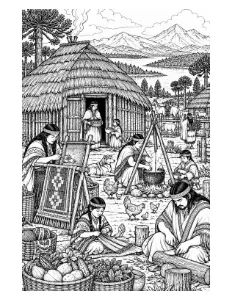
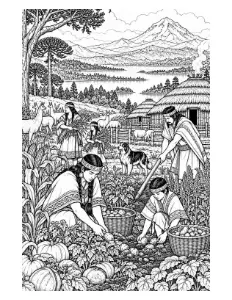
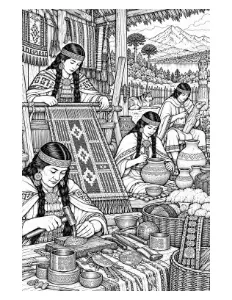
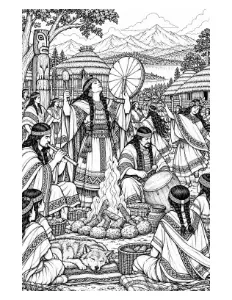
A Mapuche settlement in the Andean foothillsA Mapuche woman weaving on a witral loomLautaro, the young Mapuche war leader
Look for these
Why some peoples resisted conquest successfully and others did not
Adopting your enemy's technology without adopting his rule
A European empire signing a treaty recognising an Indigenous border
What this chapter teaches
Adaptability and innovation in the face of adversity
Unity without centralization
Perseverance in the face of overwhelming odds
Cultural pride and identity
Who you will meet
Lautaroc. 1534–1557 — who learned Spanish tactics and used them
Caupolicánc. 1499–1558 — chosen war leader of the Mapuche
Words this chapter introduces
MapuchetoquiArauco WarLautaroTreaty of QuilínBío BíoAraucanía
Meanwhile, elsewhere in the world
While this was happening in the Americas, these were happening everywhere else.
The Song Dynasty in China
960 – 1279 AD
The Ming Dynasty in China
1368 – 1644 AD
Magellan's expedition passes the strait at the tip of South America
1520 AD
Suleiman the Magnificent rules the Ottomans
1520 – 1566 AD
How to use this lesson. Read the chapter first — then work across the tabs in
order. The music hands you the era in a song, the subject matter expert puts a face to the
history, the reading takes you past the chapter, the video teaches it, the activity puts it
in your hands, and the exam at the end is how you check it stuck.
Read first
pages 203–219 —
The History of Ancient America: Ultimate Guide to Learning, the lesson plan and
activity book. This is where the activity on tab six comes from.
pages 230–251 —
Living History: Ancient America, Told By Those Who Were There, where the people
on the Subject Matter Expert tab tell it themselves.
The Music of This Era
Nothing sticks like a song. Written for this chapter, and worth having on while you do the activity.
Listen for the details. A specialist tells the story as someone who was there. The
things they mention in passing — what they ate, how they travelled, what they made, who
ruled them — are the details worth writing down.
Heroes & Villains — told in the first person
Toki Kalfukura
How he organised the Mapuche confederacy against the Inca army, and won
0:00
Who they were
Toki Kalfukurá · Mapuche war leader, c. 1775–1873
Kalfukurá, whose name means "blue stone", was a Mapuche leader who moved from the Andes onto the Argentine pampas and built a confederacy of peoples that held the frontier there for decades, until his death in 1873. Note the date. He lived in the 1800s. The Mapuche resistance to the Inca that this chapter describes took place in the late 1400s, at the Maule River. The video places him in that story to show the same people holding their land against the Inca, then against Spain, and later against Chile and Argentina. Listen for how the confederacy was held together.
These are from Living History: Ancient America, Told By Those Who Were
There, which carries the same accounts in print.
Beyond the chapter
Additional Reading
The Mapuche stopped two empires, one after the other, and made Spain sign a treaty recognising their border.
A Mapuche woman weaving on a witral loom
The Inca came first, and stopped near the Maule River. Garcilaso de la Vega describes a battle there lasting several days between the Inca army and the peoples of the south, after which the Inca drew their frontier and pushed no further. Tawantinsuyu, which ruled from Ecuador to central Chile, went no further south.
Then came Spain, and the Arauco War, one of the longest wars in the history of the Americas. Lautaro had been captured as a boy and served as a groom to the governor Pedro de Valdivia. He learned how Spanish horses were handled and how they tired, escaped, was made a war leader, and in December 1553 led the Mapuche force that destroyed Valdivia's column at Tucapel. Valdivia was killed.
The Mapuche took up the horse within a generation and became formidable cavalry. For war they chose a toqui, a war leader chosen for his ability, above the leaders of their many local groups, and returned to local leadership in peacetime. They learned Spanish tactics and built forts of their own.
In 1641 the Spanish Crown signed the Treaty of Quilín, recognising the Mapuche lands south of the Bío Bío River. The frontier held for more than two centuries, until the Chilean and Argentine campaigns of the 1860s–1880s brought Mapuche territory under the rule of those republics. The Mapuche are around 1.7 million people today.
Four things worth knowing
La Araucana, an epic poem by Alonso de Ercilla, a Spanish soldier who fought in the war, tells of the Mapuche leaders Caupolicán and Lautaro as heroes. It became a classic of Spanish literature.
The Mapuche language, Mapudungun, is still spoken today.
A machi, usually a woman, is a Mapuche spiritual leader and healer. The role continues today.
Mapuche territory south of the Bío Bío was never conquered by Spain. It came under the republics of Chile and Argentina in the late 1800s.
A Mapuche woman weaving on a witral loom
The Mapuche of southern Chile and Argentina stopped two empires, one after the other, and made Spain sign a treaty recognising their border.
The people of the land
The name Mapuche means "people of the land." They were never ruled by a single king. They lived in many local groups made up of related families, each led by its own head, called a lonko. The book describes them as farmers and hunters who moved between their lands, in the forests and river valleys of the south.
The Inca stop at the Maule
The Inca came first, pushing south from their empire in the Andes. They stopped near the Maule River. The writer Garcilaso de la Vega describes a battle there lasting several days between the Inca army and the peoples of the south. After it, the Inca drew their frontier and pushed no further. Tawantinsuyu, which ruled from Ecuador to central Chile, never went further south.
The Arauco War and Lautaro
Then came Spain, and the Arauco War — one of the longest wars in the history of the Americas. Lautaro had been captured as a boy and served as a groom, looking after the horses of the Spanish governor, Pedro de Valdivia. He learned how Spanish horses were handled and how they tired. Then he escaped, was made a war leader, and in December 1553 led the Mapuche force that destroyed Valdivia's column at Tucapel. Valdivia was killed.
Learning from the enemy
The Mapuche took up the horse within a generation and became formidable cavalry — soldiers who fight on horseback. The Mapuche lived in many local groups, each with its own leaders. For war, they chose a toqui, a war leader picked for his ability, who stood above the local leaders. In peacetime they returned to local leadership. They also learned Spanish tactics and built forts of their own.
A border in a treaty
In 1641 the Spanish Crown signed the Treaty of Quilín. It recognised the Mapuche lands south of the Bío Bío River. That frontier held for more than two centuries. It lasted until the campaigns of Chile and Argentina in the 1860s–1880s brought Mapuche territory under the rule of those two countries. The Mapuche number around 1.7 million people today.
Four things worth knowing
La Araucana is a long poem by Alonso de Ercilla, a Spanish soldier who fought in the war. It tells of the Mapuche leaders Caupolicán and Lautaro as heroes, and it became a classic of Spanish literature.
The Mapuche language, Mapudungun, is still spoken today.
A machi, usually a woman, is a Mapuche spiritual leader and healer. The role continues today.
Mapuche territory south of the Bío Bío was never conquered by Spain. It came under the republics of Chile and Argentina in the late 1800s.
A Mapuche woman weaving on a witral loom
The Mapuche live in the south of Chile and Argentina, a land of forests, rivers and snowy volcanoes. Their name means "people of the land." About 1.7 million Mapuche live there today, and many still speak their own language, Mapudungun.
People and their jobs
The lonko was the head of a family group and its lands. The Mapuche had many lonkos, not one king.
The toqui was a war leader. He was chosen because he was good at leading, and only for the time of war. In peace, each group went back to its own leaders.
The machi is a healer and spiritual leader, usually a woman. Machis still serve their communities today.
The weaver made cloth and ponchos on an upright wooden loom.
The farmer grew potatoes, maize and beans.
The horse rider. After the Spanish came, Mapuche warriors became some of the best horsemen in the Americas.
Animals
The horse came with the Spanish. Within one lifetime the Mapuche had learned to breed and ride horses and to fight on horseback.
Things they made and used
A ruka is a Mapuche house, with a roof of thick straw and a fire inside.
A kultrún is a round drum that a machi plays in ceremonies.
Forts. The Mapuche learned how the Spanish fought, and built forts of their own.
A treaty. In 1641 the King of Spain signed the Treaty of Quilín, which said the Mapuche lands south of the Bío Bío River were theirs.
A famous Mapuche
Lautaro was taken by the Spanish as a boy and made to look after the governor's horses. He learned how the Spanish rode and fought. Then he escaped, went home, and became a war leader of his people.
Where this comes from. Everything on this page is drawn from the records of the time —
letters, logs, chronicles, codices and laws — and from what excavations have found. Where a
fact rests on a single account, the page names it.
Living books for Week 3 — South America
The Inca Empire, the Mapuche, and other South American tribes
The chapter taught on video — from the Adventure Box podcast series,
week 3 of Ancient America.
W4:D4 — The unspoken South American tribes, and more on the MapucheW4:D3 — South American tribes and the Mapuche tribe
🎧 Podcast episode — Coming soon
From the Ultimate Guide — pages 203–219
Activity
Hands-on work from The Ultimate Ancient America Lesson Plan and
Activity Book. Pick one — you do not need to do all of them.
Building a Mapuche Pucará ModelAges 8–12
Build a hill fort from sticks, card and clay, adding lookout points, gates and ditches. Then decide where you would place it on a contour map, and why.
Why it is worth doing. Students think about terrain as a defensive asset.
Objective
To learn about Mapuche fortifications and their significance in resisting Spanish attacks.
Materials Needed
Clay or cardboard
Popsicle sticks (for palisades)
Scissors
Glue
Markers
Small pebbles (to represent stones for building)
Large sheet of cardboard or poster board (for the base)
Instructions
Begin with a short lesson or video on how the Mapuche constructed their defensive fortresses.
Give students materials to build their own model of a pucará on a piece of cardboard. Explain that pucará were often built on hills or in difficult-to-access areas to provide a strategic advantage.
Use clay or pebbles to create walls, and sticks for the wooden palisades. They can arrange these defensively and create entry points.
Encourage students to add features such as lookout points, gates, or moats.
Once completed, have students explain the defensive features of their models and how they would protect their community from invaders.
Learning Outcome
Students will gain a deeper understanding of the strategic importance of pucará in the Mapuche’s defense against Spanish colonization. They will learn about the importance of terrain, fortification, and military tactics in historical conflicts.
Guerrilla Warfare Strategy GameAges 10–15
One group plays a heavy column moving through a map; the other plays a light force that cannot win a set-piece battle. After a set time, swap roles.
Why it is worth doing. Students understand why the Mapuche held for 300 years against a far larger power — and how it felt from both sides.
Objective
To understand the tactics of guerrilla warfare that the Mapuche used to fight against the larger, better-armed Spanish forces.
Materials Needed
Paper
Markers
A large open space (classroom, yard, or gymnasium)
Obstacle markers (cones or chairs) to represent terrain (forests, hills, etc.)
Instructions
Begin with a discussion on guerrilla warfare tactics and how the Mapuche used their knowledge of the land to outmaneuver Spanish forces.
Divide students into two groups: one representing the Spanish forces and the other representing the Mapuche guerrilla fighters.
Use an open space as a battlefield and place obstacles like cones or chairs to represent terrain features (forests, rivers, hills). These obstacles can be used as cover for ambushes.
The Mapuche group will plan ambushes and try to attack the Spanish group using stealth, while the Spanish group will attempt to avoid or defend against these attacks.
After a set time, switch roles so both groups experience both perspectives.
Debrief the game by discussing what tactics worked for the Mapuche side and why guerrilla warfare was effective in the conflict.
Learning Outcome
Students will gain a practical understanding of how the Mapuche adapted to fighting a technologically superior force by using their environment and guerrilla tactics. They will learn about the importance of strategy and adaptability in historical warfare.
Mapuche Storytelling and Culture PresentationAges 12–16
Research Mapuche cosmology, the role of the machi, and the meaning of unity without a single ruler. Present it as the Mapuche would have explained it to a Spanish envoy.
Why it is worth doing. Students practise presenting a worldview from the inside.
Objective
To explore and present different aspects of Mapuche life and culture beyond their resistance to colonization.
Materials Needed
Internet or books for research
Art supplies (optional for artistic presentations)
Poster board (optional)
Paper for writing
Instructions
Assign students or allow them to choose a specific topic related to Mapuche culture, such as the role of the lonko (chief), the machi (spiritual healer), the nguillatun ceremony, Mapuche art, or military leaders like Lautaro and Janequeo.
Give students time to research their topic using library books or online resources. Encourage them to focus on how these cultural aspects helped the Mapuche maintain their identity and autonomy during colonization.
Have students prepare a short presentation in the format of their choice. They can present a written report, create artwork (such as drawings or maps), or perform a creative skit or storytelling performance based on their research.
Allow students to present their work to the class, explaining how their chosen aspect of Mapuche culture contributed to the society’s strength and resilience.
Learning Outcome
Through this activity, students will develop research skills while gaining a broader understanding of Mapuche culture beyond their military resistance. They will also learn how culture, spirituality, and social structure play a crucial role in maintaining community cohesion during times of conflict.
The Monthly Adventure Box ships
the craft kit for this era, so most of these arrive with the materials already cut.
Activity journal
Write about doing this activity. What did you actually make or do? What surprised you? What was harder than you expected, and what would you do differently next time? Then say one thing about Mapuche (Argentina and Chile) that you understand better now than you did before you started.
Saved on this device as you type. Send to my parent account submits it to the
Xogos parent/teacher grade page — you can keep editing and send again.
Extra
Do not have the book with you? These cover the same chapter, free, on
our blog — read them on a phone at a kitchen table or in the back of a car.
8 questions drawn from a pool of 16, plus one to
write in your own words. Open book — you are meant to look things up.
How this one works. You get four attempts. Each retake takes 5 points off
the top, never more than 20 — so a perfect paper passes however many tries it took. The
pass mark is 80%, and passing is what opens the next chapter. Every attempt draws
a different paper.
Sign in to take the exam
Your attempts, your score and your place in the course are kept on your
account, so the exam needs to know who you are.