The second Caribbean chapter is the Taíno and Kalinago world as the first Spanish writers found it. The friar Ramón Pané, whom Columbus sent to live among the Taíno of Hispaniola, wrote down their beliefs; Gonzalo Fernández de Oviedo and Bartolomé de las Casas described their chiefdoms, their song-dances and their ball game.
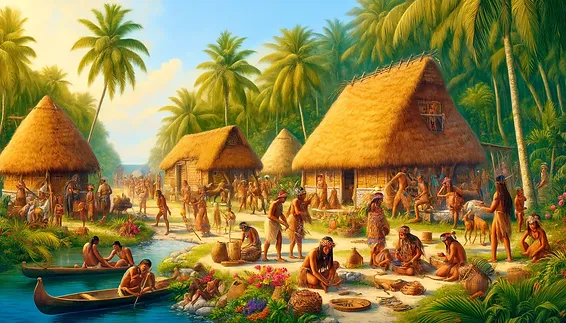
A Taíno chiefdom had its cacique, nobles called nitaínos, healer-priests called bohíques and working people called naborías; a cacique's heir, Oviedo records, was usually his sister's son. Villages were built around a plaza and a batey, the court of the ball game. In the Lesser Antilles, the Kalinago travelled, traded and made war in canoes cut from single trees.
Spanish counts on Hispaniola recorded the Taíno population falling steeply in the decades after 1492 — through smallpox and other sicknesses new to the islands, through war, and through the labour required of them under the encomienda. Taíno words, ancestry and identity continue in Puerto Rico, Cuba and the Dominican Republic, and Kalinago communities remain in Dominica.
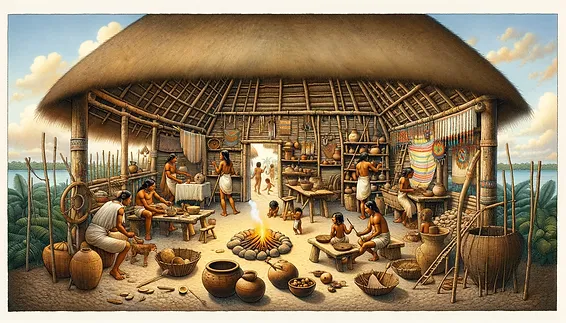
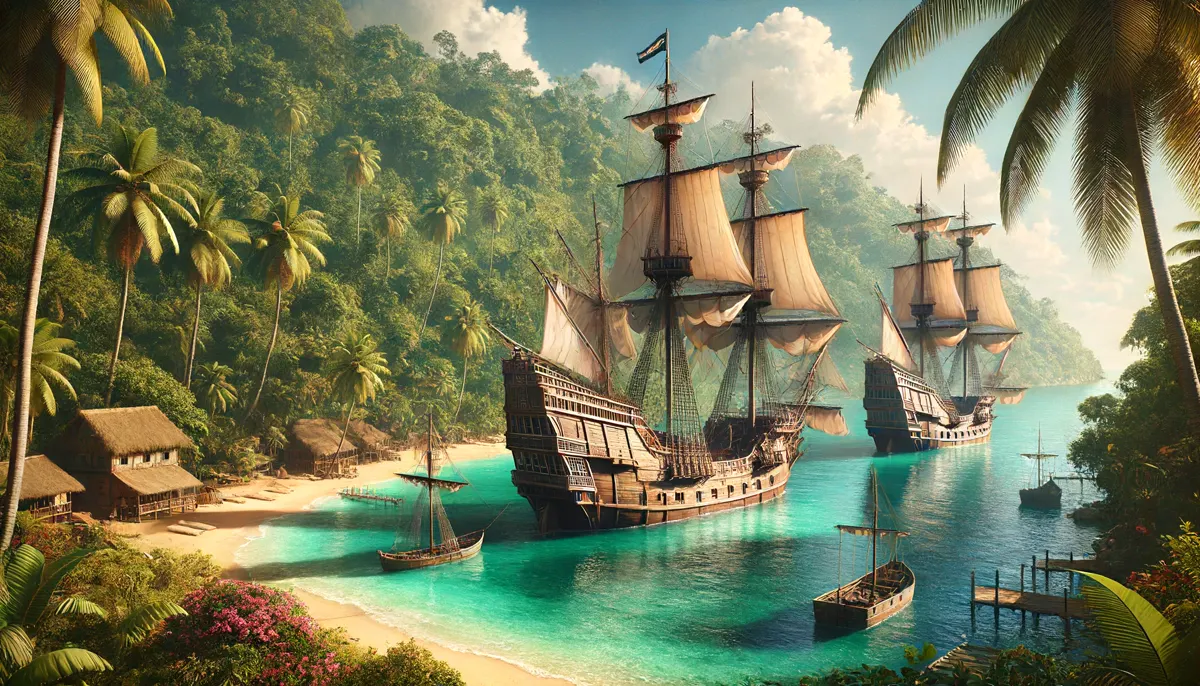
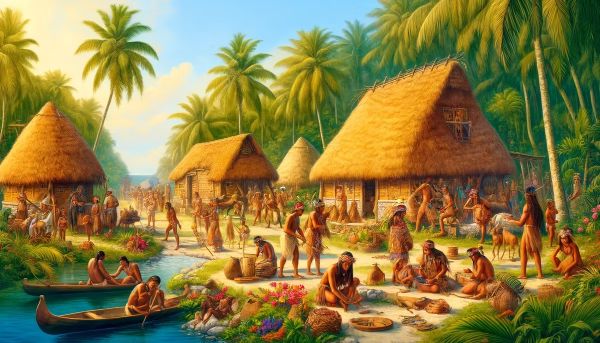
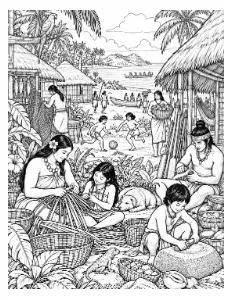
Inside a Taíno houseA Taíno yucayeque — a village of houses around its plazaShips at anchor off a Caribbean island
Look for these
How a Taíno chiefdom was ordered
Zemis, areítos and the ball game
The Kalinago at sea and at war
The first meeting of Taíno and Spaniards, and the years after
What this chapter teaches
The importance of community and cooperation
Leadership and civic responsibility
The significance of rituals and ceremonies
Who you will meet
GuarionexCacique of Maguá on Hispaniola — page 267
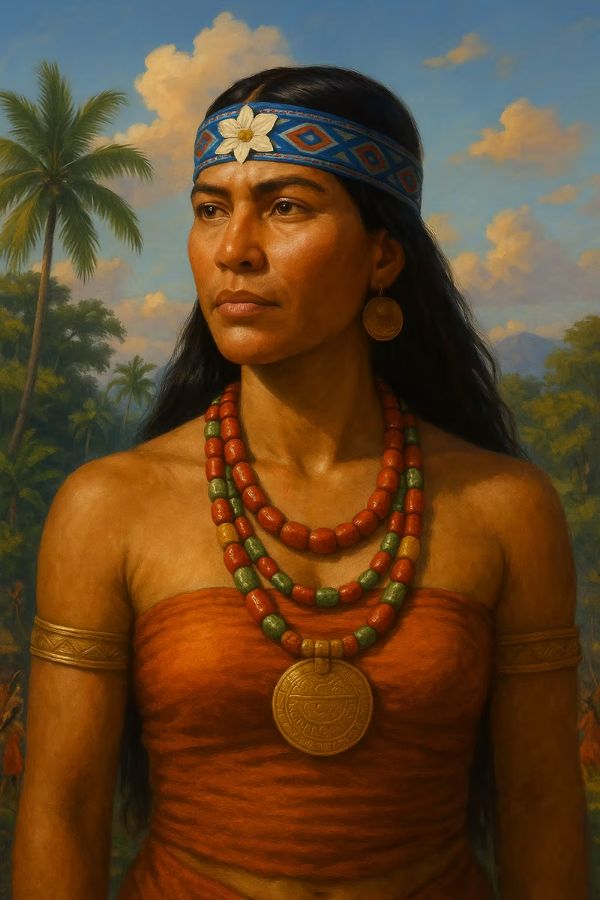
GuaricaA cacica the book invents to show the women who ruled — page 270
A Kalinago war captainOf Waitukubuli (Dominica) — page 272
A bohíque of BorikénA healer and keeper of the zemis, in Puerto Rico — page 274
AgüeybanáThe Great Sun — the cacique who first received the Spanish in Puerto Rico
HatueyWho crossed from Hispaniola to Cuba and led the resistance there
While this was happening in the Americas, these were happening everywhere else.
Norse voyages reach Vinland in North America
c. 1000 AD
The Song Dynasty in China
960 – 1279 AD
The First Crusade
1096 – 1099 AD
The Aztec Empire
1428 – 1521 AD
The fall of Constantinople
1453 AD
Columbus's first voyage
1492 AD
How to use this lesson. Read the chapter first — then work across the tabs in
order. The music hands you the era in a song, the subject matter expert puts a face to the
history, the reading takes you past the chapter, the video teaches it, the activity puts it
in your hands, and the exam at the end is how you check it stuck.
Read first
pages 184–202 —
The History of Ancient America: Ultimate Guide to Learning, the lesson plan and
activity book. This is where the activity on tab six comes from.
pages 267–283 —
Living History: Ancient America, Told By Those Who Were There, where the people
on the Subject Matter Expert tab tell it themselves.
The Music of This Era
Nothing sticks like a song. Written for this chapter, and worth having on while you do the activity.
Listen for the details. A specialist tells the story as someone who was there. The
things they mention in passing — what they ate, how they travelled, what they made, who
ruled them — are the details worth writing down.
Heroes & Villains — told in the first person
Cacique Guarionex
Cacique Guarionex, on when the conquistadors came to his island
0:00
Who they were
Cacique Guarionex · Taíno chief of Magua, d. c. 1502
The cacique of Magua, the fertile central valley of Hispaniola. He received baptism, and Bartolomé de las Casas records that he offered to have his people plant a great field of food crops stretching across the island in place of the gold tribute the Spanish required. In 1497 he led a rising against the tribute, was captured, escaped to the mountains of the Ciguayo chief Mayobanex, and was captured again. In 1502 he was being carried to Spain when the fleet sank in a hurricane. Listen for the offer he made.
More voices from this chapter
0:00
Borikén, a Taíno warrior, on resisting the Spanish
What this video covers
A Taíno warrior of Borikén · Puerto Rico, early 1500s not a specific person
Not a named man — Borikén is the Taíno name for Puerto Rico itself, which is where Boricua comes from. The video stands in for the fighters of the 1511 rebellion. The chronicler Oviedo tells the story behind it: the Taíno wished to know whether the Spanish could die, so a group held a young Spaniard named Diego Salcedo under a river and watched the body for days. The rising followed, led by Agüeybaná II, and Juan Ponce de León put it down.
These are from Living History: Ancient America, Told By Those Who Were
There, which carries the same accounts in print.
Beyond the chapter
Additional Reading
Columbus's log, Dr Diego Álvarez Chanca's letter from the second voyage, and the officials and friars who came after them recorded the Kalinago of the Lesser Antilles and the Taíno of Hispaniola in the years after 1492.
A Taíno yucayeque — a village of houses around its plaza
Las Casas and Oviedo describe the Taíno chiefdoms of Hispaniola. At the head was the cacique; below him were the nobles, the nitaínos; the healer-priests, the bohíques; and the working people, the naborías. Oviedo records that when a cacique died, his chiefdom usually passed to the son of his sister rather than to his own son, because a sister's children were certainly of the family's blood. A woman could rule: Anacaona governed Xaragua after her brother Bohechío.
The friar Ramón Pané lived among the Taíno of Hispaniola, nearly two years of it with the people of the cacique Guarionex, and wrote down what they told him. His Account of the Antiquities of the Indians records that the first people came out of two caves, Cacibajagua and Amayaúna, in a mountain called Cauta; that zemis were made of stone, of wood and of cotton; and that the bohíques and caciques inhaled a powder called cohoba through a forked tube to speak with the zemis.
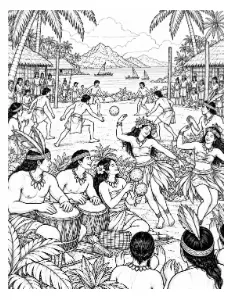
Oviedo describes the areíto: men and women dancing with linked arms, one leading the song and the rest answering, telling the deeds and histories of their past. He compared the areítos to the ballads sung in Spain. He also describes the ball game on the batey. The ball, made from the gum of trees, bounced far higher than a Spanish ball, and the players struck it with the hip, the shoulder, the knee, the elbow or the head — never the hand.
The Kalinago, whom the Spanish called Caribs, lived in the Lesser Antilles. Columbus's log records the Taíno telling of Carib raiders who took captives, and Dr Chanca's letter from the second voyage describes the houses on Guadeloupe, the Taíno captives who fled to the Spaniards for protection, and the human bones found in the houses. In 1503 Queen Isabella permitted the capture of Caribs who resisted and were reported to eat men. The English word 'cannibal' comes from the Spanish form of their name.
The French missionaries of the 1600s — Raymond Breton, Jean-Baptiste du Tertre and Charles de Rochefort — describe the Kalinago war canoes, each hollowed from a single great tree and carrying many men, and their weapons: bows with poisoned arrows, and a heavy wooden war club, the boutou.
Spanish officials counted the Taíno of Hispaniola when the island's Indians were distributed among settlers: some 60,000 in 1508, and fewer than 30,000 in 1514. Smallpox reached the island in 1518. Bartolomé de las Casas, who came to Hispaniola in 1502 and held Indians in encomienda in Cuba before giving them up in 1514, recorded the labour in the mines and fields, and the wars, of those years. In 1512 the crown issued the Laws of Burgos, setting rules for the food, housing, work and instruction of the Indians held by settlers.
The Taíno did not vanish. Their words, their ancestry and their identity continue in Puerto Rico, Cuba and the Dominican Republic, and the Kalinago Territory in Dominica has its own chief.
Four things worth knowing
Anacaona, cacica of Jaragua and a composer of areítos (song-poems), was hanged by order of Governor Ovando around 1503. She is honoured in Haiti and the Dominican Republic.
Hatuey crossed from Hispaniola to Cuba and led resistance there. Las Casas recorded that, offered baptism so that he might go to heaven, he asked whether Spaniards went there — and refused.
Guarionex, cacique of Maguá, offered — Las Casas records — to have his people plant a field of food crops across the island in place of the gold tribute. Held after the rising of 1497, he was being carried to Spain in 1502 when the fleet sank in a hurricane.
The Kalinago name for Dominica is Waitukubuli — 'tall is her body'.
A Taíno yucayeque — a village of houses around its plaza
By 1492 the Taíno held the large islands of the Greater Antilles, and the Kalinago held the smaller islands of the Lesser Antilles. From that year, Columbus's log, the letter of Dr Diego Álvarez Chanca from the second voyage, and the Spanish officials and friars who came after them record both peoples and what happened to them.
How Taíno society worked
According to the book, each Taíno village or region was led by a cacique (chief), and women could hold the title as cacica. Under the cacique were the nitaínos, the leading families who organised work and led warriors. The bohíques were healers and priests who spoke with the zemis, the spirits. The farmers, fishers and builders were the working people of the village. People worked together to build large houses and the bateyes, the plazas used for ceremonies and ball games.
The Kalinago
The Kalinago, whom the Spanish called Caribs, lived in the Lesser Antilles. They were seafarers and warriors, and farmers of cassava and sweet potatoes. Columbus's log records the Taíno telling of Carib raiders who took captives. Dr Chanca's letter from the second voyage, in 1493, describes the houses on the island of Guadeloupe, the Taíno captives who fled to the Spaniards for protection, and the human bones found in the houses. In 1503 Queen Isabella permitted the capture of Caribs who resisted and were reported to eat men. The English word "cannibal" comes from the Spanish form of their name.
Hispaniola after 1492
Under the encomienda, groups of Taíno were assigned to Spanish settlers, who took their labour. Spanish officials counted the Taíno of Hispaniola when the island's people were divided up in this way: some 60,000 in 1508, and fewer than 30,000 in 1514. Smallpox reached the island in 1518. Bartolomé de las Casas came to Hispaniola in 1502 and held Indians in encomienda in Cuba before giving them up in 1514. He recorded the labour in the mines and fields, and the wars, of those years. In 1512 the crown issued the Laws of Burgos, which set rules for the food, housing, work and religious teaching of the Indians held by settlers.
Taíno leaders
The book names the leaders of those years. Agüeybaná, "the Great Sun," was the leading cacique of Puerto Rico, which the Taíno called Borikén, when the Spanish arrived. Enriquillo, a Taíno cacique of Hispaniola, held out in the Bahoruco Mountains from 1519 to 1533, until the Spanish made a peace treaty granting his followers land and freedom.
Two things worth knowing
Anacaona was cacica of Jaragua and a composer of areítos (song-poems). She was hanged by order of Governor Ovando around 1503, and she is honoured in Haiti and the Dominican Republic.
Hatuey crossed from Hispaniola to Cuba and led resistance there. Las Casas recorded that when he was offered baptism so that he might go to heaven, he asked whether Spaniards went there — and refused.
A Taíno yucayeque — a village of houses around its plaza
By the year 1492 the Taíno lived on the big islands of the Caribbean — Cuba, Jamaica, Hispaniola and Puerto Rico. The Kalinago, whom the Spanish called Caribs, lived on the smaller islands to the east. That year, Christopher Columbus sailed in and met them.
Taíno people and their jobs
The cacique was the chief of a village or a whole region. A woman chief was a cacica. Anacaona was a famous cacica, and she made up songs and poems.
The nitaínos were the important families who helped the cacique lead and led the warriors.
The bohíque was a healer and priest who spoke to the spirits.
The workers farmed, fished, built houses and made canoes.
The ball player kept a heavy rubber ball in the air in a game on the village ball court.
Kalinago people and their jobs
The war captain led the fighting men.
The canoe men built big canoes and sailed from island to island.
The farmers, mostly women, grew cassava and sweet potatoes, and made pottery and baskets.
Animals
Parrots. Columbus wrote that the Taíno brought parrots to his ships.
Things they built and used
A batey is a flat plaza and ball court in the middle of a village, used for games and ceremonies. Some, at Caguana in Puerto Rico, still stand today.
A bohío is a house made of wooden posts, with a roof of palm leaves or straw.
A zemi is a carved figure that stood for a spirit.
A duho is a carved wooden seat for the cacique.
A canoe was cut from one tree trunk. Columbus saw some that held forty men.
The areíto was a song-and-dance that kept the people's history.
After 1492
Spanish settlers came to the islands, and new sicknesses came with them. Many Taíno died. But the Taíno did not disappear. Their families and their words live on, and Kalinago people still live in Dominica, where they have their own chief.
Where this comes from. Everything on this page is drawn from the records of the time —
letters, logs, chronicles, codices and laws — and from what excavations have found. Where a
fact rests on a single account, the page names it.
The chapter taught on video — from the Adventure Box podcast series,
week 4 of Ancient America.
W4:D2 — Who did Columbus meet when he came to the Americas?
🎧 Podcast episode — Coming soon
From the Ultimate Guide — pages 184–202
Activity
Hands-on work from The Ultimate Ancient America Lesson Plan and
Activity Book. Pick one — you do not need to do all of them.
Interactive Storytelling and Role-PlayingAges 10–16
Stage the first meeting of 1492 from both sides, using Columbus's own journal and what is known of Taíno society. Then swap and replay it.
Why it is worth doing. Students see how the same event reads completely differently from two directions.
Objective
Enhance understanding of ancient Caribbean cultures.
Materials Needed
Story books or scripts about the Ciboney, Taíno, and Carib tribes
Simple costumes or props (optional)
Instructions
Storytelling : Start by reading a story or script that describes a day in the life of a Taíno family, or a significant event involving the Carib people.
Role-Playing : Assign roles to students, and have them act out parts of the story. Encourage them to use props and costumes, to make the experience more immersive.
Discussion : After the role-playing, discuss what the students learned about the daily lives, social structures, and challenges faced by the tribes.
Learning Outcome
Students see how the same event reads completely differently from two directions.
Creating a Model VillageAges 12–16
In groups, build a model Taíno or Kalinago village on a board — the houses, the plaza and batey, the conucos. Each group researches and builds one part, then explains it when the village is put together.
Why it is worth doing. Students understand how a Caribbean village was laid out and what each part of it was for.
Objective
Understand the layout and structure of ancient Caribbean villages.
Materials Needed
Cardboard or foam board
Modeling clay or playdough
Craft sticks, toothpicks, and other building materials
Paints, markers, and glue
Reference images of village layouts
Instructions
Research : Begin with a research session, where students look up information and images of Taíno or Carib villages. Discuss the common features of these villages, such as communal houses, ball courts, and agricultural fields.
Planning : Divide students into groups, and assign each group a specific part of the village to build (e.g., houses, gardens, ceremonial areas).
Building : Provide materials, and guide students as they construct their sections of the village. Encourage them to add details, and make their models as accurate as possible.
Assembly : Once all parts are completed, assemble the village on a large board. Have each group explain their section, and its importance to the overall village.
Learning Outcome
Students understand how a Caribbean village was laid out and what each part of it was for.
The Monthly Adventure Box ships
the craft kit for this era, so most of these arrive with the materials already cut.
Activity journal
Write about doing this activity. What did you actually make or do? What surprised you? What was harder than you expected, and what would you do differently next time? Then say one thing about Caribbean Tribes and Cultures — Part 2 that you understand better now than you did before you started.
Saved on this device as you type. Send to my parent account submits it to the
Xogos parent/teacher grade page — you can keep editing and send again.
Extra
Do not have the book with you? These cover the same chapter, free, on
our blog — read them on a phone at a kitchen table or in the back of a car.
8 questions drawn from a pool of 16, plus one to
write in your own words. Open book — you are meant to look things up.
How this one works. You get four attempts. Each retake takes 5 points off
the top, never more than 20 — so a perfect paper passes however many tries it took. The
pass mark is 80%, and passing is what opens the next chapter. Every attempt draws
a different paper.
Sign in to take the exam
Your attempts, your score and your place in the course are kept on your
account, so the exam needs to know who you are.